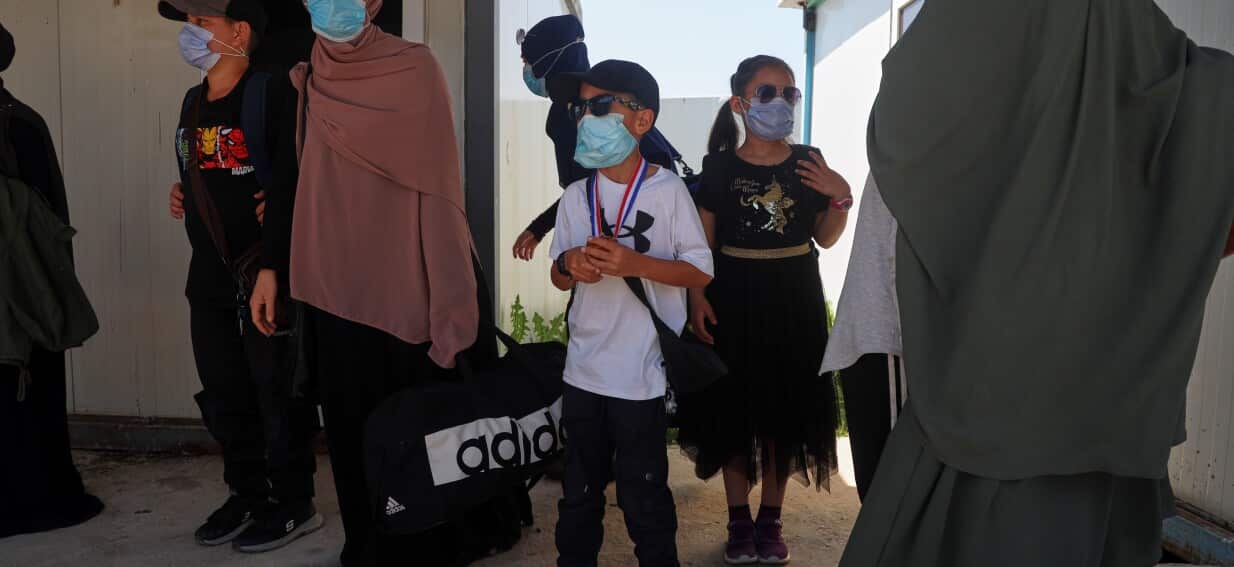
Four Australian women and nine children are currently moving across a fractured Syrian landscape toward Damascus, marking a desperate, self-funded gamble to return home. This journey follows a failed attempt in February 2026 and comes as the Australian government explicitly refuses to facilitate their extraction. While the Prime Minister maintains a "you make your bed, you lie in it" stance, the reality on the ground is far more complex than simple political rhetoric. The group represents the first wave of what could be a chaotic, unmanaged influx of citizens from a region where state control is shifting and security guarantees are evaporating.
The Damascus Gamble
Late on April 24, 2026, the cohort departed the al-Roj detention camp in northeast Syria. Unlike previous extractions in 2019 and 2022, which were coordinated by the Australian Federal Police and intelligence agencies, this movement is a private negotiation with Syrian authorities. By bypassing official Australian channels, these women are testing the limits of international law and the practical reach of the Temporary Exclusion Order (TEO) regime.
The strategy is high-risk. Damascus is now the gateway, a shift necessitated by the collapsing influence of the Kurdish-led Syrian Democratic Forces (SDF) in the face of renewed Syrian government offensives. If these families reach a third country like Lebanon or Jordan, the Australian government is legally obligated to recognize their citizenship, even as it signals it will meet them with the "full force of the law."
A Policy of Calculated Abandonment
The Australian government’s refusal to assist is a sharp pivot from the 2022 repatriation mission. That mission was conducted under the cover of night and brought 17 citizens home. Today, the political appetite has vanished. Internal polling in Western Sydney electorates and a vocal opposition have effectively paralyzed the Labor government’s humanitarian mechanisms.
Security experts argue this paralysis creates a new kind of risk. By forcing citizens to find their own way home through illicit networks or hostile regimes, the government loses the ability to manage the re-integration and surveillance process from the moment of departure. We are seeing a transition from a controlled security operation to a "wild west" scenario where individuals arrive at Australian airports unannounced, potentially having spent weeks in the company of unknown facilitators.
The Technological Shadow of al-Roj
While the public debate focuses on morality, a silent technological war is being waged in the camps. For years, Australian agencies have utilized high-altitude surveillance and signals intelligence to monitor these specific cohorts. Metadata analysis of smuggled devices and biometric data collected during previous humanitarian visits have created a digital fingerprint for every Australian in the camp.
There is no "clean" return. The moment these women touch a cellular network in Damascus or Beirut, they are flagged. Intelligence agencies are not just watching for extremist intent; they are mapping the financial networks that funded this private escape. Who paid the Syrian officials for the convoy? Which middle-men brokered the travel documents? These questions are more vital to national security than the women themselves.
The Innocent Collateral
The most harrowing aspect of the Syrian camps is the status of the children. Out of the group currently in transit, many are under the age of ten. These minors have spent their entire lives in a securitized environment defined by malnutrition, dysentery, and the constant threat of radicalization incursions by Islamic State remnants.
International law, specifically the Convention on the Rights of the Child, suggests that Australia’s refusal to act may constitute a breach of its obligations to protect its youngest citizens from indefinite, arbitrary detention. Human rights advocates argue that by leaving these children in a combat zone, the state is effectively punishing them for the choices of their parents.
Current Camp Demographics (Estimated April 2026)
| Status | Women | Children |
|---|---|---|
| Departed al-Roj (April) | 4 | 9 |
| Remaining in al-Roj | 7 | 14 |
| Repatriated since 2019 | 12 | 21 |
The Legal Bottleneck at the Border
Returning to Australia is not the end of the struggle; it is the beginning of a legal marathon. The Home Affairs Minister now possesses strengthened powers to issue Arrival Control Determinations. This means that even if these women successfully land in Sydney or Melbourne, they can be subjected to:
- Immediate secondary questioning by Border Force and ASIO.
- Strict limits on movement and communication.
- Mandatory participation in de-radicalization programs.
- Potential prosecution for "entering a declared area" under the Criminal Code.
The government is banking on the deterrent effect of these measures. By making the return as difficult and legally perilous as possible, they hope to signal to the remaining cohort in Syria that Australia is no longer a soft target for repatriation.
The Security Vacuum
The US military has recently described these camps as "incubators" for the next generation of threats. As the SDF loses territory to the Damascus government, the risk of a mass breakout increases. If the Australian government does not lead a managed repatriation soon, it may find itself dealing with citizens who have vanished into the regional underground, only to resurface years later with untraceable histories.
This is the brutal trade-off. A controlled return offers the chance for prosecution and monitoring. Abandonment offers a temporary political reprieve at the cost of long-term, unpredictable security failures. The 13 people currently on the road to Damascus are not just a humanitarian case; they are a stress test for a nation that has decided it is safer to look away.
The road from al-Roj to Sydney is paved with political landmines. Every kilometer these women travel brings the Australian government closer to a confrontation with the very citizens it hoped to forget.