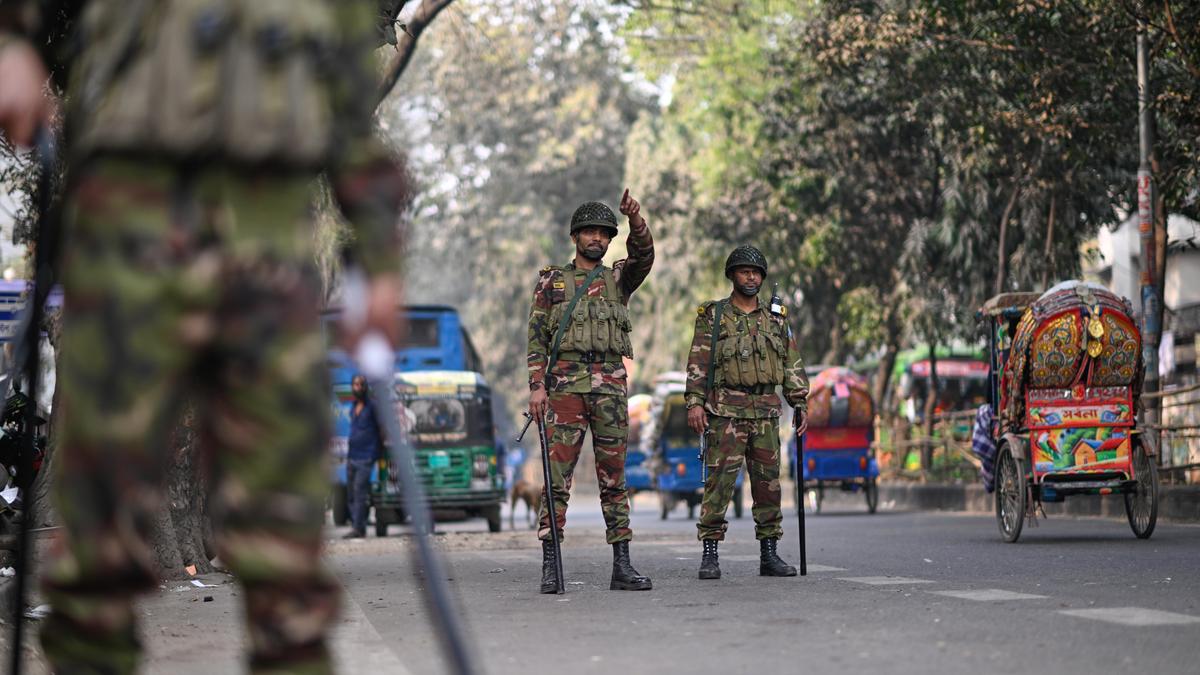
Bangladesh’s sudden issuance of a nationwide security alert signifies more than a routine reaction to intelligence; it represents a calculated attempt to disrupt the Operational Lifecycle of Extremist Cells before they transition from surveillance to execution. While media reports often focus on the spectacle of increased police presence, the underlying strategy relies on a binary mechanism: hardening soft targets to increase the "cost of entry" for militants and simultaneously forcing these underground actors to break radio silence.
The Triple Constraint of Domestic Insurgency
To understand why the state has shifted to a high-readiness posture, one must examine the three variables that dictate militant success: Personnel Density, Resource Access, and Operational Windows.
- Personnel Density: The ability of a group to recruit and radicalize. In the current South Asian context, this is increasingly decentralized. The shift from centralized command structures to "lone-actor" or "small-cell" configurations creates a visibility gap for traditional intelligence agencies.
- Resource Access: This involves the procurement of Improvised Explosive Devices (IEDs) or small arms. The state’s alert serves as a friction point, tightening the supply chain for precursor chemicals and illicit hardware through heightened border and checkpoint scrutiny.
- Operational Windows: Every attack requires a period of relative calm to conduct final reconnaissance. By flooding urban centers with security personnel, the state effectively closes these windows, forcing militants to either postpone their plans or attempt a high-risk operation that is more likely to fail.
Structural Vulnerabilities in the Urban Grid
The issuance of a security alert highlights the inherent difficulty in protecting a high-density urban environment like Dhaka or Chittagong. The Urban Friction Coefficient in these cities is remarkably high—meaning that security forces cannot move as quickly as decentralized actors who blend into the civilian population.
The state’s current response targets three specific categories of vulnerability:
Critical Infrastructure and Transit Hubs
Airports, railway stations, and bus terminals are high-yield targets because they offer Maximum Psychological Impact per unit of kinetic energy used. The security alert mandates a shift from passive monitoring (CCTV) to active screening (physical pat-downs and baggage inspection). This transition aims to negate the advantage of concealment that militants rely on in crowded spaces.
Diplomatic Enclaves and Foreign Interests
Protecting the "Gulshan-Banani" corridor is a matter of economic survival. Any breach in these areas triggers capital flight and a downgrade in international security ratings. The state uses a Concentric Circle Defense Model here, where the innermost circle consists of elite tactical units, while the outer circles involve traffic restriction and biometric verification.
Religious and Cultural Gatherings
Extremist groups often target the very fabric of secular or minority identity to incite communal tension. The security alert forces organizers to integrate state security into their private logistics, effectively nationalizing the responsibility of safety.
The Signal-to-Noise Ratio in Intelligence Gathering
A nationwide alert is a double-edged sword. While it signals strength, it also creates an influx of "noise"—false reports, low-level leads, and public panic—that can overwhelm analytical desks. The effectiveness of the Bangladesh security apparatus depends on its ability to filter this data through the Intelligence Funnel.
- Human Intelligence (HUMINT): Informants within local communities provide the "intent" behind a threat.
- Signals Intelligence (SIGINT): Intercepted communications provide the "timing" and "location."
- Open-Source Intelligence (OSINT): Monitoring radicalized forums provides the "ideology" and "tactics."
The current alert suggests that the state has identified a high-probability "Intent" but lacks the precise "Timing" or "Location." Therefore, the blanket alert is a statistical play: by covering all bases, they hope to provoke a mistake from the adversary.
The Cost of the Security State
There is a measurable economic and social cost to maintaining a prolonged nationwide alert.
- Resource Depletion: Elite units like the Rapid Action Battalion (RAB) and the Counter-Terrorism and Transnational Crime (CTTC) unit have finite man-hours. A long-term alert leads to fatigue, reducing the "Detection Probability" over time.
- Economic Friction: Increased checkpoints and cargo inspections slow down the "Velocity of Goods," particularly in the garment export sector. If a security alert lasts more than 14 days, the cumulative delay in logistics can impact GDP growth by fractions of a percentage point.
- Psychological Fatigue: Constant exposure to armed patrols desensitizes the public. For an alert to remain effective, it must be either resolved or de-escalated within a specific timeframe to prevent "Security Apathy."
Digital Radicalization and the Shadow Network
Traditional security alerts are designed for physical threats, but the contemporary landscape includes a digital dimension that no checkpoint can block. Modern militant groups utilize End-to-End Encryption (E2EE) and decentralized social media platforms to coordinate.
The state’s counter-strategy involves a "Digital Hardening" process. This includes monitoring for sudden spikes in specific keyword usage or the movement of cryptocurrency across borders. However, the limitation of this strategy is the "Encryption Barrier." When militants move their communication to offline or highly encrypted channels, the state’s visibility drops to near zero, necessitating the physical show of force seen in the current nationwide alert.
The Probability of Asymmetric Escalation
If the state successfully blocks major targets, militants often pivot to Asymmetric Escalation. This involves attacking lower-priority targets that are impossible to defend—village markets, remote police outposts, or individual soft targets. This shift is a sign of desperation but remains highly effective at maintaining a climate of fear.
The current security deployment must therefore account for the "Hydra Effect." Suppressing a threat in the capital often pushes the risk into the periphery where security infrastructure is thinner and response times are longer.
Strategic Recommendation for Risk Mitigation
To move beyond reactive alerts and toward a proactive security equilibrium, the state must implement a Dynamic Risk Scoring System. Instead of a binary "Alert/No Alert" status, security protocols should be automated based on the following triggers:
- Anomaly Detection in Financial Flows: Monitoring unusual spikes in small-value transfers within specific geographic clusters.
- Sentiment Mapping: Using AI to analyze public discourse for rapid shifts toward extremist rhetoric in localized digital echo chambers.
- Infrastructure Hardening via Technology: Replacing manpower with smart-city tech, such as facial recognition linked to national ID databases at all major transit points.
The final strategic move is not simply to sustain the alert, but to transition into a "Persistent Surveillance" model that lowers the public profile of security forces while increasing their actual lethality. This involves moving from visible patrols to covert, high-mobility strike teams positioned at strategic nodes identified by predictive modeling. The goal is to make the environment so inherently hostile to militant logistics that the "Cost of Attempt" outweighs the "Value of the Target."