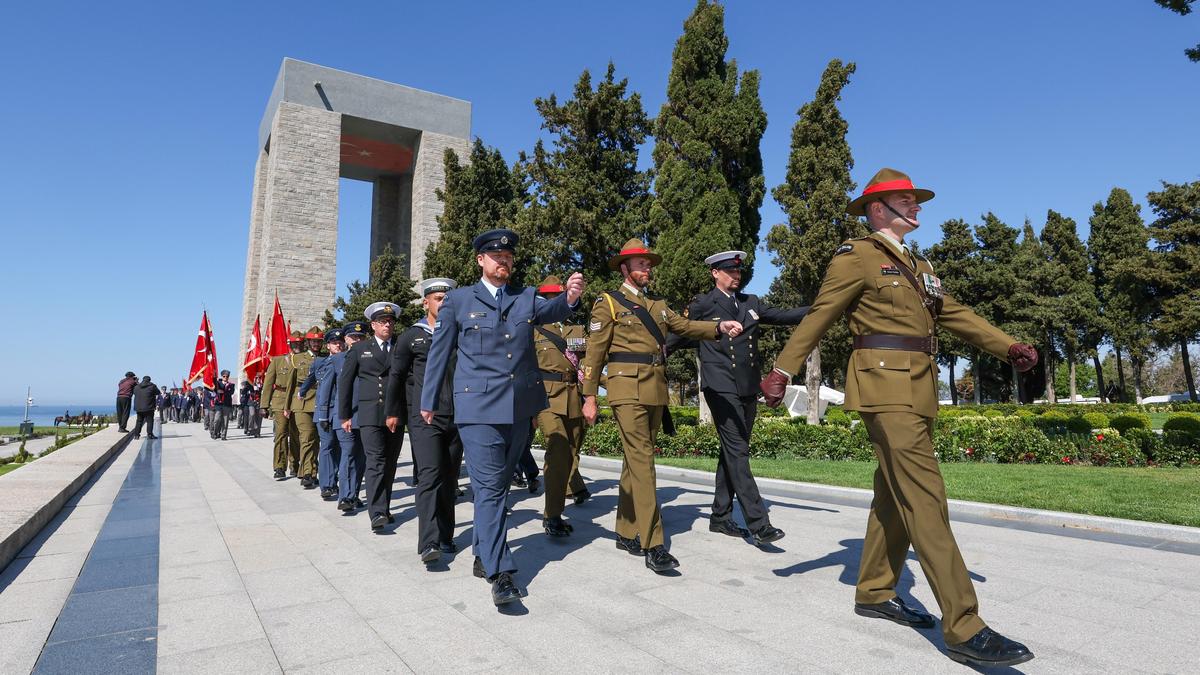
The wind at Anzac Cove doesn’t just blow; it whispers. It carries the scent of salt, scrubby rosemary, and a heavy, unspoken grief that hasn’t lifted in over a century. Every year, as the sky over the Dardanelles shifts from an inky violet to a bruised, hopeful pink, thousands of people stand in a silence so profound you can hear the heartbeat of the person next to you. They aren’t there for a history lesson. They are there to keep a promise.
Most news reports will tell you that officials from Australia and New Zealand gathered in Türkiye this week to commemorate the Gallipoli campaign. They will mention the dates—April 25—and the diplomatic presence of the Turkish government. But those are just the skeletons of the story. The marrow is found in the shivering teenagers from Auckland who have traveled halfway around the world to stand in the dirt where their great-great-uncles fell, and in the Turkish descendants who now welcome their former enemies as "Johnnies and Mehmets" in the same soil.
Gallipoli is a geography of ghosts.
The Weight of a Name
Consider a young man named Thomas. He is a hypothetical stand-in for the 8,700 Australians and 2,700 New Zealanders who never left these ridges. In 1915, Thomas might have been a shearer from New South Wales or a clerk from Christchurch. He was told he was going on an adventure. He ended up in a vertical nightmare of crumbling sandstone and sniper fire.
When you walk the North Beach today, the terrain is still vertical. It defies logic that anyone could scramble up these cliffs under the weight of a pack, let alone a hail of lead. To stand at the Dawn Service is to realize that the "Anzac spirit" isn't a marketing slogan for beer or football matches. It is the residue of a collective trauma that forged two nations' identities in a furnace they never asked to enter.
Australia and New Zealand were young then. Barely more than ideas. Gallipoli was the moment those ideas became blood and bone.
The stakes were never just about a military objective or seizing the peninsula to open the Black Sea. For the families waiting back in Melbourne or Wellington, the stakes were the empty chairs at dinner tables that would remain empty for generations. We see the ripples of those absences even now, in the way these nations carry themselves—with a quiet, rugged independence and a deep-seated skepticism of distant authorities who trade lives for map coordinates.
The Turkish Handshake
There is a unique, almost confusing grace to this commemoration. Usually, when nations meet on an old battlefield, there is a lingering tension. Not here.
The Turkish people treat the Anzac pilgrimage with a reverence that borders on the sacred. This is largely due to Mustafa Kemal Atatürk, the founder of modern Türkiye, who led the defense at Gallipoli. His words are etched into stone near the beach, and they are perhaps the most healing ever uttered in the wake of war:
"Those heroes that shed their blood and lost their lives... you are now lying in the soil of a friendly country. Therefore rest in peace. There is no difference between the Johnnies and the Mehmets to us where they lie side by side here in this country of ours."
Imagine being a mother in 1934, thousands of miles away, knowing your son’s body would never be returned. Then, reading those words.
This sentiment transforms the annual gathering from a military parade into a family reunion. When the Turkish band plays the "Last Post," it isn’t a victory lap. It’s a shared mourning. The Turkish soldiers died defending their homes; the Anzacs died trying to take them. In the end, the earth claimed them both equally.
The Ritual of the Cold
Attending the Dawn Service is a physical trial. Travelers arrive the night before, huddling in sleeping bags on the grass as the temperature plummets. You don't sleep. You listen to the waves. You think about the men who sat in those same spots 111 years ago, terrified, watching the same stars, waiting for the sun to rise so they could begin the fight.
The cold is an essential part of the experience. It grounds the abstract horror of 1915 into a sensory reality. Your toes ache. Your breath hitches. You realize, with a jolt of clarity, that you get to leave when the sun comes up. They didn't.
The ceremony itself is sparse. A few hymns, a few prayers, the haunting, lonely wail of the bugle. But the power lies in the faces of the crowd. You see veterans with medals pinned to their chests, their eyes fixed on the horizon. You see young families. You see Turkish locals offering tea.
The narrative has shifted over the decades. It used to be about the glory of the charge. Now, it is about the futility of the waste. We have moved from celebrating the war to honoring the warrior, and finally, to cherishing the peace that allows us to stand together on a beach that once ran red.
The Invisible Threads
Why does this matter in 2026? Why do we still fly across oceans to look at a strip of sand?
Because we live in a world that forgets. We live in a digital blur where "sacrifice" is a word used to describe a slow internet connection or a lost weekend. Gallipoli forces a recalibration. It reminds us that our current freedoms were bought with a currency we can barely imagine.
The connection between Australia, New Zealand, and Türkiye is one of the world's strangest and most beautiful anomalies. It is a friendship built on a foundation of mutual slaughter. It suggests that if even the bloodiest of enemies can find a way to weep together over their shared dead, then perhaps there is hope for the rest of us.
The hills of Gallipoli are silent now, covered in pine and wildflowers. The trenches have largely slumped back into the earth, reclaimed by the slow, indifferent march of nature. But as the sun finally clears the ridge and hits the water, illuminating the thousands of people standing shoulder to shoulder, you realize the battle isn't over.
The battle is against forgetting.
As the crowds begin to shuffle away, heading toward the buses and the breakfast stalls, a few people always linger. They walk down to the water's edge. They touch the sea. They leave a sprig of rosemary in the sand. They look out toward the horizon, where the past and the present meet in the light, and they realize that some debts can never be repaid, only remembered.
The bugle's echo finally fades, but the silence it leaves behind is the loudest thing on the peninsula.