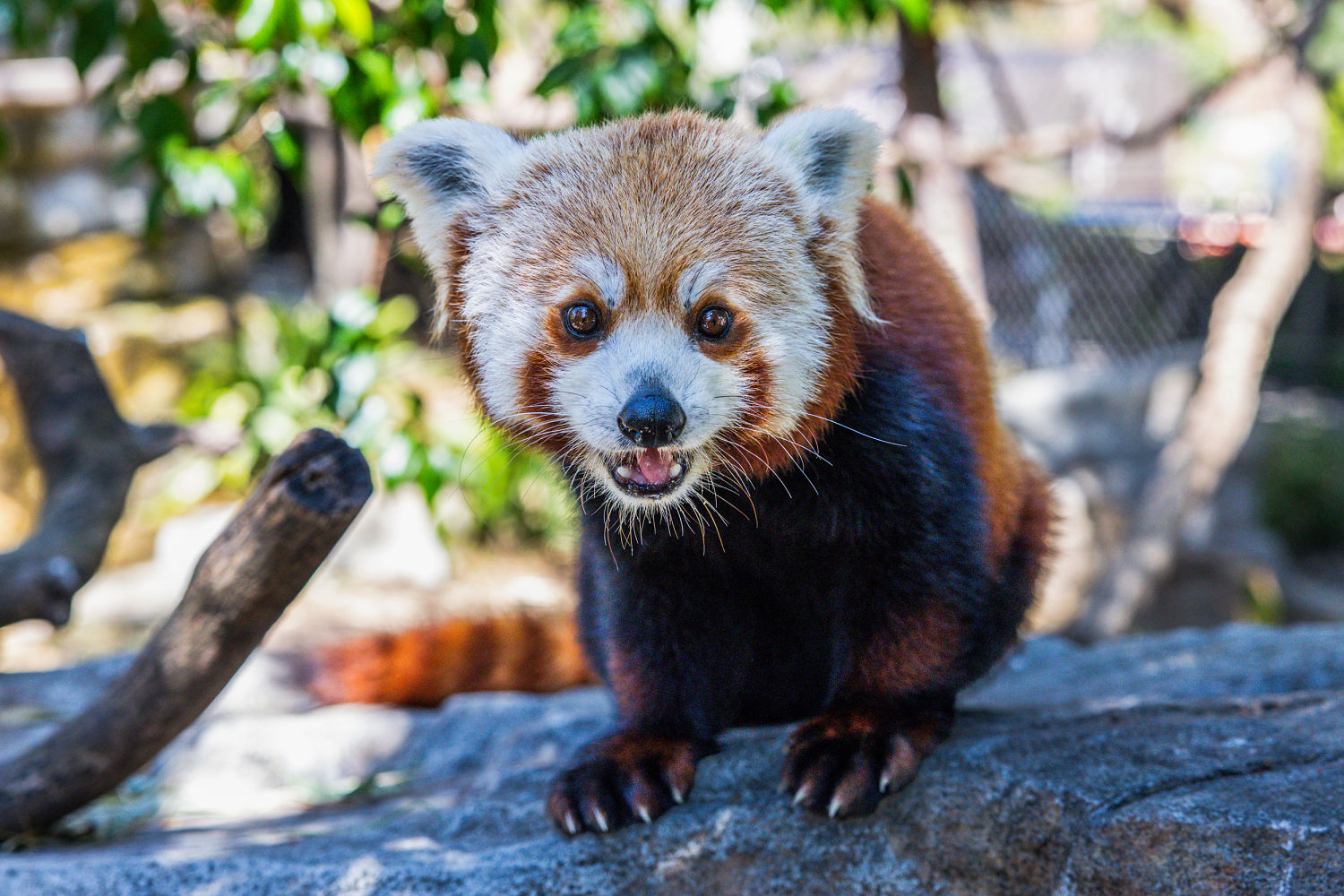
The headlines rolled in with predictable melancholy when the second of two red panda cubs born at a California zoo perished. Cue the collective digital mourning. Cue the candle emojis. Cue the instant outpouring of institutional hand-wringing about breeding programs, habitat loss, and the fragile state of modern zoological curation.
Everybody wants to point a finger at the facility. Everybody wants to demand tighter protocols, round-the-clock neonatal monitoring, and air-conditioned dens built like high-security neonatal units.
That instinct is pure emotional laziness.
Zoom out past the tragic press release. Look at the raw mechanics of captive species management. We have built an entire public discourse around the illusion that a modern zoo can or should operate as an infallible maternity ward where zero infant mortality is the baseline expectation of success.
It is a lie. Worse, it is a biological impossibility that actively sabotages the very conservation efforts people claim to care about.
The Sanitized Zoo Fantasy
Let us define terms immediately. A modern Association of Zoos and Aquariums accredited institution is not a petting zoo. It is an ark. Or at least, it is supposed to be.
An ark does not exist to guarantee a comfortable, risk-free existence for every individual specimen that draws breath inside its perimeter. An ark exists to maintain genetic diversity, hedge against total extinction in the wild, and preserve baseline behavioral adaptability for a species teetering on the edge.
When a red panda cub dies, the knee-jerk media narrative treats it as a systemic failure. The assumption is simple: humans intervened, humans brought them into captivity, therefore humans bear absolute liability for every heartbeat that stops prematurely.
That logic collapses the moment you look at wild baseline statistics. In native Himalayan habitats, red panda infant mortality rates swing wildly between thirty and sixty percent in the first year alone. Harsh winters, maternal inexperience, parasitic loads, and congenital weaknesses cull the herd with brutal efficiency.
When a zoo environment tries to artificially suppress infant mortality to zero through hyper-sterile intervention, hand-rearing, and chemical shielding, what happens? You do not get a stronger population. You get genetic drift, coddled stock, and animals utterly incapable of coping with the biological realities of their own species.
I have spent years consulting alongside wildlife management veterinarians and institutional curators. I have watched millions of dollars poured into specialized incubator arrays and bespoke dietary pastes to save fragile neonates that, frankly, lacked the baseline vigor to thrive.
And every time we artificially drag a genetically compromised or frail cub across the finish line of infancy, we quietly weaken the gene pool for the next generation. We mistake an emotional victory for a conservation triumph.
The Mechanics of Natural Culling
Biology is not a social democracy. It does not care about your feelings, your local news segment, or the emotional investment of a donor who bought a naming rights package for a newborn cub.
Red pandas are solitary, highly sensitive arboreal specialists. Ailurus fulgens is notoriously difficult to breed consistently in captivity because their stress thresholds are razor-thin. First-time mothers in captivity frequently display erratic maternal behavior—abandoning cubs, failing to nurse properly, or crushing them accidentally due to micro-environmental stressors like nearby construction noise, unfamiliar keepers, or excessive public viewing pressure.
The mainstream consensus argues for more enclosure soundproofing, heavier veterinary oversight, and more chemical sedation or hormone tracking.
That approach misses the forest for the trees. It treats the symptom while ignoring the fundamental friction of keeping wild animals in artificial steel-and-glass simulations.
When you strip away natural pressures, you invite unnatural outcomes. A captive mother red panda under chronic, low-grade stress is far more likely to reject a litter. Doubling down on human intervention—pulling the cubs immediately for hand-rearing—breaks the behavioral loop entirely. A hand-reared red panda cub does not learn species-typical maternal care patterns. It imprints on humans, develops severe behavioral abnormalities, and usually proves useless for future breeding exchange programs.
You saved the cub today. You ruined the lineage tomorrow.
The Cost of Zero Risk
Institutions are terrified of public backlash. Social media outrage has become the primary metric by which zoo directors measure operational risk.
When a cub dies, the comment sections light up with demands for investigations, staff firings, and total overhauls. This creates a perverse incentive structure. To appease the pitchfork mob, zoos over-engineer their protocols. They wrap animals in cotton wool. They intervene at the first sign of a squeak out of place.
This is cowardly conservation.
Real conservation requires a stomach for grim arithmetic. If a population requires constant, invasive life-support to stay afloat, you no longer have a conservation breeding program. You have an expensive, public-facing animal shelter.
Look at the heavy hitters in population genetics. Theoretical models in conservation biology consistently demonstrate that maintaining artificial stability without natural selection leads to rapid loss of adaptive fitness. You cannot preserve a wild animal by domesticating it inside a municipal park through sheer bureaucratic willpower and around-the-clock bottle-feeding.
Admitting this publicly is terrifying for marketing departments. It is much easier to sell the public a fairy tale where every birth is a miracle and every death is a preventable tragedy.
Dismantling the PAA Fallacy
People Also Ask queries online constantly obsess over questions like: "Why do zoo animals reject their babies?" or "How can we protect endangered species better in captivity?"
The framing of those questions assumes that rejection is a malfunction and that total protection is the goal.
Let us correct that immediately.
Maternal rejection in captivity is rarely a random glitch. It is often a biological evaluation made by an animal that senses something we cannot see—congenital defects, neurological weakness, or an environment fundamentally unsuited to raising viable offspring. The mother knows her ecosystem is an artificial box. Her hormonal response reacts to the friction of captivity.
The question should not be how to force a stressed mother to nurse against her instincts, or how to invent a better synthetic formula.
The question should be whether we are maintaining populations that can actually endure, or if we are simply running a taxpayer-funded hospice for animals we failed to protect in their native ranges.
The Uncomfortable Road Ahead
If we want zoos to serve a real purpose beyond entertainment with a conservation label slapped on the gift shop, we have to drop the perfectionist illusion.
Death is part of biology. Failure is part of breeding complex, wild organisms in artificial settings. Every time a facility cowers before public opinion and pretends that a neonatal death represents a moral failing, they push the industry further into irrelevance.
Stop demanding zero risk. Stop expecting wild animals to behave like plush toys in a sanitized nursery. Let nature—even caged, managed nature—operate with enough room for reality to take its course.
Because if we refuse to accept the occasional tragedy of life and death in the breeding pens, we will end up with an entire generation of captive species that are nothing more than biological museum pieces, too weak to survive the truth of their own existence.