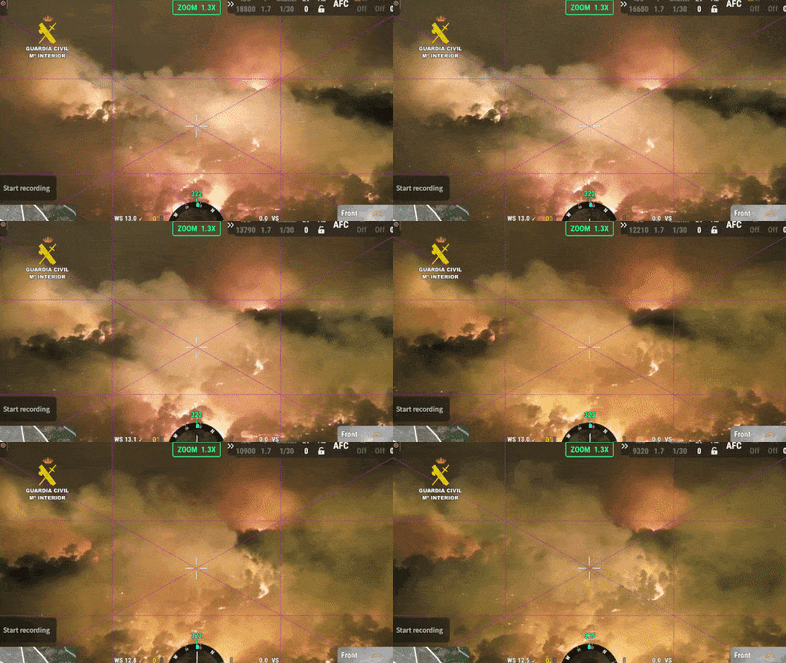
Europe faces an unprecedented wildfire crisis driven by a lethal combination of record-shattering heatwaves, human error, and deliberate arson. As meteorological agencies warn of an incoming, prolonged heat surge pushing temperatures past forty degrees Celsius, countries like France and Spain are battling massive infernos that have already forced hundreds of thousands of evacuations. While climate change provides the dry, parched fuel load across the continent, investigators and emergency officials emphasize that the spark is almost always human.
The Anatomy of a Human-Made Disaster
The narrative that nature alone is responsible for Europe’s burning forests ignores the uncomfortable statistical reality on the ground. European agriculture ministries and forestry protection agencies report that an overwhelming majority of wildfires—frequently cited as high as nine out of ten—are triggered directly by human activity.
This human footprint spans two distinct categories. Accidental ignitions from discarded cigarette butts, unmanaged campfires, agricultural machinery sparks, and electrical infrastructure failures account for a massive share. However, a darker element defines the current crisis. Law enforcement agencies across France and Spain have arrested dozens of individuals on suspicion of intentionally setting fires.
Consider the operational findings in regions like the famous Fontainebleau Forest near Paris, where investigators identified multiple distinct ignition points scattered within a tight radius. That specific spatial distribution points away from natural spontaneous combustion and toward a voluntary, coordinated origin. When multiple ignition vectors appear simultaneously across a tinder-dry landscape, emergency response systems fragment instantly.
The Tinderbox Created by Land Mismanagement
Dry timber and high air temperatures do not catch fire on their own without a spark, but they dictate how catastrophic that spark will become. Decades of demographic shifts have transformed rural economies. As traditional farming and grazing industries decline, vast swaths of interior land and wilderness are left unmanaged.
Uncleared underbrush accumulates year after year. When combined with historical drops in rainfall and successive heatwaves that strip remaining moisture from vegetation, the ecosystem becomes a loaded weapon.
Take a hypothetical example of a rural valley in southern Europe. Fifty years ago, intensive grazing and local agriculture maintained low fuel loads by clearing dry scrub. Today, that same valley features abandoned acreage choked with dead wood, surrounded by growing suburban interfaces where housing developments push directly into forested zones. When an intentional or accidental spark lands in that unattended brush, the fire behavior defies traditional firefighting containment tactics.
Fire science professionals note that modern blazes exhibit extreme convective behaviors, creating localized fire whirlwinds and spreading with a velocity that outpaces ground crews. Ground infrastructure is simply not designed to manage simultaneous mega-fires across thousands of square kilometers.
The Economic and Human Toll Before the Next Surge
The crisis extends far beyond charred timber and blackened hillsides. The cascading economic and public health consequences are mounting daily. Regional tourism economies in southwestern France and along the Spanish coast face cancellations as smoke blankets resorts and beaches are evacuated.
Simultaneously, emergency services are stretched to their absolute breaking point. International assistance from neighboring European Union member states—including the deployment of extra water-dropping aircraft—provides temporary relief, but ground crews face weeks or months of mop-up work.
As state meteorological agencies project yet another brutal heatwave, governments are urging extreme caution while struggling to counter rampant online disinformation about the origins and scale of the blazes. The immediate priority remains containment, but the structural vulnerability of Europe’s landscape remains unaddressed.
The flames licking at the edges of major cities are symptoms of a deeper structural failure in how landscapes are inhabited, protected, and policed. Until preventative land management matches the escalating reality of extreme weather, the continent will remain one spark away from the next catastrophe.