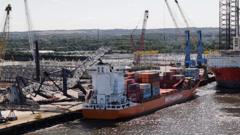
The coffee in the captain’s quarters of the Maran Centaurus is always lukewarm and tastes faintly of zinc.
Airi Kallas, a chief engineer who has spent twenty-two years tracking the rhythmic thrum of massive marine diesels, doesn't mind the flavor. What he minds is the silence that falls over the bridge every time they approach the Hormuz Strait. It is a specific, heavy kind of quiet. On the radar screen, the gap between Iran and Oman looks like a tight throat. Two miles wide for inbound ships, two miles wide for outbound, separated by a two-mile buffer of pure anxiety.
Through this choke point passes one-fifth of the world’s petroleum and a massive chunk of the liquefied natural gas that keeps heaters running in Tokyo and factories humming in Stuttgart. When a single sea lane carries twenty million barrels of oil a day, it ceases to be mere water. It becomes a global carotid artery.
When it constricts, the world suffers a stroke.
The Cost of a Shiver
We tend to look at international disputes through the lens of maps, treaties, and gray-hulled naval destroyers. We read headlines about regional friction and calculate the risk in abstract percentages.
But the real math is done in the dark, away from the cameras.
Consider what happens the moment a single sea-drone detonates near a tanker, or when a routine patrol turns into an international incident. Within hours, a series of invisible gears begins to grind in London and New York. Underwriters at Lloyd's re-classify the waters. War risk insurance premiums skyrocket. A voyage that cost fifty thousand dollars in insurance the previous week suddenly costs three hundred thousand.
That expense doesn’t vanish into the ocean. It cascades. It finds its way into the price of a gallon of milk in Ohio, the cost of plastics in Seoul, and the electricity bill of a family in Munich.
The traditional response to this vulnerability has always been the same: more steel in the water. For decades, foreign navies have played the role of reluctant lifeguards, patrolling the hot, humid waters of the Gulf to keep the lanes open. It is a reactive, fragile kind of peace. It relies on the assumption that everyone will behave rationally, all the time, under immense pressure.
It is a bad assumption.
A Shared Roof Over the Gulf
There is a fundamental flaw in letting outsiders police your front yard. It creates a strange dependency where the local states—the ones whose economies entirely depend on the stability of these waters—remain spectators in their own security.
The dry policy papers call for a "Shared Pact Among Gulf States." They use sterile words like multilateralism and maritime domain awareness.
Let's strip away the jargon. What we are talking about is a shared roof.
Imagine living in a row of houses at the bottom of a canyon where rocks occasionally fall. You can wait for the county to send a crew to watch the cliffs, or you and your neighbors can chip in to build a protective canopy. The nations bordering the Strait—Saudi Arabia, the United Arab Emirates, Oman, Qatar, Kuwait, Bahrain, and critically, Iran—have spent generations looking across the water with varying degrees of suspicion.
Yet, they all share the same vulnerability. If the Strait closes, the economic damage doesn't discriminate based on ideology or religion. A blocked channel locks in Saudi crude just as effectively as it strangles Iranian exports.
The solution isn't a massive, unified grand navy under a single flag. That is a diplomat's daydream. The reality must be built on small, dull, practical steps.
The Digital Invisible Mesh
The true shift toward stability won't come from larger aircraft carriers. It will come from data.
Right now, the maritime tracking systems in the Gulf resemble a patchwork quilt. One country tracks targets using localized radar; another relies on commercial automated identification systems; a third uses satellite imagery that arrives hours too late. In this fog of information, misunderstandings thrive. A fishing boat drifting off course can look like a raid. A malfunctioning transponder can trigger an alarm that scrambles fighter jets.
A localized pact starts with a shared digital mirror.
By interlinking automated tracking networks and creating a joint data clearinghouse, the regional states can eliminate the ambiguity that breeds conflict. When everyone sees the exact same pixel moving across the exact same screen in real-time, the room for catastrophic miscalculation shrinks. It becomes much harder to lie, and much easier to verify.
This requires a delicate piece of machinery: trust. Not the grand, sweeping trust of historical allies, but the cold, transactional trust of business partners who know that cheating ruins the market for everyone.
The Long Wake
On board the Maran Centaurus, the throat of the Strait finally opens up. The cliffs of Musandam recede into the haze, looking like sleeping prehistoric beasts. Airi Kallas watches the RPM gauges settle back into their steady, ocean-going rhythm. The ship has passed through safely this time.
But behind the vessel, the wake stretches back into the narrow channel, crossing paths with dozens of others—liquid natural gas carriers bound for Europe, container ships loaded with electronics for the West, empty supertankers coming back for more.
They move through a geography defined by its fragility. We can continue to treat this stretch of water as a permanent fuse waiting for a spark, relying on the sheer luck of avoided crises to keep the lights on around the globe. Or the people who actually live on its shores can decide that the water between them is less of a barrier and more of a common floor.
Until that shift happens, every ship that enters those waters will continue to carry a hidden cargo: the uneasy knowledge that the entire world's economy is riding on a thin ribbon of blue, waiting for someone to blink.