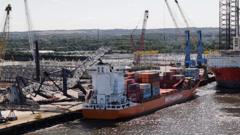
The waterfront never truly sleeps. At 3:00 AM, when the rest of the city is buried under blankets and silence, the docks are a symphony of diesel engines, grinding gears, and the rhythmic thud of steel shipping containers meeting concrete. It is a world of scale. Humans look like ants moving among towering geometric mountains of global commerce.
We take this machinery for granted. Every item in your living room, the coffee in your mug, the shoes on your feet—it all likely passed through the mechanical teeth of a dockside gantry crane. These monolithic structures are the unsung musculature of the global economy. They stand hundreds of feet tall, lifting forty-ton loads as if they were feathers. For another perspective, see: this related article.
Until the metal tires.
It starts with an unfamiliar sound. Not the usual deep rumble of a winch or the hiss of pneumatic brakes, but a sharp, agonizing screech of tearing steel. When a dockside crane suffers a catastrophic structural failure, there is no time to run. There is only the sudden, terrifying realization that gravity always wins. Related reporting regarding this has been provided by TIME.
The Illusion of Indestructibility
To understand what happened during the recent dockside crane collapse, you have to understand the mind of a port operator. Let’s invent a composite figure based on decades of industrial safety data. We will call him Marcus.
Marcus has spent fifteen years in the cabin of a ship-to-shore crane, suspended a hundred feet in the air. To Marcus, the crane isn’t just a machine; it is an extension of his own body. He feels the wind shear through the steel joists. He knows exactly how much the structure will sway when a gust hits the harbor.
The danger lies in familiarity. When you operate a machine every day without incident, it begins to feel permanent. You forget that under the thick layers of industrial yellow paint, the metal is subject to the relentless laws of physics.
Every single lift inflicts a microscopic amount of stress on the crane's structural joints. Think of a paperclip. Bend it back and forth once, and it stays intact. Bend it fifty times, and it snaps effortlessly. This is structural fatigue. In the maritime industry, cranes endure millions of these stress cycles every year, fighting against the corrosive effects of salt air and heavy loads.
When the collapse occurred, it wasn’t because a single weld failed out of nowhere. It was the culmination of thousands of tiny, invisible fractures finally reaching their breaking point.
When the Sky Falls
The incident report reads with cold, clinical detachment: One worker sustained non-life-threatening injuries following a partial structural failure of a dockside crane.
But let’s strip away the corporate jargon. What does that actually look like on the ground?
Imagine sitting in a glass-and-steel cab, suspended high above the black water of the harbor. Suddenly, the ground beneath you vanishes. The structural geometry of the crane twists violently. Cables snap with the force of firing cannons, whipping through the air and slicing through anything in their path. The sound is deafening—a mix of thunder and breaking glass.
The worker who survived this ordeal wasn’t just a statistic in a safety ledger. He was a human being who went to work expecting a routine shift and ended up trapped in a mangled cage of iron. The injuries may be classified as "non-life-threatening," but the psychological trauma of watching the world tilt upside down while encased in thousands of tons of falling steel is a scar that doesn’t show up on an X-ray.
Emergency responders who arrived at the scene described a chaotic scramble. Navigating a collapsed crane is like climbing a mountain made of razor blades. The structure remains unstable. Every piece of shifted metal exerts pressure on another. One wrong step, one cut cable, and the entire mass can shift again, crushing anyone underneath.
The Hidden Cost of Speed
Why do these failures happen in an era of advanced engineering and predictive maintenance? The answer isn't a lack of technology. It is a conflict of priorities.
The global supply chain is a monster that demands constant feeding. Ports are rated on their efficiency—how many "moves" they can make per hour. A ship sitting idle at a berth is losing tens of thousands of dollars every sixty minutes. The pressure on port authorities and crane operators to move faster, lift heavier, and minimize downtime is immense.
Consider the dilemma faced by maintenance crews:
- Option A: Shut down a vital crane for three days to conduct deep, ultrasound testing of the structural welds, delaying three massive container ships and drawing the ire of corporate stakeholders.
- Option B: Run a visual inspection, check the hydraulic fluids, sign off on the paperwork, and keep the cargo moving.
Too often, the system incentivizes Option B. We rely on the buffer zone built into the engineering. We assume the safety margins will catch our shortcuts.
But machines do not care about quarterly profit margins. They do not care about shipping deadlines. When the threshold of material endurance is crossed, the metal gives way.
Rewriting the Code of Safety
This collapse should serve as a wake-up call for an industry that operates on the edge of human and mechanical endurance. We cannot continue to treat industrial safety as a box-ticking exercise.
Modern sensor technology exists that can monitor structural stress in real-time. Fiber-optic networks can be woven into the very fabric of these cranes, acting like a nervous system that alerts operators to microscopic shifts before they become catastrophic failures. Implementing these systems is expensive. It requires halting operations and investing heavily in infrastructure that doesn't immediately show a return on investment.
But the alternative is clear. It is measured in broken bones, shattered lives, and ruined livelihoods.
The injured worker will eventually heal. The twisted metal will be cut apart by torches and hauled away to be melted down into something new. A new crane will eventually rise in its place, gleaming with fresh paint and promise.
But the next time you look out over a city harbor and see those giant steel giraffes silhouetted against the dawn sky, look a little closer. Remember the immense forces held in check by nothing more than human vigilance and a few inches of welded steel. The line between a normal workday and a catastrophic headline is much thinner than we care to admit.
:watermark(/images/watermark_5000_10percent.png,0,0,0):watermark(/images/logo_url.png,-10,-10,0):format(jpeg)/images/overview_image/3938/BRtdY8wfp3h9Xln0ku99w_auditory-tube_es.jpg)