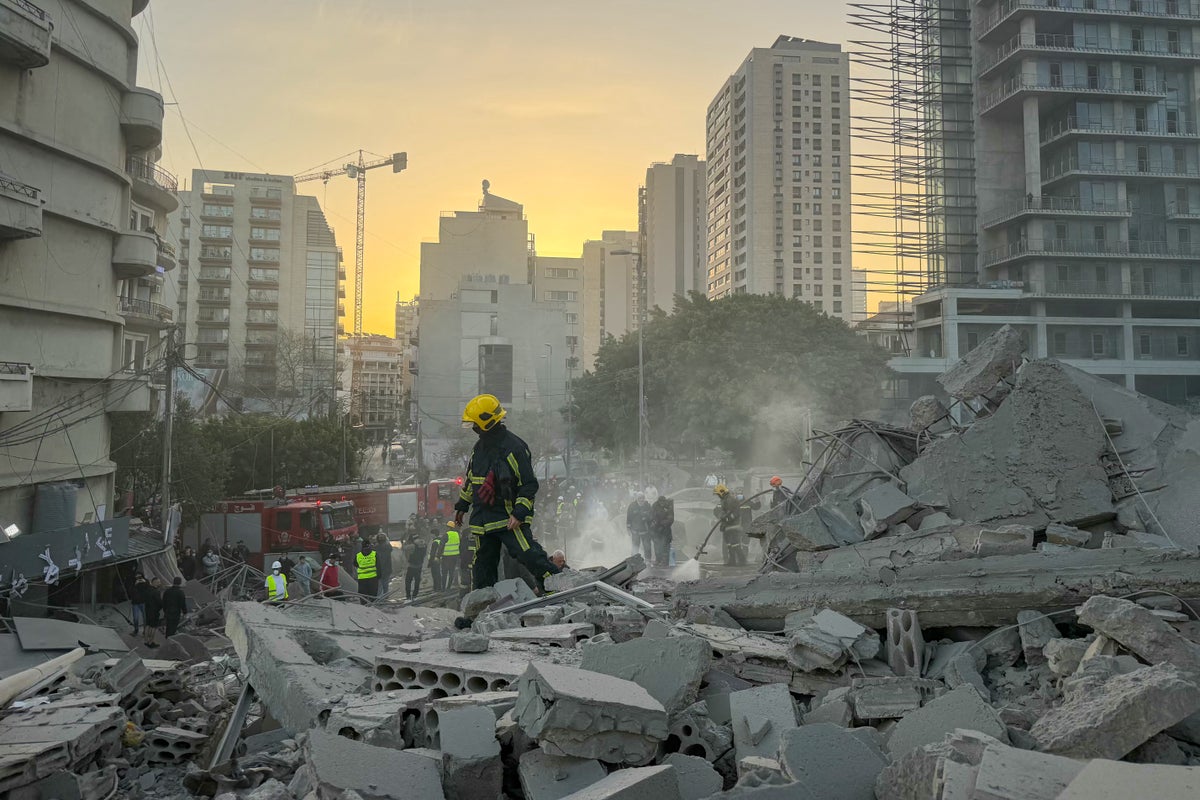
The transition from a "war of attrition" to a "limited ground operation" in Southern Lebanon is not a shift in intent, but a shift in the physical requirements of Israeli security. The operational objective is the degradation of Hezbollah’s "Conquer the Galilee" plan, a tactical framework designed to mirror the October 7 incursions but on a significantly larger, more militarized scale. To evaluate the trajectory of this conflict, one must move past the rhetoric of "total victory" and instead quantify the structural variables of border proximity, subsurface infrastructure, and the physics of short-range ballistic trajectories.
The Buffer Zone as a Functional Necessity
The current conflict is defined by the geography of the Blue Line. For Israel, the presence of Radwan Force—Hezbollah’s elite offensive unit—within line-of-sight of civilian communities creates a permanent state of strategic vulnerability. This is the Geography of Threat. When an actor can deliver high-explosive payloads with flight times measured in seconds rather than minutes, traditional missile defense systems like Iron Dome reach a saturation point where the cost-per-interception ($50,000 to $100,000) becomes secondary to the physical impossibility of kinetic interception at such low altitudes and short distances.
A ground incursion seeks to solve what air power cannot: the systematic dismantling of the Southern Lebanon Subsurface Network. Unlike Gaza’s "Metro," which is largely built in sandy clay, Hezbollah’s infrastructure is carved into mountainous limestone. This provides a different set of tactical constraints:
- Structural Integrity: These tunnels are more resistant to standard "bunker buster" munitions (GBU-28/31), requiring ground forces to physically enter or use specialized thermobaric charges for neutralisation.
- Topographical Advantage: Hezbollah utilizes the high ground of the ridge lines overlooking the Galilee. A "limited" incursion aims to seize these specific observation and fire points to push the Anti-Tank Guided Missile (ATGM) threat beyond its effective 5km–8km range.
The Asymmetric Attrition Model
The conflict follows a specific Cost-Exchange Ratio. Hezbollah’s strategy relies on the mass employment of low-cost, unguided rockets and Iranian-manufactured "Almas" ATGMs. The latter, which utilize a "top-attack" flight profile and fiber-optic guidance, bypass the frontal armor of Main Battle Tanks (MBTs) like the Merkava IV.
Israel’s response utilizes a High-Value Target (HVT) Compression strategy. By accelerating the tempo of decapitation strikes—killing the leadership of the Jihad Council and the Radwan Force in rapid succession—Israel aims to trigger a "cascading failure" in the chain of command. However, the limitation of this strategy is the decentralized nature of Hezbollah’s local units. The organization is structured as a "Hydra-Cell" system where local commanders have pre-authorized autonomy to launch fires if communication with the central Beirut command is severed.
The Logistics of the Three Frontiers
The scale of this conflict is governed by three distinct logistics corridors, each with its own bottleneck:
The Syrian Land Bridge
This is the primary artery for heavy weaponry. Iran utilizes the M2 highway through Syria to move long-range precision-guided munitions (PGMs). Israel’s strategy here is "Interdiction at Source," involving the kinetic targeting of warehouses in the Homs and Damascus regions. The bottleneck is the speed of reconstruction; as long as the Syrian government remains a passive facilitator, the flow of hardware is an infinite loop that Israel can only disrupt, not stop.
The Litani River Constraint
UN Resolution 1701 mandates that no armed personnel other than the Lebanese Armed Forces (LAF) and UNIFIL exist south of the Litani. In practice, the Litani serves as a tactical backstop. If Israeli forces push to the river, they create a 20km to 30km buffer. The tactical risk is the "Occupation Trap." Holding territory in Lebanon historically converts a maneuver force into a static target for IEDs (Improvised Explosive Devices) and sniper fire.
The Domestic Resource Drain
Israel’s economy is sensitive to the mobilization of reserve forces. Reservists are the backbone of the "Start-up Nation" tech sector. Prolonged mobilization creates a contraction in GDP that functions as a secondary front for Hezbollah. The longer the "limited" operation lasts, the higher the economic pressure on the Israeli government to accept a diplomatic compromise that may not meet its security requirements.
The Failure of Traditional Deterrence
The concept of "Deterrence" has failed because both actors are operating on different Value-at-Risk (VaR) calculations.
- Israel's VaR: The permanent displacement of 60,000+ citizens from the north is an existential threat to the state’s social contract. For the Israeli government, the risk of a full-scale war is now viewed as lower than the risk of a "depopulated north."
- Hezbollah’s VaR: The organization’s primary value is its role as Iran’s forward-deployed deterrent. If Hezbollah exhausts its 150,000-rocket arsenal in a regional war, Iran loses its primary shield against a strike on its nuclear facilities. Therefore, Hezbollah is incentivized to maintain "Calibrated Escalation"—doing enough damage to satisfy its domestic and regional narrative without triggering the total destruction of its political and military infrastructure in Beirut.
Technical Limitations of the Current Escalation
Neither side possesses a "silver bullet" technology to end the stalemate.
- The Drone Gap: Hezbollah has successfully used "one-way attack" (OWA) UAVs to penetrate Israeli airspace. These small, low-radar-cross-section drones often fly below the detection thresholds of traditional radar.
- The PGM Threat: While Israel has high-tier missile defense, Hezbollah has not yet deployed its full inventory of "Fateh-110" precision missiles. These missiles have a Circular Error Probable (CEP) of less than 50 meters, meaning they can target specific Israeli infrastructure (power plants, refineries, ports) rather than just civilian centers.
The current Israeli operation is a race against the Inventory Depletion Curve. Israel must neutralize the short-range launch sites before Hezbollah decides to transition to its long-range, high-precision inventory.
The Structural Path to Neutrality
The only mechanism to avoid a multi-year war of attrition is the decoupling of the "Lebanon Front" from the "Gaza Front." Hezbollah has tied its cessation of fire to a ceasefire in Gaza. Israel’s military strategy is an attempt to force a "De-linking" through sheer kinetic pressure—making the cost of supporting Gaza higher than Hezbollah or the Lebanese state can bear.
The strategic play is the implementation of a Hardened Enforcement Mechanism north of the border. This is not a diplomatic paper like 1701, but a physical reality where Israel maintains "Fire Control" over the border region. This involves the permanent use of high-altitude long-endurance (HALE) drones equipped with AI-driven target recognition to strike any movement within the 5km buffer zone immediately.
Moving forward, the success of the Israeli operation will be measured by a single metric: the Volumetric Return of Populations. If the Israeli government cannot convince its citizens that the Radwan Force has been pushed back beyond the ATGM "kill zone," the ground operation will inevitably expand in scope, leading to a direct confrontation with the Lebanese state's remaining infrastructure. The operational window for a "limited" action is closing; the friction of urban combat in the Dahieh or the complex terrain of the Bekaa Valley will dictate the next phase of the regional security architecture.
Establish a permanent, automated kinetic monitoring zone from the Blue Line to the Litani, shifting the burden of enforcement from ineffective international bodies to technological interdiction.