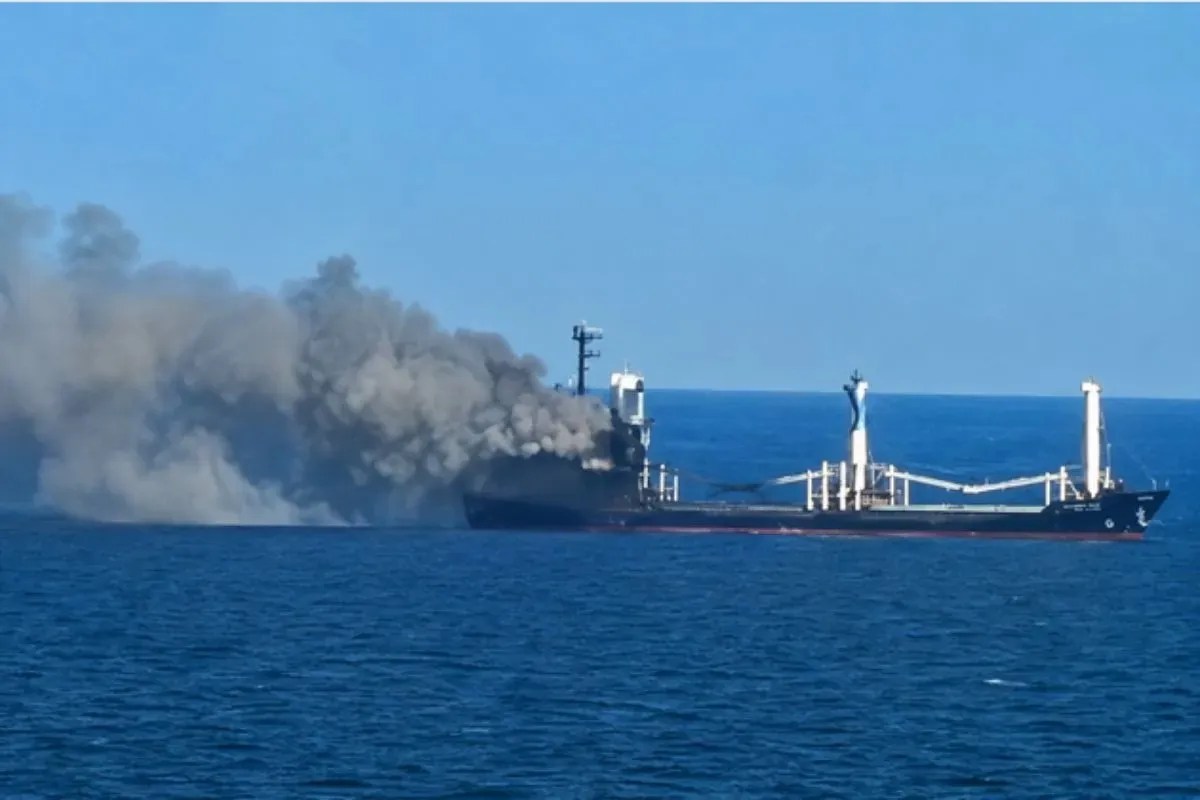
Another ship gets clipped in the Strait of Hormuz, and global markets immediately lose their minds. The financial press dusts off its favorite apocalyptic templates, screaming about supply chain collapse, runaway crude prices, and the imminent strangulation of world commerce. Insurance rates spike overnight. Executives in Houston and Singapore sweat through their collars. Analysts who have never stepped foot on a bridge wing or spent an hour in a vessel traffic service center start spouting theories about geopolitical checkpoints.
It is all absolute theater.
I have spent years watching the shipping industry react to these manufactured crises from the inside. I have seen underwriters panic-sell risk portfolios while quietly raking in record premiums on routes that statistically remain safer than driving an SUV down the Interstate. The lazy consensus says that a single constrained chokepoint makes global trade inherently fragile.
The reality is precisely the opposite.
The Strait of Hormuz is not a fragile glass pipe waiting to be shattered. It is a stubborn, self-healing hydraulic system. The panic you see on your terminal screen is not a reflection of physical vulnerability; it is a tax levied on ignorance by people who profit from your anxiety. Let us tear down the lazy assumptions dominating the headlines and look at how maritime commerce actually survives when the political noise gets deafening.
The Myth of the Single Point of Failure
Every time an incident occurs in the Persian Gulf, commentators trot out the same tired statistic. Roughly a fifth of the world's petroleum consumption passes through this twenty-mile-wide strip of water. Therefore, the argument goes, close the strait and the global economy flatlines within forty-eight hours.
This logic treats global logistics like a static plumbing diagram where pinching one hose cuts off the water. Global shipping does not work that way. It is a dynamic, constantly re-routing neural network.
When freight rates spike or transit risks escalate in Hormuz, charterers do not just sit around waiting to be torpedoed. They adapt. Ships slow down, they adjust departure windows, they optimize deadweight tonnage, and yes, alternative pipelines absorb the shock long before the doomsayers finish drafting their op-eds.
Take the East-West pipeline capacity across Saudi Arabia and the Habshan-Fujairah pipeline in the UAE. Millions of barrels of crude can bypass the strait entirely, heading straight to terminals on the Gulf of Oman. Yet the media treats these bypass routes as minor footnotes rather than the massive structural shock absorbers they actually are.
Why? Because fear sells subscriptions. A headline reading "Global Energy Markets Slightly Adjust Routing and Carry On" does not get clicks. A headline screaming "Strait Under Siege" keeps the adrenaline pumping and the trading desks frantic.
The Economics of War Risk Insurance
Let us look at the actual mechanism that drives this panic: the marine insurance market.
When an attack or interception happens, hull and machinery underwriters, along with protection and indemnity clubs, immediately re-evaluate war risk premiums. During high-tension periods, these additional premiums can add tens or even hundreds of thousands of dollars to a single voyage.
Outsiders look at these soaring premiums and assume they reflect a skyrocketing probability of total vessel loss. That is a fundamental misunderstanding of how marine underwriting operates.
War risk pricing is not an actuarial calculation of total destruction; it is a volatility tax combined with a margin for opportunistic pricing. Underwriters know that shipowners and cargo interests have zero short-term alternatives to moving their tonnage. When panic grips the market, underwriters test the upper bounds of what owners will pay to keep their ships moving.
I have watched syndicates in London double their rates overnight not because the physical threat on the water changed by fifty percent, but because the psychological threat inside the boardroom made owners desperate enough to accept the cost. The ship still steams through the corridor at eighteen knots, burning the same bunker fuel, monitored by the same seasoned masters, but the cost ledger absorbs an artificial inflation tax dictated by sentiment rather than steel.
Navigational Reality Versus Media Hysteria
Step onto the bridge of an ultra-large crude carrier navigating the Traffic Separation Scheme in the Persian Gulf, and you will find an atmosphere that bears zero resemblance to a war zone.
The bridge team is not cowering behind bulkheads. They are managing radar clutter, tracking AIS signatures, coordinating with regional naval coalition patrols, and maintaining strict bridge resource management protocols. The routing through Hormuz is divided into inbound and outbound lanes separated by a safety buffer zone. Masters and chief mates are drilled relentlessly in security level protocols, citadel procedures, and evasive maneuvering.
The media portrays these transits as rolling the dice in a floating casino. Professional mariners treat them as a series of calculated, highly regulated operational parameters.
Imagine a scenario where an aircraft pilot encounters severe turbulence. Passengers scream, grab the armrests, and assume the wings are about to snap off. The pilot, meanwhile, calmly adjusts trim, checks weather radar, and maintains altitude because turbulence is a known, manageable variable in atmospheric physics.
Maritime transit through volatile zones is identical. The risks are real, measurable, and mitigated by layers of operational redundancy. The people shouting about catastrophe from air-conditioned offices in Manhattan are the passengers screaming in cabin seats, ignoring the flight deck entirely.
Why Chokepoints Breed Resilience
There is a deeper economic principle at play here that critics consistently miss: chokepoints do not destroy systems; they harden them.
In biology, controlled stress triggers adaptation and immunological strength. In logistics, geopolitical friction forces operators to eliminate inefficiencies. Every time a disturbance occurs in Hormuz, shipping lines invest heavier capital into tracking software, encrypted communication arrays, predictive route-optimization tools, and superior intelligence-sharing networks.
Before recent decades, ship operators operated with a troubling degree of complacency. They relied on open, uninterrupted oceans and cheap insurance. Incidents in the Gulf acted as a brutal wake-up call, forcing the industry to professionalize its threat assessment. Today, major fleet operators maintain dedicated security operations centers that rival government intelligence desks.
By driving out sloppy operational habits, these geopolitical tremors actually make global supply chains more resilient over the long haul. The weak operators get weeded out or forced to upgrade their risk management; the sophisticated operators build redundancy into every link of their charter parties.
The Cost of Over-Regulation and Knee-Jerk Policymaking
The real danger in these situations is rarely the event on the water itself. It is the legislative and regulatory overreaction that follows.
Politicians love to grandstand after a maritime incident. They call for emergency naval escorts, impose broad sanctions that disrupt normal commercial dialogue, and push through regulatory mandates that add bureaucratic drag without improving actual safety at sea.
When governments try to micromanage complex logistics through political fiat, they create bottlenecks far worse than any regional conflict. Forcing vessels into rigid convoy systems, for instance, creates massive port congestion at destination terminals, destroying turnaround times and throwing global vessel scheduling into chaos.
A ship sitting idle outside a discharge port for ten days because of convoy bunching loses more money and causes more supply disruption than a minor navigational delay in the Gulf ever could. But politicians do not understand port rotation metrics or demurrage rates. They want a photo-op showing action.
Dismantling the People Also Ask Fallacy
If you search for information regarding transit through this region, certain questions consistently pop up across search engines. Let us address them with the blunt honesty the mainstream avoids.
Is the Strait of Hormuz closed?
No. It has never closed, and barring a total global war, it will not close. The economic incentives for every regional actor, including those hostile to Western interests, require the continued export of hydrocarbons. Hydrocarbons in the ground are worthless if you cannot put them on a tanker and send them to market. Physical disruption is always tactical and temporary; absolute closure is an economic suicide pact.
Can ships avoid the Strait of Hormuz entirely?
For containerized cargo and general merchandise, yes, alternative intermodal paths exist. For massive crude carriers, shifting entirely away from the Persian Gulf is physically impossible given current global refining configurations. But avoidance is the wrong question. The correct question is how to price and manage the transit risk efficiently, which modern fleet operators do every single day.
Are maritime attacks increasing overall?
Statistically, maritime safety over the last four decades has improved dramatically despite regional flare-ups. The concentration of media coverage gives the illusion of an escalating wave of anarchy, but long-term data shows that vessel security measures, private armed security teams, and international naval coordination have made commercial shipping remarkably adept at neutralizing localized threats.
The Uncomfortable Truth About Global Supply Chains
Here is the part nobody wants to admit. Global commerce is messy, violent, and entirely dependent on imperfect human beings making hard choices under pressure.
You cannot insulate a ten-thousand-box container ship or a two-million-barrel supertanker from the realities of international politics. Risk cannot be legislated out of existence, and insurance cannot turn a volatile geopolitical corridor into a suburban cul-de-sac.
When you read the next breathless report about a vessel grazed by shrapnel or detained for questioning in the Gulf, do not panic. Do not dump your stocks, and do not buy into the narrative that the global trade architecture is hanging by a frayed rope.
The ships keep moving because the economic gravity driving them is infinitely stronger than the temporary static generated by regional actors. The system absorbs the shock, recalculates the voyage plan, and delivers the cargo.
Stop listening to the panic merchants. Look at the balance sheets, understand the redundancies, and recognize that the chaos you see on the surface is just the cost of doing business in a world that refuses to stand still.