The media loves a good reducer. Give the public a cute, mocking nickname, flatten a complex operator into a literal office appliance, and pat yourselves on the back for explaining how the world works.
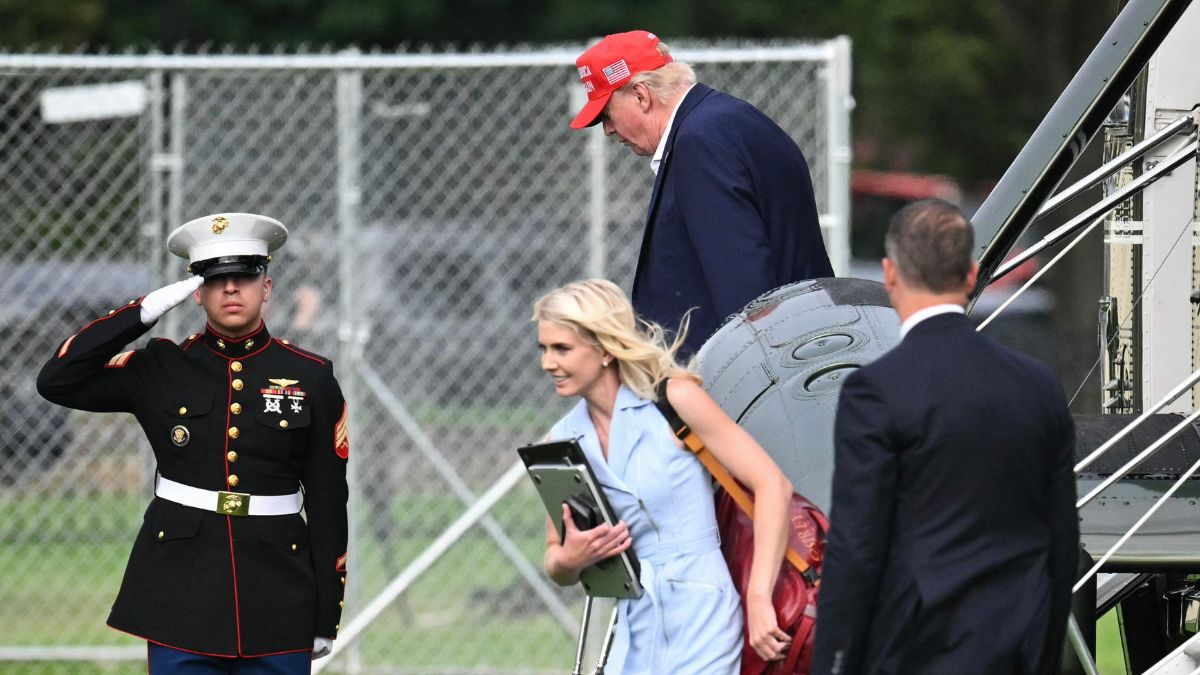
For months, the conventional press corps has lazily recycled a single caricature of Natalie Harp. They call her the human printer. They paint a picture of a loyal aide sprinting down Air Force stairs, clutching positive news clippings, briefing Donald Trump with upbeat headlines like an over-eager intern in a high-stakes West Wing soap opera. Building on this idea, you can find more in: Behind Closed Doors The High Stakes Behind the US Envoy Meeting Maharashtra Leadership.
It is a comfortable narrative. It frames her as a prop, an accessory to power rather than a practitioner of it.
I have watched political staff corridors for two decades. I have seen chiefs of staff panic, communication directors burn out, and media surrogates crash because they failed to understand the actual currency of modern politics. It is not policy papers. It is not legislative mastery. It is informational synchronization. Observers at NPR have provided expertise on this situation.
Dismissing Harp as a mobile copy machine is worse than a misread. It is professional negligence.
The Fallacy of the Passive Aide
Let us clear up the core misconception right away. In modern political machinery, whoever controls the sensory input of the principal controls the output of the state.
The lazy consensus in mainstream political journalism assumes that proximity equals subordination. If you carry things for the boss, you are beneath the boss. If your primary job is feeding positive coverage to a man famously obsessed with media framing, you are merely a sycophant.
This view ignores how attention economies actually operate.
Donald Trump does not need someone to inform him of the macro-trends. He has cable television, social media firehoses, and an internal radar honed over decades of public survival. What he needs—and what Harp provides with surgical precision—is a curated, friction-free loop of validation and rapid tactical ammunition.
Think about the physical reality of a modern campaign bubble. It is chaotic, exhausted, and intensely hostile. Every person inside that orbit is screaming for attention, pitching angles, or pushing internal agendas. In that environment, the person who manages to place the exact right visual, the exact right quote, or the exact right vindicating statistic into the hands of the decision-maker at the exact millisecond of need is not an assistant. They are a bottleneck controller.
The Mechanics of Information Flow
To understand why the "human printer" label falls flat under basic scrutiny, look at the logistics of high-level crisis response.
When a hostile news cycle breaks, political principals face two distinct dangers:
- Information starvation, where they are flying blind against enemy narratives.
- Information pollution, where conflicting internal advice paralyzes decision-making.
Harp’s utility lies in her ability to eliminate both. By carrying printed dossiers, real-time social metrics, and favorable legal or media developments directly to the floor, she bypasses the standard bureaucratic layers. She cuts through the cautious gatekeeping of traditional handlers who are often too terrified to bring bad news or too slow to capitalize on good news.
Imagine a scenario where a major investigative piece drops against a principal at 9:00 AM. A traditional communications team spends two hours holding emergency syncs, drafting memos, and running risk assessments. By the time a synthesized memo reaches the desk, the news cycle has already hardened into a permanent scar.
Now look at the alternative. An operator who tracks the counter-punch in real-time, extracts the exact supporting data points, prints the vindication, and places it in front of the principal before the morning coffee has cooled. That is not printing. That is operational acceleration.
The Battle Scars of Proximity
I have seen corporate boards and political war rooms blow millions on expensive communication consultants who fail to achieve what a single, highly disciplined tactical operator does by simply managing the room's temperature.
People outside the loop always underestimate the psychological toll of proximity to high-friction leadership. You do not survive long at the right hand of a disruptor by being a machine. You survive by anticipating emotional and strategic velocity.
Harp transitioned from a television host and cancer survivor who publicly credited experimental treatments for saving her life, directly into the inner sanctum of the Trump campaign. That trajectory requires an uncommon blend of ideological alignment and tactical ruthlessness. Survivors of major health crises who pivot into aggressive political warfare are rarely docile. They understand stakes differently than career staffers padding their LinkedIn profiles for a post-administration lobbying gig.
When critics mock her for carrying articles, they reveal their own detachment from how power is exercised in the digital age. Power is fast. Power is physical. Power requires physical documentation when digital systems are being intercepted, ignored, or filtered by hostile corporate gatekeepers.
The Real Question Nobody Is Asking
Instead of asking why a loyal aide is carrying paper, the press should be asking a much harder question about their own institutions.
Why are traditional media organizations so terrified of aides who bypass traditional editorial filters?
The answer is simple. The legacy press relies on maintaining a monopoly on narrative framing. When an insider like Harp creates a direct, unfiltered pipeline of curated validation and tactical intelligence, it breaks the media's ability to isolate a political leader within their own ecosystem of negative coverage.
She isn't just printing pages. She is jamming their radar.
Stop looking at the hardware. Start looking at the network.