Urban violence incidents inside high-density residential properties expose structural vulnerabilities where property management protocols, municipal emergency response chains, and individual threat indicators intersect. When an active shooter incident unfolded at a high-rise apartment complex near Loring Park in downtown Minneapolis, resulting in three fatalities including the suspect and multiple injuries among civilians and law enforcement, the event underscored the operational failures preceding active containment. Deconstructing this crisis requires mapping the exact systemic breakdowns that allow predictable threat vectors to escalate into multi-casualty events.
The Failure Cascade in Property Management Threat Mitigation
The operational baseline of multi-family real estate security relies on early identification and administrative intervention. In the Minneapolis incident, multiple residents noted that the suspect had a documented history of brandishing firearms in common areas and had allegedly been issued an eviction notice earlier that day following a series of violent threats.
The transition from behavioral anomaly to violent execution highlights three distinct structural gaps in property management risk models:
- The Reporting-to-Action Latency: Tenants routinely report brandishing and weapons intimidation to building management, yet legal constraints, leasing agreements, and slow administrative verification create a dangerous time lag before formal intervention occurs.
- The Eviction-Violence Vulnerability Spike: Administrative displacement represents a high-probability inflection point for acute behavioral destabilization. Property management frameworks rarely pair standard eviction notices with mandatory security standbys or coordinated law enforcement check-ins, leaving vulnerable residential corridors exposed during the tenant's final hours on-site.
- Access Control Erosion: High-density urban towers feature high foot-traffic volumes, making internal perimeter security porous. When a known threat resides within a building, static electronic locks fail to mitigate internal hallway access, allowing armed movement across floors without friction.
Tactical Constraints in Vertical High-Rise Clearances
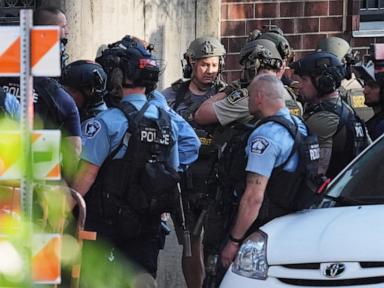
Law enforcement response metrics demonstrate exceptional tactical speed, with Minneapolis police units arriving within two minutes of the initial 911 dispatch and entering the structure immediately. However, vertical urban environments impose severe operational bottlenecks on tactical teams attempting to neutralize an active threat on upper floors.
The propagation of gunfire within enclosed concrete and drywall high-rises creates acoustic distortion, making precise shooter localization difficult from ground level or building entry points. Furthermore, tactical accounts from the scene noted a dense "haze" on the upper target floor that significantly degraded visual acquisition parameters. This atmospheric obstruction—whether generated by discharge smoke, structural damage, or deployment mechanisms—forces advancing officers to operate blind in hostile architectural layouts.
The engagement vector is inherently asymmetrical:
- The entrenched shooter maintains elevation advantage, spatial familiarity, and concealment behind structural fire doors or reinforced apartment partitions.
- Responding officers must advance through linear choke points such as stairwells and long corridors, where cover is minimal and the risk of friendly fire or crossfire is exponentially magnified.
Resource Surge Dynamics and Interagency Deployment Vectors
A critical variable in major metropolitan shootings is the speed and scale of the multi-agency resource surge. The Loring Park incident triggered an immediate deployment of municipal police, tactical SWAT vehicles, state operational assets, the Bureau of Alcohol, Tobacco, Firearms and Explosives, and federal intervention resources.
While a massive tactical response secures the outer perimeter and manages triage points effectively, it introduces secondary operational friction points:
- Communication Silos: Integrating municipal tactical channels with state and federal command structures introduces bandwidth saturation and potential delays in intelligence sharing during the critical containment window.
- Staging Congestion: Concentrating heavy armored units and emergency medical vehicles in densely populated urban corridors creates transit gridlock, occasionally impeding rapid casualty evacuation from the immediate hot zone to regional trauma centers such as Hennepin County Medical Center.
- Secondary Exposure Risks: Beyond direct ballistic trauma, tactical operations in confined multi-family environments expose first responders to peripheral hazards, including chemical irritants, structural smoke, and environmental contaminants.
Operational Redirection for Multi-Family Residential Safety
Mitigating future high-rise urban shooting events requires a fundamental shift from reactive tactical deployment to predictive asset allocation. Property operators must establish direct digital escalation channels with local precincts the moment a tenant exhibits firearm-based intimidation, bypassing standard property management sluggishness. Municipalities should mandate emergency intervention protocols whenever an eviction involves documented threats of violence, ensuring that housing court actions trigger concurrent safety assessments rather than administrative isolation. Finally, building security designs must incorporate remote-override environmental controls and zone-isolation capabilities, allowing building management or responding authorities to restrict elevator banks and secure floor-by-floor access instantly during an active crisis.