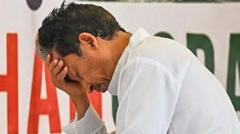
The scale does not lie, but it does simplify. When the needle swings back, clearing a gap of exactly 8.2 kilograms, it registers only a change in mass. It does not record the quiet, terrifying physics of a human body dismantling itself to keep a promise.
Eight point two kilograms.
To a mathematician, it is a minor variable. To a traveler, it is a light piece of carry-on luggage. But to a doctor standing in the dust of a high-altitude protest camp, watching the skin of a frail sixty-year-old activist grow increasingly translucent, that number represents a steady, biological eviction. It is the loss of the protective fat surrounding the kidneys. It is the wasting of the intercostal muscles between the ribs, making every breath a conscious, heavy labor. It is the slow, deliberate cannibalization of skeletal muscle, ground down into glucose just to keep a heart beating in the freezing mountain air.
When a person stops eating to make a point, the world usually watches the politics. We debate the demands, analyze the press releases, and speculate on the government’s next bureaucratic chess move. We treat the protest as a game of chicken played in the clean air of intellectual debate.
But under the canvas of a makeshift tent, far from the television cameras and the polished offices of Delhi, there is no theory. There is only the smell of antiseptic, the dry rattle of a sleeping sleeping bag, and the terrifyingly quiet ticking of a biological clock.
The Geography of the Flesh
Imagine a man who has spent his life building schools, designing passive solar structures, and teaching his community how to harvest glacial water in one of the most hostile environments on Earth. He is not a professional politician. His hands are rough from soil and clay; his eyes are permanently creased from squinting into the blinding glare of the Himalayan sun.
For decades, his body was an instrument of construction. Now, it has been forced to become an instrument of refusal.
When the fast began, his frame was already lean—hardened by decades of walking the high-altitude passes of Ladakh. He did not have spare reserves to lose. In the first forty-eight hours without food, the body undergoes a quiet panic. The liver empties its stored glycogen, a quick-burning fuel source that keeps the brain firing. It is a resource designed for a brief famine, a temporary delay between hunts. By day three, that reserve is entirely gone.
The body must make a choice. It cannot stop. The brain requires glucose to function, and the heart must pump blood through miles of vascular highway. Without external fuel, the system turns inward.
It is a remarkably orderly, yet horrifying, process of self-digestion.
First goes the fat. In a healthy person, adipose tissue is a bank account, storing energy for a rainy day. But in a body already rendered thin by a lifetime of physical labor, the bank account is nearly empty. The body must liquidate other assets. It begins to break down muscle tissue, converting amino acids into life-sustaining sugar through a process called gluconeogenesis.
To sit beside someone undergoing this process is to witness a strange, slow-motion transformation. The voice changes first. It loses its resonant, chest-driven depth, rising into a thin, reedy whisper that requires immense concentration to produce. The skin, deprived of hydration and essential fatty acids, loses its elasticity. If you pinch the back of his hand, the skin remains tented for several long seconds, a silent testament to severe dehydration and systemic exhaustion.
Outside the tent, the wind howls off the glaciers, carrying the scent of juniper and dry earth. Inside, the only sound is the rhythmic, shallow wheeze of a man whose chest lacks the strength to fully expand.
The Asymmetry of the Scale
There is a profound, almost absurd asymmetry in a hunger strike. On one side of the ledger sits a massive state apparatus with its millions of citizens, its police forces, its bureaucratic departments, and its endless, glacier-slow committees. On the other side sits a single cot, a wool blanket, and a man who has decided that his physical existence is the only currency he has left to spend.
It is a desperate transaction. The activist is betting that the moral weight of his suffering will eventually register on the conscience of a nation.
But conscience is a difficult thing to measure, whereas physical decline is brutal in its precision.
Every morning, a local physician enters the tent. The routine is always the same, carried out with a solemn, almost ritualistic quietness. The blood pressure cuff is wrapped around an arm that grows noticeably thinner by the week. The stethoscope is pressed against a chest where the ribs now stand out like the rafters of an abandoned house.
"Eighty-six over fifty-four," the doctor notes quietly, writing the numbers down in a worn leather notebook.
The numbers are dropping. The heart, facing a dwindling supply of electrolytes—specifically potassium and magnesium—must work harder to maintain a rhythm. It begins to beat with a irregular, skipping pattern, like a wooden cart rolling over a cobblestone street. If the potassium levels drop too low, the heart simply stops. There is no warning. There is no gradual fading away. The electrical pathways of the cardiac muscle misfire, and the heart locks in a useless, fatal spasm.
This is the invisible cliff that everyone in the tent is trying not to look at. They talk about the weather. They discuss the news from the villages. They talk about the tourists who are beginning to arrive in the lower valleys, completely unaware that a few miles away, a man is slowly dying for the right of those valleys to exist as they always have.
But the silence between their words is heavy with the knowledge of that cliff.
The Chemistry of Conviction
We often hear about the psychological strength required to undertake such an ordeal. We use words like "determination," "willpower," and "resolve." But these terms are too abstract. They do not capture the physical reality of what resolve actually feels like when your stomach is screaming for sustenance.
In the first five days of a fast, hunger is a loud, physical beast. It claws at the lining of the stomach, producing sharp, nauseating cramps. The mind becomes hyper-focused on food. Every memory of a simple meal—a warm piece of flatbread, a bowl of lentil soup, a cup of salty butter tea—becomes an obsession. The salivary glands ache at the mere thought of salt.
But around the sixth or seventh day, a strange and dangerous shift occurs.
The liver, running out of muscle to convert, begins to break down fatty acids into compounds called ketones. The brain, which usually runs exclusively on glucose, reluctantly adapts to using these ketones for fuel.
This state of ketosis brings with it a bizarre, quiet euphoria. The acute hunger pains fade into a dull, distant ache. The mind, previously foggy and sluggish, suddenly clears. The activist feels a surge of intense focus, a calm that can easily be mistaken for recovery.
It is a biological illusion. It is the body’s final, desperate attempt to give the hunter the mental clarity needed to find food before the system collapses entirely.
To the untrained eye, the activist looks better. He smiles more. He speaks with a sudden, quiet intensity. He tells the visitors that he feels strong, that he can go on forever.
But the doctor knows better. He looks at the dark, bruised circles under the activist's eyes—the result of capillary fragility and lack of sleep. He looks at the pale, bloodless color of the gums. He knows that this surge of clarity is the final candle-flicker of a system running on its emergency reserves.
Behind the calm eyes, the kidneys are struggling to filter the waste products of muscle breakdown. The urine turns a dark, amber color, thick with the proteins of the man's own disintegrating flesh. If the kidneys fail, the toxins will build up in the blood, leading to a slow, drifting coma.
The weight loss is no longer just fat and muscle. It is the very infrastructure of life.
The Silent Witness
To understand why someone would subject themselves to this, you have to look at the people who stand watch outside the tent.
They are farmers, schoolteachers, yak herders, and mothers. They do not speak in the polished prose of political analysts. They gather in small, quiet groups, holding prayer wheels or simply sitting on the cold ground, their eyes fixed on the entrance of the tent.
For them, the activist's body is not his own. It has become a living monument to their collective anxiety.
They live in a region that is changing faster than the ice can melt. They see the glaciers retreating higher into the peaks every summer, leaving their irrigation channels dry. They see the roads carving through their sacred valleys, bringing concrete, diesel exhaust, and the promise of a future where their traditional way of life is merely a postcard for tourists.
They feel powerless. Their letters to the capital go unanswered. Their protests are ignored by national media outlets obsessed with the sensational and the trivial.
But they cannot ignore a man who is disappearing before their eyes.
Every ounce of weight he loses is a physical manifestation of their disappearing heritage. The 8.2 kilograms are not just lost tissue; they are a sacrifice offered to an indifferent world, a desperate attempt to create a gravity well of attention that might finally pull the decision-makers into their reality.
A young woman sits near the edge of the camp, her fingers nervously spinning a small prayer wheel. She does not look at the cameras of the journalists who occasionally wander through. She looks at the ground.
"If he dies," she says, her voice barely louder than the wind, "we lose more than a leader. We lose the proof that we are human to them."
Her words hang in the cold air, far more devastating than any political manifesto.
The Threshold of the Unreversible
There is a point in a long-term hunger strike where the damage ceases to be temporary.
If the fast is broken early enough, the body is remarkably resilient. With careful, medically supervised refeeding—starting with tiny sips of diluted broth and glucose water—the liver recovers, the muscles slowly rebuild, and the cognitive fog lifts. The scale eventually returns to its baseline.
But if the fast crosses a certain invisible threshold, usually around the three-to-four-week mark depending on the individual’s starting health, the damage becomes permanent.
The heart muscle, having been thinned to sustain the brain, may never fully recover its pumping capacity, leaving the individual with chronic, lifelong heart failure. The kidneys, scarred by the effort of filtering high concentrations of protein waste, can suffer permanent nephron loss, leading to chronic kidney disease. The nerves, starved of essential B-vitamins, can begin to misfire, causing a burning, agonizing pain in the hands and feet that never truly goes away.
This is the true cost of the 8.2 kilograms.
It is not a temporary loan that can be paid back with a few hearty meals. It is a permanent surrender of physical capability. Even if the activist survives, even if the government yields and the papers are signed, he will never again walk those high mountain passes with the same easy, effortless stride. He will never again carry the heavy wooden beams to build schools for the children of the valley.
He is trading his future physical self for the future of his people.
The sun begins to set behind the jagged teeth of the mountains, casting long, purple shadows across the valley. The temperature inside the tent drops instantly, the cold seeping up through the frozen earth despite the layers of wool blankets.
The doctor prepares another warm water bottle, placing it gently against the activist’s feet. The activist does not stir. He lies perfectly still, his breathing so light that the blanket over his chest barely moves.
His face, cast in the dim light of a single solar lantern, is incredibly peaceful. The sharp lines of his cheekbones and jaw, carved out by the loss of those 8.2 kilograms, give him the appearance of a stone carving—one of the ancient Buddha statues carved directly into the cliffs of these valleys, weathered by centuries of wind and ice, yet still standing, silent and unyielding, against the storm.