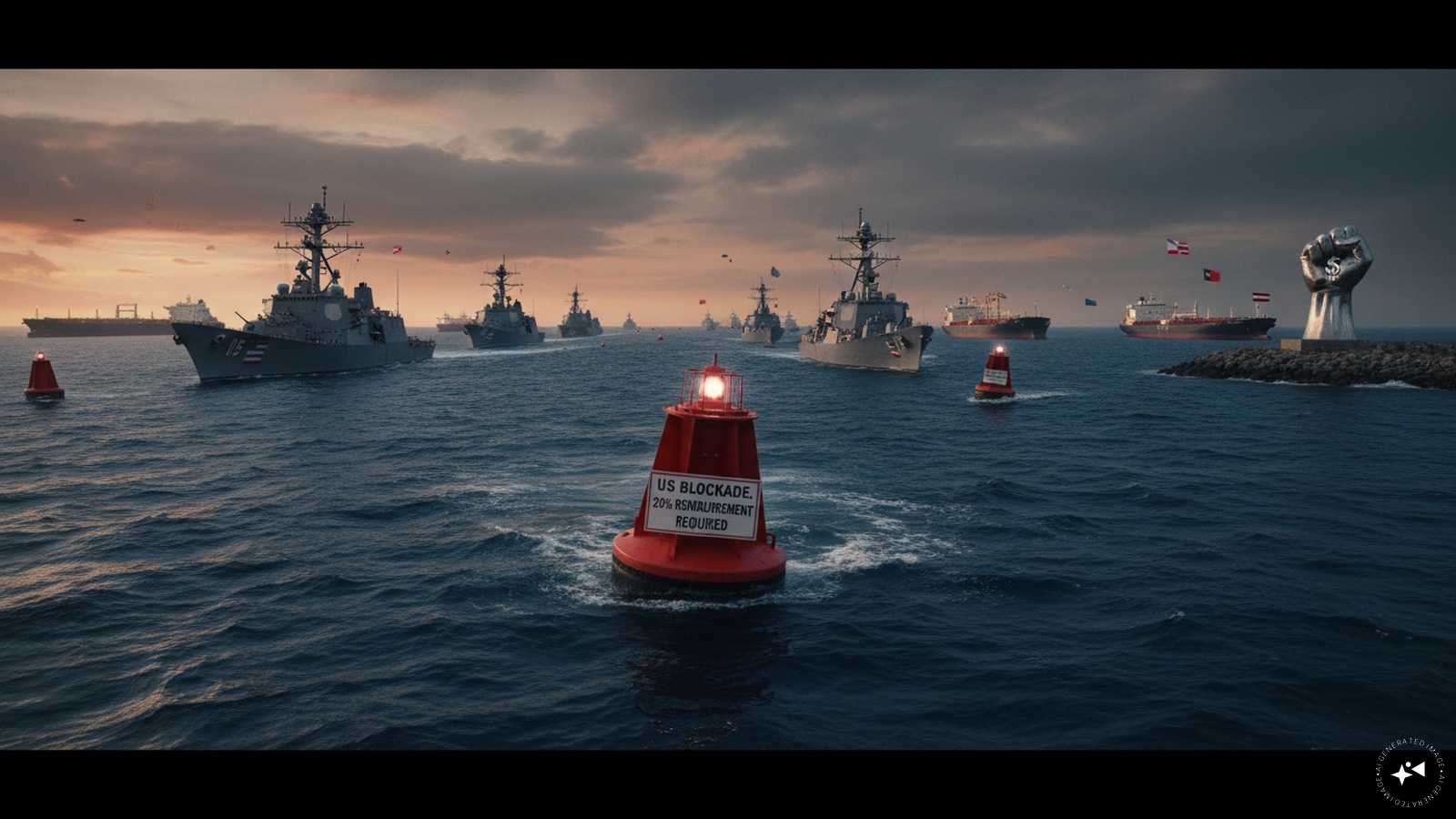
The United States has shattered centuries of maritime precedent with a single executive decree. By launching a third consecutive night of airstrikes against Iranian military targets and simultaneously imposing a 20% tariff on commercial cargo transiting the Strait of Hormuz, the White House has converted a global chokepoint into a proprietary toll zone. This represents a profound shift in American foreign policy. For generations, the primary justification for the global projection of the United States Navy was the unyielding defense of freedom of navigation, ensuring that international waters remained open, unhindered, and free of charge to all nations. That era has ended.
The administration now frames maritime security as a commercial transaction. In a series of public declarations, the presidency stated that the United States would henceforth operate as the "Guardian of the Strait of Hormuz" and must be financially reimbursed for the significant expenses incurred while securing the waterway. Meanwhile, United States Central Command has reactivated a strict naval blockade encompassing the entire Iranian coastline, targeting ports, oil terminals, and coastal assets.
This double-pronged strategy of kinetic bombardment and economic extraction has plunged global energy markets into a state of severe friction. Tehran responded immediately by declaring the strait closed until further notice and launching cruise missiles at commercial tankers associated with the United Arab Emirates. Air raid sirens have echoed across Bahrain, home to the American Fifth Fleet. What began as an attempt to enforce compliance through overwhelming military pressure has devolved into a volatile maritime stand-off where the rules of global commerce are being rewritten under fire.
The Financialization of Global Chokepoints
Charging for passage through an international strait upends the foundational mechanics of global logistics. Under standard maritime practices, tolls are restricted to artificial canals, such as Suez or Panama, where engineering infrastructure requires continuous capital maintenance. Natural waterways have historically escaped these levies. The proposal to capture a 20% fee on the value of eligible cargoes passing through the 21-mile-wide strait is an unprecedented monetization of geopolitical dominance.
Estimated Daily Pre-Conflict Value through Hormuz: $1.2 Billion
Proposed U.S. Transit Fee (20%): $240 Million per day
Vessel Traffic Reduction (July 2026): 52% decline
The mathematics of this policy are staggering. Before hostilities erupted, roughly 15 million barrels of crude oil and liquefied natural gas moved through the chokepoint each day. At a 20% tariff rate, international shipping lines would collectively owe Washington an estimated $240 million daily. This is not a standard customs duty; it is a protection premium enforced via carrier strike groups.
International shipping firms face an impossible dilemma. Paying the American toll validates an unrecognized maritime levy and invites immediate retaliatory targeting from Iranian asymmetric forces. Refusing to pay risks denial of entry or legal interdiction by the Joint Maritime Information Center. MarineTraffic data already indicates that vessel activity through the strait has plummeted by over 50%, as commercial operators choose expensive delays or protracted detours around the Cape of Good Hope rather than entering a militarized corporate tariff zone.
The Legal Fiction of the Guardian Role
The administration maintains that the United States possesses the practical and moral authority to govern the strait because its forces bear the burden of keeping it safe. This assertion lacks a credible basis in international law. The United Nations Convention on the Law of the Sea strictly guarantees the right of transit passage through straits used for international navigation. It explicitly forbids coastal or external states from levying taxes or fees on foreign ships merely for transiting these waters.
Iranian diplomats have quickly exploited this legal vulnerability. Foreign Minister Abbas Araghchi noted sarcastically that whoever provides secure passage should indeed be compensated, but argued that Iran has historically functioned as the historical protector of the waterway. Tehran has already moved to establish its own Persian Gulf Strait Authority, threatening to collect its own competing transit fees once stability is restored.
The structural danger here is the normalization of the practice. If the United States can charge a premium for deploying its navy to secure a waterway, nothing prevents China from implementing a similar protection fee in the South China Sea, or Russia from charging commercial fleets navigating the Northern Sea Route. By treating freedom of navigation as a service rather than an absolute right, the administration has compromised the core argument Washington has used for decades to contest unlawful maritime claims globally.
Kinetic Reality on the Iranian Coastline
While the political rhetoric focuses on tariffs, the military reality is defined by explosive violence. The third night of American strikes targeted deep-seated military infrastructure across western and southern Iran. Central Command confirmed that these operations explicitly targeted air defense networks, radar installations, drone storage facilities, and Islamic Revolutionary Guard Corps fast-attack craft.
====================================================================
           TARGETED MARITIME LOGISTICS INFRASTRUCTURE
====================================================================
* Bandar Abbas Port Facilities & Logistics Hubs
* Kish Island Radar and Shore-to-Ship Missile Sites
* Qeshm Island Asymmetric Drone Launch Bases
* Abu Musa Island Fortified IRGC Garrisons
====================================================================
Explosions shattered the coastline near Bandar Abbas, a vital artery for domestic Iranian trade, as well as the strategic islands of Kish and Qeshm. White House officials have even explicitly threatened to target Pickaxe Mountain, a heavily fortified underground facility linked to Iran's nuclear program. The objective is clear: strip Iran of its ability to contest the strait through conventional or asymmetric means.
Yet, the history of asymmetric warfare suggests that total suppression is difficult to achieve. The IRGC operates hundreds of small, mobile missile launchers hidden along thousands of miles of jagged coastline. They do not require major naval bases to cause severe damage. The cruise missile strikes against the tankers Mombasa and Al Bahiyah demonstrate that even amid intense bombardment, Iran retains the capability to strike and ignite commercial vessels at will.
The Domino Effect on Regional Allies
The unilateral deployment of a maritime blockade and a commercial toll has alienated traditional regional partners who rely heavily on the stability of the Persian Gulf. Gulf cooperation states find themselves trapped between an unpredictable Washington administration and an aggressive neighbor. The state of Bahrain, hosting thousands of American military personnel, has been forced to activate its missile defense sirens repeatedly as incoming Iranian ordnance targets proximity zones.
Allies are quietly furious. For decades, countries like the United Arab Emirates, Saudi Arabia, and Kuwait tolerated the massive American military footprint because it guaranteed unhindered access to global energy consumers. A 20% tariff applied across the board directly eats into their national oil revenues and complicates their long-term supply contracts. If every barrel of oil exported from the region is suddenly taxed by Washington at the point of exit, the economic calculations that underpin regional sovereign wealth funds will collapse.
Furthermore, the escalation has spilled into neutral territories. Iranian missile strikes have targeted areas within Jordan and Qatar, the latter having served as a key diplomatic conduit for ceasefire negotiations. By expanding the geographic scope of its retaliatory strikes, Tehran is sending a clear warning to the region: if Iranian oil exports are reduced to zero by the American blockade, no other nation in the Persian Gulf will be permitted to export energy safely.
The Looming Constitutional Crisis in Washington
Beyond the waters of the Middle East, the re-ignition of this conflict has set off a major political confrontation within the United States government. The executive branch formally notified Congress that active military hostilities had resumed, effectively triggering a 60-day window under the administration's interpretation of executive authority. This move bypasses the explicit constitutional requirement for a formal declaration of war.
Lawmakers are pushing back with unusual bipartisan urgency. Both chambers of Congress previously passed a War Powers Resolution specifically designed to curtail unilateral executive military action against Iranian forces without legislative approval. The administration's current strategy deliberately exploits legal loopholes by framing the strikes as defensive measures necessary to protect commercial shipping and enforce a lawful maritime blockade.
Legislative leaders are exploring defunding mechanisms and direct legal challenges to compel compliance with the War Powers act. This internal division weakens the international credibility of the policy. Foreign capitals are well aware that the entire architecture of the Hormuz tariff system rests on an executive foundation that could be dismantled by legislative intervention or subsequent judicial review.
The Friction of Enforcement
Operationalizing a naval blockade across a vast maritime region presents an immense logistical challenge for the United States Navy. While Central Command asserts that neutral transit to non-Iranian destinations will remain unhindered, verifying the true origin, destination, and ownership of every vessel in a crowded waterway is a monumental task. Modern shipping relies on complex networks of shell companies, flags of convenience, and mid-ocean cargo transfers.
Enforcement requires constant physical presence. Destroyers and cruisers must shadow, intercept, and potentially board giant supertankers that refuse to comply with automated data queries. If an unauthorized vessel carrying Iranian crude attempts to run the blockade, American forces must decide whether to use physical force to halt a civilian ship, an action that could instantly trigger a catastrophic environmental disaster or a direct diplomatic confrontation with nations like China or India.
The infrastructure required to process, manage, and audit a 20% transaction fee on international shipping does not exist. The Treasury Department would effectively need to transform into a global maritime clearinghouse, tracking satellite telemetry and invoicing corporate entities spread across dozens of jurisdictions. The administrative friction alone could stifle maritime commerce far more effectively than any physical barrier.
The fundamental contradiction of the current policy lies in its dual objectives. The administration seeks to punish Iran by cutting off its economic lifelines while simultaneously attempting to run the Strait of Hormuz as a lucrative commercial asset. History demonstrates that you cannot easily run a profitable business inside an active combat zone. By tying the historical principle of freedom of navigation to an aggressive corporate tariff structure, the United States has permanently altered its relationship with the global commons, forcing both allies and adversaries to prepare for a world where international waters belong to whoever has the biggest guns and the highest invoice.