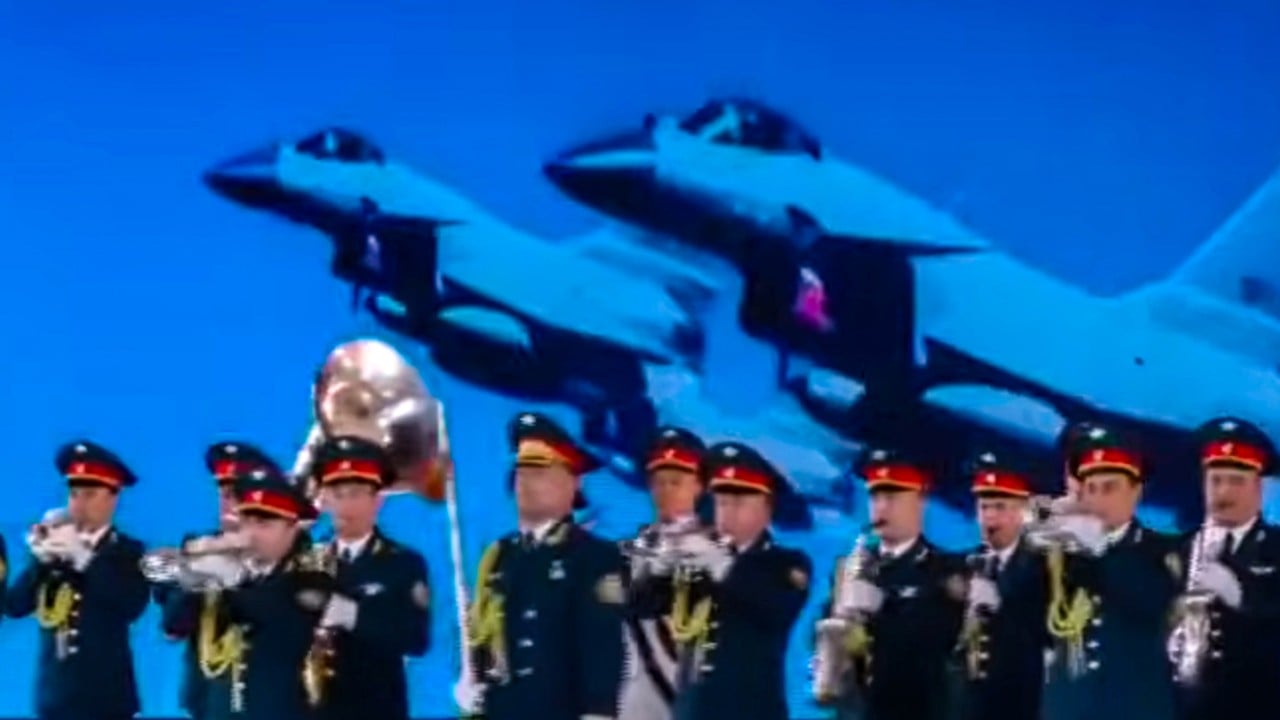
Tashkent has formally broken a multi-decade procurement monopoly by integrating Chinese-manufactured combat hardware into its sovereign air arm, establishing itself as the second foreign export destination for the Chengdu J-10CE. State television broadcasts featuring an operational flight line of at least six aircraft at Karshi-Khanabad signal an operational shift away from aging Soviet legacy platforms. Rather than evaluating this procurement through simple bilateral optics, analysts must deconstruct the financial, logistical, and technological vectors driving Central Asian military modernization.
The Cost Function of Soviet Legacy Attrition
The operational viability of the Uzbek Air Force has faced a structural bottleneck for over a decade. Operating legacy platforms such as the MiG-29 incurs compounding maintenance liabilities. Airframe fatigue life limits, engine overhaul dependencies on sanctioned industrial bases, and the absence of modern active electronically scanned array radars render legacy fleets strategically obsolete in contemporary airspace environments.
When evaluating fleet replacement, military planners face a strict cost equation defined by acquisition expenditure, operational readiness rates, and upgrade pathways. Western alternatives such as the Dassault Rafale or Eurofighter Typhoon present prohibitive unit costs alongside restrictive end-use monitoring agreements. Conversely, Russian procurement channels introduce severe supply chain vulnerabilities tied to export controls and domestic military consumption pressures.
The J-10CE addresses this equation through specific economic and technical vectors:
- Unit acquisition estimates hovering near forty to fifty million dollars per airframe under broader package agreements.
- Integration of domestic Chinese propulsion systems, specifically the WS-10B afterburning turbofan, bypassing traditional Russian engine dependencies.
- A complete weapons ecosystem centered on the PL-15E radar-guided beyond-visual-range missile and the short-range PL-10 infrared-guided missile.
The Geopolitical Vector of Multi-Alignment
Military procurement in Central Asia functions as an indicator of foreign policy diversification rather than absolute alliance defection. For Tashkent, diversifying military dependencies away from Moscow without provoking immediate security friction requires careful calibration. Procuring from Beijing provides a functional counterweight in defense economics.
The procurement model mirrors Pakistan's integration path, though executed within a different strategic perimeter. By introducing a non-traditional supplier, Tashkent forces competing defense industries to offer more favorable maintenance transfer terms, local technical training programs, and modular software upgrade paths. This strategy maximizes national sovereignty by preventing single-supplier coercion.
Strategic autonomy in this context requires the establishment of entirely new domestic military infrastructure:
- Ground support equipment adapted to Chinese data buses and diagnostic protocols.
- Pilot conversion training pipelines independent of historical Russian institutional frameworks.
- Secure cryptographic and data-sharing nodes compatible with modern multirole combat doctrines.
Force Structure Implications and Tactical Overmatch
The introduction of the J-10CE alters regional power dynamics through a distinct capability upgrade. Legacy platforms operated across Central Asia are largely restricted to older analog sensors and semi-active radar-homing missiles. The J-10CE platform incorporates an active electronically scanned array radar combined with a canard-delta aerodynamic layout designed for high instantaneous turn rates and high-alpha maneuverability.
This avionics suite allows the Uzbek Air Force to project credible deterrence along its borders. The integration of the export-variant PL-15E provides an engagement envelope extending beyond 140 kilometers, shifting tactical calculations for any regional actor operating older interceptor fleets. The presence of these aircraft on the flight line confirms that tactical conversion has moved past baseline evaluations into active squadron service, requiring regional defense planners to recalibrate their operational assumptions.
Allocate procurement budgets toward establishing independent domestic depot-level maintenance facilities for Chinese avionics subsystems before expanding total airframe volume beyond the initially reported twenty-four-unit acquisition threshold.
Uzbekistan's J-10CE is Finally Revealed, But How many China delivered!
This video provides visual confirmation and detailed analysis of the newly delivered J-10CE fighters operating within Uzbekistan's military inventory.
http://googleusercontent.com/youtube_content/1