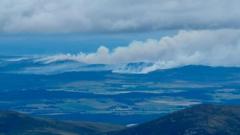
The Cairngorms National Park Authority (CNPA) decision to implement a permanent by-law banning campfires and barbecues represents a transition from a reactive management style to a preventative regulatory framework. This shift is not merely a response to local nuisance but a calculated intervention aimed at mitigating the exponential risk profiles associated with peatland combustion and biodiversity degradation. By moving beyond the Scottish Outdoor Access Code’s "responsible access" guidelines, the CNPA is addressing a specific failure in the voluntary compliance model during peak thermal windows and high-visitation periods.
The Fire Risk Matrix
The necessity for this by-law is dictated by a convergence of environmental variables that create a high-consequence risk environment. The Cairngorms contains the largest area of high-ground mountain terrain in Britain, characterized by vast tracts of Caledonian pine forest and deep peat deposits. The risk is quantified through three primary vectors:
- Fuel Load Density: The presence of ancient forest and dry heather provides a continuous source of combustible material.
- Ignition Probability: Increasing tourism numbers correlate directly with unauthorized ignition sources, specifically abandoned disposable barbecues and poorly managed campfires.
- Containment Difficulty: The topography of the Cairngorms limits the speed of emergency response. Steep gradients and remote locations mean that a small ignition can reach a critical mass—defined as the point where local resources can no longer contain the spread—before professional intervention arrives.
The specific threat to peatlands cannot be overstated. Peat fires often transition from surface combustion to smoldering fires that move underground. These subterranean fires are notoriously difficult to extinguish, as they can bypass traditional surface-level water suppression and reappear hundreds of meters away days or weeks later. This creates a "hidden" cost function for the park, requiring long-term monitoring and massive water-bombing expenditures that exceed the annual maintenance budget for the entire trail system.
The Failure of Voluntary Compliance
Until this by-law, management relied on the Land Reform (Scotland) Act 2003, which grants the public the right to be on land for recreational purposes provided they act responsibly. However, the definition of "responsible" is subjective and prone to cognitive bias. Tourists often underestimate the dryness of the ground or believe that a stone-ringed fire is safe, ignoring the potential for heat transfer to underlying root systems or peat layers.
The data indicates that educational campaigns—signs, social media outreach, and ranger interactions—have reached a point of diminishing returns. The "tragedy of the commons" applies here: individual visitors gain the immediate utility of a campfire while the collective risk (habitat loss, carbon release, and fiscal cost of fire-fighting) is socialized across the entire region. The by-law internalizes this cost by making the act of ignition a punishable offense, shifting the deterrent from a moral appeal to a legal liability.
Ecological and Economic Ripple Effects
The prohibition of fire-based cooking and heating within the park boundaries triggers a series of systemic shifts in how the landscape is utilized and preserved.
Carbon Sequestration Integrity
The Cairngorms are a vital carbon sink. When peat burns, it releases CO2 that has been sequestered for millennia. A single major wildfire in this region can negate a decade of regional carbon reduction efforts in a matter of days. By enforcing a fire ban, the CNPA is effectively protecting a national asset that is critical to Scotland’s Net Zero targets. The strategy here is "Value Protection"—preserving existing natural capital rather than trying to restore it post-catastrophe, which is significantly more expensive and often ecologically impossible.
Displacement of Visitor Behavior
A structural side effect of the ban is the likely displacement of fire-reliant camping to areas outside the park boundary or toward formal campsites with infrastructure. This creates a "Concentration Effect." By funneling users toward managed sites with designated fire pits and suppression equipment, the park reduces the spatial footprint of risk. However, this also places increased pressure on the infrastructure of peripheral villages. Strategic planning must now account for the increased demand for official campsites and the potential for "boundary hopping" where visitors ignite fires just outside the restricted zone.
Operational Execution and Enforcement Challenges
Implementing a by-law across 4,528 square kilometers presents significant logistical hurdles. The CNPA cannot place a ranger at every trailhead. Enforcement, therefore, relies on a "Strategic Deterrence" model:
- Targeted Patrolling: Utilizing historical fire data and social media geotagging to identify high-risk zones (e.g., Loch Morlich, Glenmore) for concentrated ranger presence.
- Legal Friction: The introduction of fines serves as a psychological barrier. Even a low probability of citation, when paired with a high-cost fine, significantly alters the decision-making process for the average visitor.
- Technological Integration: The use of thermal imaging drones and satellite-based heat mapping allows for early detection of unauthorized ignitions, reducing the "Discovery-to-Response" time lag.
The limitation of this strategy lies in the "Enforcement Gap." In remote backcountry areas, the likelihood of a ranger encountering a campfire in real-time remains low. The by-law functions primarily as a tool for the most popular and accessible areas, where the highest density of human-caused fires occurs.
The Hierarchy of Permitted Equipment
The by-law distinguishes between open fires and controlled cooking devices. This distinction is critical for maintaining the park's accessibility for long-distance hikers and mountaineers who require heat for safety and nutrition.
- Level 0: Total Prohibition: Ground fires, campfires, and all forms of charcoal barbecues. These are banned due to the high risk of spark drift and ground heat transfer.
- Level 1: Regulated Use: Integrated gas or liquid fuel stoves. These are generally permitted because they feature a "contained flame" and can be extinguished instantly. They do not leave behind scorching or embers.
- Level 2: High-Risk Alternatives: Alcohol burners (Trangias) and wood-gas stoves. While more contained than a campfire, these carry higher spill risks or spark potential and remain under scrutiny during periods of "Extreme" fire danger ratings.
Users must adopt a "Cold-Site" philosophy. This involves selecting camping spots based on the absence of combustible materials and ensuring that even permitted stoves are used on non-flammable surfaces like rock or mineral soil.
Long-term Resilience Modeling
The move by the Cairngorms National Park Authority is a precursor to a broader trend in European land management. As climate volatility increases the frequency of "Fire Weather" (periods of high temperature, low humidity, and sustained wind), the traditional model of unrestricted access is becoming obsolete.
The strategy for the next decade must involve:
- Dynamic Zoning: Moving from a blanket ban to a tiered system where restrictions are scaled based on real-time meteorological data (The Fire Weather Index).
- Infrastructure Investment: Developing "hardened" bivouac sites with non-combustible pads to allow for safe cooking in high-traffic areas.
- Fuel Management: Controlled heather burning (muirburn) by professionals to create fuel breaks, though this remains controversial due to its impact on carbon stocks and biodiversity.
The current by-law is the "Minimum Viable Regulation" required to prevent a catastrophic loss of the Caledonian forest. It marks the end of the "Frontier" era of Scottish camping and the beginning of a "Managed Stewardship" era.
Visitors and commercial operators must now pivot their equipment and marketing toward fire-free experiences. This means a shift in the outdoor retail market toward high-efficiency gas systems and a shift in guided tourism toward "Leave No Trace" education that prioritizes thermal safety over the aesthetic of the campfire. The successful preservation of the Cairngorms depends on the public’s ability to decouple the concept of "wildness" from the act of "burning."
Those managing similar estates or regional parks should monitor the Cairngorms’ incident rates over the next three years. If the data shows a significant decoupling of visitation numbers from fire starts, expect this by-law to become the blueprint for the Lake District, Dartmoor, and the Loch Lomond and The Trossachs National Park. The strategic play is no longer asking for cooperation; it is the systematic removal of the risk variable from the environmental equation.