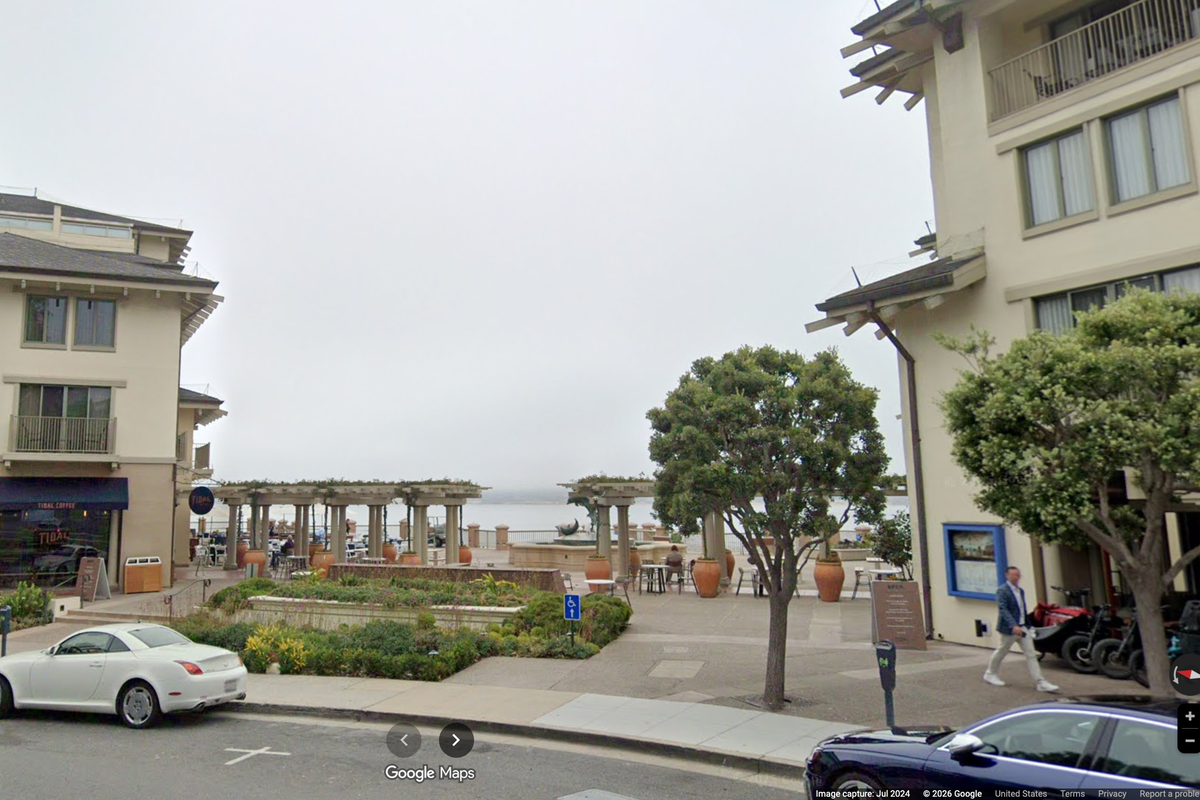
The intersection of human volatility and architectural elevation creates a high-stakes failure point for the hospitality industry. When a physical altercation occurs on a hotel patio overlooking California cliffs, the transition from a civil dispute to a terminal event is governed by a predictable set of gravitational physics and structural vulnerabilities. These incidents are not merely tragedies; they are the result of specific environmental stressors and mechanical failures in risk mitigation. By deconstructing the dynamics of the recent fatal fall in California, we can identify the cascading failures that turn a common social friction into a fatal structural breach.
The Physics of Peripheral Hazards
The primary risk factor in cliffside properties is the gravitational potential energy inherent in the site's topography. In the incident where an individual was propelled over a patio railing following a physical struggle, the transformation of horizontal kinetic energy—generated by the fight—into vertical momentum defines the outcome.
The Velocity Vector Shift
In a confined space like a hotel patio, the presence of multiple bodies in motion increases the probability of a "force multiplier" effect. During a fight, the participants are not just stationary actors; they represent mass moving at varying speeds. If a body is pushed toward a perimeter, the force required to clear a standard 42-inch guardrail is significantly lower if the individual’s center of gravity is already elevated or if the momentum is shifted upward during a grapple.
Impact Dynamics
The California coastline typically consists of sedimentary rock formations or jagged tidal zones. A fall from a significant height involves a terminal velocity that ensures total system failure upon impact. The biological cost function here is binary: once the threshold of the railing is crossed, the probability of survival approaches zero because the dissipation of kinetic energy occurs almost instantaneously against a non-yielding surface.
Structural Integrity and the Barrier Paradox
Building codes, such as those mandated by the California Building Code (CBC), require guardrails to withstand a concentrated load of 200 pounds applied in any direction at the top of the rail. However, these standards are designed for passive occupancy, not for the dynamic, high-impact forces generated by adult males engaged in combat.
The Failure of Standard Mitigation
- Dynamic Load Exceedance: A 200-pound static load rating does not account for the "surge" force of two or three individuals colliding with the barrier simultaneously. The structural anchors of the railing (the "point-of-fixity") become the single point of failure.
- Geometric Vulnerability: The standard height of 42 inches is calculated to prevent accidental trips for an average-sized adult. In a violent struggle, the center of gravity often rises as individuals brace or lift one another, rendering the 42-inch height ineffective as a pivot point rather than a barrier.
- Environmental Degradation: Coastal properties face constant salt-spray corrosion. Even high-grade stainless steel or aluminum railing systems experience microscopic pitting and oxidation that can compromise the tensile strength of the fasteners over time.
The Behavioral Catalyst: The Alcohol-Aggression Feedback Loop
The presence of a patio overlooking a scenic vista almost always coincides with the presence of a bar or restaurant. This introduces a chemical variable that destabilizes the social environment.
Inhibitory Conflict Theory
Alcohol narrows a person's perceptual field, a phenomenon known as alcohol myopia. This creates a cognitive bottleneck where the individual focuses only on the immediate provocation (the fight) while ignoring the catastrophic environmental risk (the 100-foot drop). The biological drive for dominance during a struggle overrides the survival instinct that would typically keep a person away from a cliff's edge.
Environmental Priming
High-altitude environments can induce a mild physiological stress response, including increased heart rate and cortisol levels. When paired with alcohol and social friction, the "fight or flight" mechanism is primed. In a fight, the "flight" option is physically restricted by the patio’s boundaries, forcing an escalation of the "fight" component until a physical breach occurs.
Quantifying Operational Liability for High-Risk Properties
For hospitality stakeholders, the California incident highlights a profound liability gap. Traditional security focuses on preventing unauthorized entry, but "internal safety" requires a more granular approach to physical architecture and guest management.
The Three Pillars of Site Vulnerability
- Topographical Exposure: The vertical distance between the occupied surface and the nearest impact zone.
- Crowd Density and Flux: The number of individuals in a confined "high-edge" area during peak social hours.
- Response Latency: The time required for security or staff to intervene before a verbal dispute escalates into physical momentum.
Mechanical Interventions and Redundancy
To mitigate the risk of a "plunge" event, properties must look beyond the minimum requirements of the building code. The goal is to design environments where even a violent struggle cannot result in a perimeter breach.
Recessed Perimeters
The most effective structural intervention is the implementation of a "buffer zone." By placing the railing three to five feet back from the actual cliff edge and filling the gap with non-traversable vegetation or a secondary safety net (similar to those used at the Golden Gate Bridge), the facility creates a redundancy. If the primary railing fails or is bypassed, the individual does not immediately enter freefall.
Energy-Absorbing Glazing
Replacing traditional post-and-rail systems with reinforced, laminated glass panels provides a continuous surface. This eliminates the "ladder effect" where individuals might climb or be lifted over a rail. These panels should be engineered to flex under impact, absorbing the kinetic energy of a collision rather than snapping at the base.
The Legal Landscape of Foreseeability
In California, premises liability often hinges on whether an incident was "foreseeable." While a fight might be considered an intervening criminal act by third parties, the presence of a low-friction path to a fatal drop is an architectural fact.
Duty of Care in Extreme Topography
Courts are increasingly looking at whether property owners accounted for the "known propensities" of guests in social settings. If a hotel serves alcohol on a cliffside patio, it is foreseeable that balance and judgment will be impaired. Therefore, the architectural standard of care is higher than that of a ground-level parking lot.
The Discovery of Negligence
Investigators will focus on the maintenance logs of the railing system and the training of the staff regarding de-escalation. If the railing showed signs of rust or if previous near-misses went unreported, the property’s liability shifts from "unfortunate accident" to "negligent homicide" or "wrongful death."
Strategic Imperatives for Vertical Hospitality
The Californian incident serves as a definitive case study in why aesthetic design must be secondary to kinetic safety in high-altitude zones. The transition from a hospitality experience to a crime scene occurs in less than two seconds of freefall.
Property managers and developers must immediately audit cliffside and rooftop assets using a high-energy impact model. This involves:
- Testing perimeter barriers against dynamic, multi-person loads rather than static weights.
- Installing high-definition, low-light surveillance that uses AI-driven motion analytics to detect aggressive posturing before physical contact is made.
- Implementing "hard-stop" occupancy limits in areas where the edge-to-floor-area ratio is high.
The strategy moves from passive observation to active containment. If the environment permits a fight to result in a fall, the environment is fundamentally flawed. Safety is not a feature of the railing; it is a function of the entire spatial geometry. Management must treat every cliffside edge not as a view, but as a potential launch point for a liability event that can bankrupt a brand and terminate a life.
.jpeg?width=1200&auto=webp&trim=10%2C0%2C11%2C0)