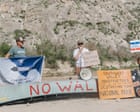
The outrage machine has found its latest muse. Environmental advocates, river guides, and regional tourism boards are clutching their pearls over heavy machinery turning up dust near Santa Elena Canyon, as documented by outlets like The Guardian. The narrative is neat, predictable, and entirely lazy: federal bulldozers are tearing through an 800,000-acre Texas sanctuary, ruining vistas, and violating pristine wilderness for a redundant security footprint.
Here is the truth nobody in the mainstream media wants to articulate. The collective freakout over grading equipment and vehicle barriers misses the actual mechanics of modern border logistics. We are so busy defending the abstract concept of a postcard-perfect desert that we are ignoring how cartels actually exploit remote topography. Discover more on a similar issue: this related article.
The Myth of the Untouched Wilderness
Let us strip away the romanticism. For years, opponents of border infrastructure have leaned on a comfortable statistic: the Big Bend sector registers a fraction of the unlawful crossings seen in urbanized sectors like El Paso or the Rio Grande Valley. Activists point to minuscule apprehension numbers from past years as proof that physical deterrence in a rugged national park is an absurd waste of taxpayer capital.
This argument relies on a fundamental misunderstanding of geographic risk displacement. Criminal networks do not operate uniformly. When you harden high-density urban corridors, traffic inevitably bleeds into extreme terrain. The brutal, unforgiving topography of the Chihuahuan Desert was never an insurmountable obstacle for transnational smuggling rings; it was simply a low-resistance path when easier routes were saturated. Further analysis by The Guardian explores similar views on this issue.
Customs and Border Protection (CBP) contractors moving into the region under a multibillion-dollar framework are not building medieval stone monoliths across 1,500-foot limestone cliffs. They are installing targeted vehicle barriers, upgrading primitive patrol routes, and deploying surveillance architecture. To call a graded access road an unmitigated environmental apocalypse is to ignore the reality of how emergency response and interdiction actually function in the backcountry.
The Cost of Outrage Without Alternatives
I have watched public lands advocates spend decades fighting every single infrastructure upgrade while offering zero functional solutions for remote sovereign enforcement. They want the federal government to secure the border magically via satellite uplinks and good intentions.
Imagine a scenario where a medical emergency or a high-speed interdiction occurs twenty miles deep into the park without an operational patrol road. Agents cannot teleport. Without proper transit corridors, enforcement gridlocks. When local sheriffs and federal personnel are restricted by archaic bureaucratic delays, the security vacuum gets filled by illicit networks that treat federal acreage as an open-air transit lounge.
The Center for Biological Diversity and allied groups have filed lawsuits arguing that waiving environmental review statutes under expedited federal contracting strips communities of due process. Legally, they have a mechanism for dispute. Logistically, their insistence on zero-footprint conservation in a volatile geopolitical zone is a luxury born of distance.
Why the Real Fight is Being Ignored
The fierce debate over pink ribbon markers near the Rio Grande obscures a much more vital question: how do we balance ecological preservation with tactical necessity when transnational cartels adapt faster than federal procurement cycles?
The $1.7 billion allocation managed by firms like Southwest Valley Contractors is not just about concrete and steel. It is an admission that passive observation fails when ground mobility is compromised. If you want to protect the Dark Sky status and the fragile riparian habitats of the borderlands, the solution is not pretending the border does not exist. The solution is engineering smart, localized infrastructure that stops motorized smuggling without turning public parks into militarized zones.
Stop treating every shovel of dirt in a national park as an existential crisis. The real crisis is our collective addiction to performative outrage instead of functional management.
For ongoing local updates and specialized regional coverage, consult resources like the CBS Austin News Station or listen to investigative reports on CBS Austin YouTube Channel. This segment provides an in-depth look at the local law enforcement and community perspectives surrounding the ongoing heavy equipment operations in the region.