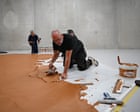
Imagine stepping into a high-end art gallery and getting hit by the overwhelming, unmistakable scent of a school lunchbox. Three floors up at the Depot offshoot of the Museum Boijmans Van Beuningen in Rotterdam, that is exactly what is happening. The museum has covered a 25-square-meter floor space with more than 800 pounds of smooth peanut butter.
It sounds like a prank. It looks like a massive mess. But it is actually a meticulous, deeply serious tribute to the late Dutch conceptual artist Wim T. Schippers, who died in June at the age of 83. The installation, formally titled Pindakaasvloer (Peanut Butter Floor), is back on display for a two-month run, and it challenges everything we think we know about the boundaries of modern art.
The Method Behind the Madness
Schippers first conceived the idea back in 1962 and finally executed it in 1969. It was part of his Floor Covering Series, which also featured installations made of glass shards and salt. While those materials carry a certain sterile, dangerous edge, peanut butter brings something entirely different to the table: an aggressive, nostalgic aroma and a bizarrely domestic familiarity.
If you think the gallery staff just dumped a bunch of jars and went to lunch, you are mistaken. The installation process is grueling. It took two museum workers several days to carefully spread 40 massive tubs of smooth Calvé peanut butter across a precise hexagonal layout. Using drywall trowels, they worked to ensure the layer reached a consistent thickness of two centimeters.
Before his passing, Schippers worked directly with the museum to draft a rigid 20-point instruction manual for future installations. He wanted to make sure nobody messed up his vision, which comes with a few strict requirements:
- The Texture: Curators must use 15.6 kilograms of non-chunky peanut butter per square meter.
- The Technique: The paste must be spread as smoothly, boringly, and monotonously as possible.
- The Rules: Visitors absolutely cannot walk on, stand in, or lie down on the installation.
- The Intent: The work must never be approached with an educational purpose.
Schippers did not want a lecture series about the socio-economic implications of legumes. He wanted people to look at a massive sheet of brown paste and feel a sense of pure, unadulterated bewilderment.
When Art Meets Childhood Snacks
When you put 800 pounds of breakfast spread on a floor, people are going to react unpredictably. The history of Pindakaasvloer is packed with bizarre public interactions that Schippers often found amusing rather than offensive.
During a 1997 exhibition at Utrecht's Centraal Museum, a group of pranksters decided the installation was missing something. They laid down 12 slices of bread and scattered several bags of hagelslag—the chocolate sprinkles that Dutch people famously eat on bread for breakfast. Instead of calling the police, Schippers took a look and praised the rogue additions. He noted that the sprinkles had been applied with a genuine sense of proportion and a skillful hand.
Of course, not every interaction is a creative success. During a 2011 run at the Museum Boijmans Van Beuningen, an inattentive visitor ignored the boundaries, stepped right into the sticky display, and immediately wiped out.
The physical reality of the piece forces the museum to adapt. For the current exhibition, a prominent sign sits at the entrance warning anyone with severe peanut allergies that they might want to turn back. Meanwhile, the museum cafe is leaning into the theme, serving a dedicated peanut butter sandwich that visitors can customize with cheese or spicy sambal relish.
The Genius of Wim T. Schippers
To understand why this piece matters, you have to understand the man who built it. Schippers was a giant of the Dutch neo-dadaist movement. In the early 1960s, he co-founded the A-dynamische groep, an art collective dedicated to fighting commercialization and, above all, boredom in the art world. They made headlines by shaving live cactuses and upholstering chairs with canned noodles.
Schippers did not limit his absurdity to elite galleries. He was a massive mainstream cultural figure in the Netherlands. For decades, he was the voice of Ernie, Kermit the Frog, and Count von Count on the Dutch version of Sesame Street. He also created legendary, chaotic television shows and cult comedy characters like Sjef van Oekel, a chaotic Belgian french-fry salesman who wore a tuxedo.
His philosophy was simple: life and art are entirely serious and entirely non-serious at the exact same time. He loved forcing people to ask basic questions like, "Is this art?" or "Am I even allowed to like this?"
Experiencing the Absurd
If you happen to find yourself near Rotterdam before the exhibition closes on September 6, do not look for a tour guide to explain the deeper meaning of the peanut butter room. Just follow your nose to the third floor, stand at the edge of the hexagon, and let the sheer oddity of the space wash over you. If you want to take a piece of the experience home, the museum gift shop is selling smooth Calvé jars so you can recreate a miniature, boringly smooth installation on your own kitchen counter.