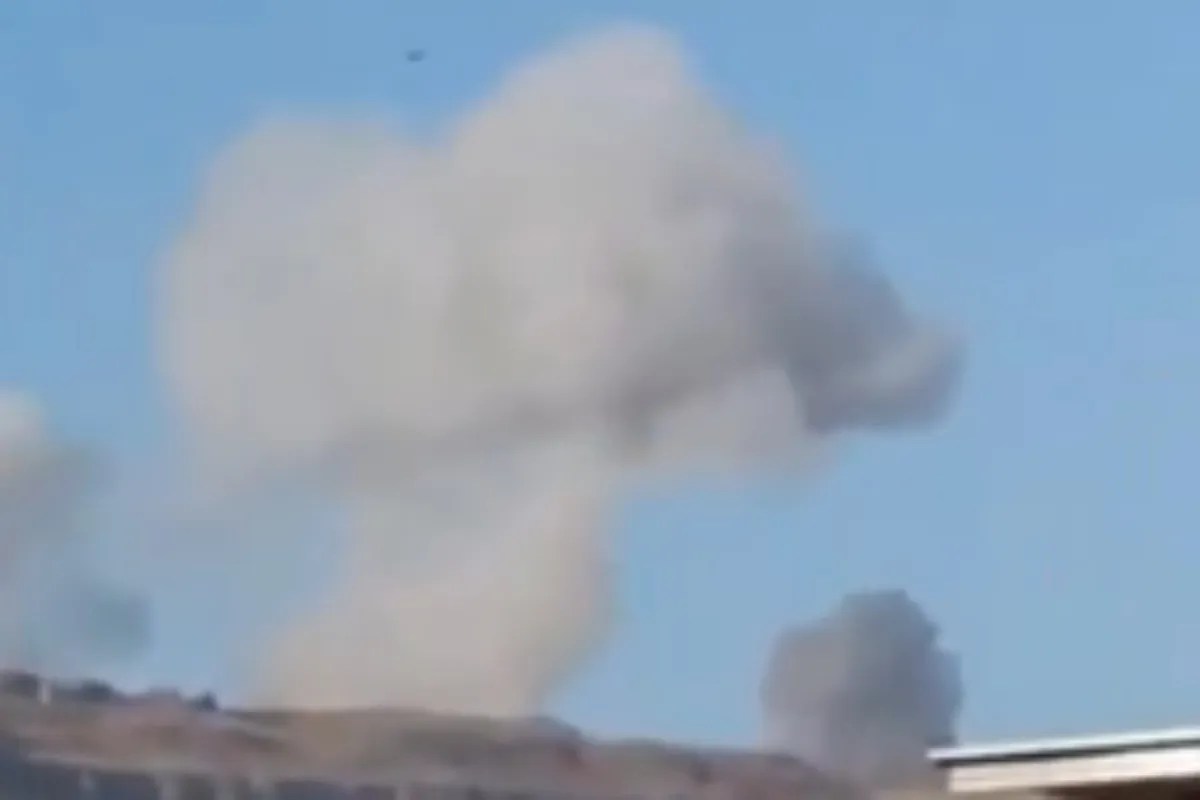
Dust settles differently after an explosion.
In the first three seconds, it hangs suspended in the air like a thick, gray curtain, blinding everyone inside it and muting the screams that haven't quite caught up to the shockwave. Then, slowly, the grit begins to fall onto open sacks of sorghum, onto spilled plastic canisters of cooking oil, onto the wooden stalls where women were bargaining over tomatoes just heartbeats earlier.
Silence.
Then the sound returns, and it is never the sound of a war between soldiers. It is the sound of a market dying.
A headline crossed the global wires recently, sanitized into the tidy arithmetic of international journalism: More than 100 people killed in Sudanese army drone attack on market, says Sudanese rights group. You read those fourteen words while waiting for your coffee to brew, your thumb already hovering at the bottom of the screen to scroll toward the weather or a celebrity breakup. The number—one hundred—is simultaneously too big to picture and too familiar to shock. When a tragedy repeats itself across continents for years, human suffering gets compressed into a statistic, stripped of smell, weight, and name.
To understand what actually happened when that drone dropped its payload onto a crowded Sudanese marketplace, you have to step away from the military briefings and walk into the heat of a morning that was supposed to be entirely ordinary.
The Architecture of a Saturday Morning
Consider a hypothetical mother named Amira, standing near the edge of a bustling open-air market in Darfur or Kordofan—regions that have borne the brutal brunt of Sudan’s civil war since fighting erupted between the Sudanese Armed Forces and the paramilitary Rapid Support Forces in April 2023. We have to invent Amira because the communications blackouts across Sudan mean the real names of the dead often take weeks to trickle out through fragmented satellite connections and volunteer networks. Yet Amira’s morning is built from the documented, verified reality of how millions of Sudanese survive right now.
In a country where the formal banking system has largely collapsed and supply chains have been severed by shifting frontlines, the local market is not a convenience. It is an organ of survival. People do not go there to browse. They go there because hyperinflation means the cash in your pocket loses value by sundown, so you convert whatever scraps of money you have into millet, lentils, or charcoal immediately.
Amira has walked four miles since dawn, holding the hand of her seven-year-old son, Tariq. Around them, hundreds of neighbors are packed shoulder-to-shoulder beneath makeshift awnings of stitched burlap and corrugated tin. The air smells of roasted peanuts, diesel exhaust from battered pickup trucks, and red earth baked by the sun.
Nobody here is carrying a rifle. Nobody here is wearing a uniform.
Yet three miles above their heads, invisible against the glare of the morning sky, a machine is watching.
The Cold Geometry of Remote War
To understand why a bustling civilian square becomes a target, you have to understand how modern drone warfare has altered the psychology of conflict.
Think of a traditional artillery shell or a low-flying fighter jet. Both carry a degree of friction. A pilot flying low feels the vibration of the airframe, sees the rooftops rush beneath the cockpit, and risks being shot down by ground fire. Artillery crews have to calculate trajectories manually and haul heavy ammunition across treacherous terrain. That physical friction used to create a pause—a tiny window where hesitation or second thoughts could survive.
Armed drones erase that friction entirely.
Operating from a climate-controlled shipping container dozens or hundreds of miles away, an operator looks at a monochrome video feed on a high-definition monitor. From twenty thousand feet, human beings do not look like mothers, bread-sellers, or children. They look like gray thermal blobs moving across a gridded screen. A pickup truck carrying bags of sugar looks identical on an infrared sensor to a pickup truck carrying ammunition crates.
Military planners call this "precision warfare," a phrase designed to reassure politicians and the public that technology has made battlefields surgical. In practice, across Sudan’s sprawling civil war, drones have become instruments of indiscriminate terror. Both the Sudanese Armed Forces, under General Abdel Fattah al-Burhan, and the rival Rapid Support Forces, led by Mohamed Hamdan Dagalo, have increasingly relied on unmanned aerial vehicles to strike deep into territory held by the other side.
When you lack the ground troops to capture a town, you send a drone to make life inside that town impossible.
At 10:14 AM—or whatever exact minute the strike occurred—the high-pitched whine that survivors across Sudan describe as a "mechanical wasp" barely registers over the chatter of the crowd. There is no time to dive behind a brick wall. There is no bomb shelter to run toward. The munition strikes the center of the produce stalls, where foot traffic is densest.
What One Hundred Bodies Actually Looks Like
We struggle to hold the number one hundred in our minds, so let's break it down the way local emergency responders have to when they arrive on foot with wheelbarrows and wooden carts.
One hundred people is roughly the population of three full school buses.
When Emergency Lawyers—an independent Sudanese human rights group that has painstakingly documented atrocities throughout the war—reported that more than a hundred civilians were killed in the market strike, they were not offering an abstract estimate. They were counting bodies pulled from beneath collapsed wooden beams and charred metal roofing. They were counting the people who bled out on the dirt floor of understaffed local clinics because the hospital had run out of surgical gauze and intravenous fluids months ago.
I have spoken with aid workers who have walked into the aftermath of similar strikes in Khartoum and El Fasher, and what stays with them isn't just the scale of the loss—it is the domesticity of the wreckage. You find a child's plastic sandal beside a melted scale used for weighing flour. You find a ledger book where a merchant had written down small debts owed by neighbors, its pages speckled with blood and ash.
And then comes the second wave of trauma: the realization that there is nowhere safe left to stand.
In a conventional war, civilians flee toward the edges of the fighting. They leave military bases and government buildings behind, congregating in schools, mosques, and marketplaces under the universal assumption that places of daily bread and prayer carry an unspoken immunity. When a military force bombs a market at peak shopping hours, it shatters that final psychological refuge. Every gathering becomes a gamble. Buying food for dinner becomes a calculated risk with your children’s lives.
Why the World Looks Away
You might be wondering how a massacre of more than one hundred civilians in broad daylight can happen without triggering emergency sessions at the United Nations, wall-to-wall cable news coverage, and immediate diplomatic intervention.
Honestly, it is exhausting to admit how predictable the silence has become.
Sudan’s war is now well into its third year, having displaced more than eleven million people—the largest internal displacement crisis on Earth—and pushed entire regions into famine. Yet because the conflict does not sit squarely on a major global shipping lane or directly threaten Western oil supplies, it suffers from chronic geopolitical neglect. Regional powers funnel weapons and drones into the country behind closed doors, treating Sudan’s cities as testing grounds for foreign hardware and proxy influence, while public diplomacy stalls in endless, toothless cease-fire talks.
There is also a deeper, uncomfortable truth about how we consume news. Stories require clear villains and simple arcs to hold our attention. Sudan’s civil war is a brutal power struggle between two military factions that once stood side by side to crush a civilian democratic revolution in 2021. Neither side represents the millions of ordinary Sudanese people who marched in the streets for freedom, peace, and justice just a few years ago. Because there is no easy hero for foreign audiences to root for, the entire nation gets written off as "hopeless"—a convenient excuse for global indifference.
Look closer, though, and you find extraordinary courage operating in the shadows of those drone strikes.
The Quiet Heroism of the Emergency Response Rooms
When the smoke clears over a bombed market in Sudan, no international rescue teams descend from helicopters. United Nations convoys are routinely blocked by checkpoints, bureaucratic delays, and active gunfire.
Instead, the first people to run toward the blast site are young Sudanese volunteers belonging to neighborhood networks known as Emergency Response Rooms.
Born out of the neighborhood resistance committees that organized pro-democracy protests in 2019, these volunteers—teachers, university students, shopkeepers, and retired nurses—have transformed themselves into the country’s primary humanitarian lifeline. Working without salaries, armored vehicles, or reliable internet, they pull survivors from rubble with their bare hands, ferry the wounded to makeshift clinics in private cars, pool donations from the Sudanese diaspora via mobile apps to run community kitchens, and meticulously document war crimes so the world cannot claim ignorance later.
These volunteers, alongside human rights monitors like Emergency Lawyers, are the sole reason we even know that more than one hundred people died in that market. Without their willingness to stand in the rubble with a notebook and a phone, those hundred lives would have vanished into total darkness, uncounted and unmourned beyond their immediate families.
Yet even their resilience is being pushed past the breaking point. Volunteers themselves are regularly targeted, detained, or killed while delivering aid. Community kitchens are running out of grain as fighting chokes off harvest routes. Every time a drone hits a market, it doesn't just kill the people standing there; it destroys the local food supply for thousands of survivors who relied on those stalls to eat the following week.
What Accountability Actually Demands
If we refuse to let this become just another forgotten headline, what does real action look like?
First, it requires naming the supply chains. Drones do not materialize out of the desert sand. They are manufactured in foreign factories, shipped through international ports, and paid for through illicit gold smuggling and regional patronage networks. Enforcing arms embargoes—not just on paper, but by sanctioning the cargo airlines, shell companies, and foreign backers supplying drones to Sudan’s warring parties—is the fastest way to clear the skies over civilian neighborhoods.
Second, international donors must bypass rigid, top-down aid bureaucracies and fund Sudan’s local Emergency Response Rooms directly. Every dollar sent to a neighborhood kitchen or local clinic reaches hungry families in hours rather than getting trapped in months of diplomatic negotiations with generals who use starvation as a weapon of war.
Finally, it demands that we resist the numbness that statistics are designed to induce.
Back in that imaginary market where Amira and her son Tariq stood beneath a burlap awning, the morning sun eventually breaks through the gray dust. A wooden scale lies twisted in the dirt beside scattered red tomatoes. Somewhere down a dusty road, a young volunteer with ash on his shirt is writing another name onto a torn piece of paper, determined that at least one person on Earth will remember who was standing there before the sky fell.