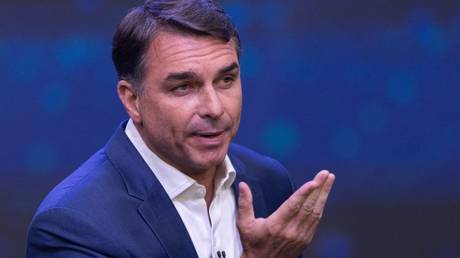
When a prominent Brazilian political figure allied with former President Jair Bolsonaro stood on American soil and declared himself the rightful leader of Brazil, mainstream outlets treated it as an isolated viral stunt. They missed the real story. This declaration is not an erratic outburst from a sidelined politician; it is the latest move in a coordinated, multi-year legal and media strategy designed to build a government-in-exile from South Florida. By relocating to the United States, key figures of the Brazilian hard right are attempting to shield themselves from Brazil’s Supreme Federal Court while lobbying Washington for diplomatic and economic intervention against Brasília.
To understand how a self-proclaimed leader of South America’s largest democracy ends up broadcasting from a suburban studio in Florida, you have to look at the mechanics of jurisdictional arbitrage. In Brazil, the legal net surrounding the events of January 8, 2023—when thousands of Bolsonaro supporters stormed the Congress, the Supreme Court, and the presidential palace—has tightened steadily. Supreme Court Justice Alexandre de Moraes has issued sweeping warrants, frozen bank accounts, revoked passports, and banned social media profiles belonging to lawmakers, bloggers, and financial backers accused of orchestrating an attempted coup.
For individuals facing imminent arrest or asset seizure in Brasília, Miami and Orlando offer more than pleasant weather. They offer legal friction.
The Architecture of the Florida Sanctuary
Crossing into the United States changes the legal terrain overnight. Under American law, political speech—even rhetoric that explicitly questions election results or calls for the removal of sitting judges—is heavily protected under the First Amendment. What Brazilian courts classify as anti-democratic acts or threats to the rule of law, American courts generally view as constitutionally protected expression.
This fundamental clash of legal doctrines creates a protective buffer. When Brazilian authorities issue an extradition request or ask U.S. tech companies to deplatform an individual residing in Florida, the request hits a bureaucratic and constitutional wall. Extradition treaties between the United States and Brazil require dual criminality, meaning the alleged offense must be a crime in both countries. Sedition and coup plotting meet that threshold, which is why Brazilian prosecutors frame their indictments around organized criminal conspiracies rather than pure speech. However, proving active operational conspiracy rather than loud political dissent takes years in an American courtroom.
During those years, the exile operates freely. They hold rallies, record podcasts, raise funds through international payment processors, and cultivate ties with sympathetic members of the U.S. Congress. Declaring oneself the "leader of Brazil" from abroad is a calculated performance aimed at two distinct audiences. First, it signals to the domestic base back home that the movement has not surrendered, framing criminal suspects as persecuted statesmen. Second, it pitches a familiar narrative to American conservatives: the story of a socialist regime persecuting its rightful, pro-American opposition.
Borrowing the Venezuelan Playbook
The tactic of claiming executive legitimacy from abroad did not originate in Brazil. It is lifted directly from the Venezuelan opposition playbook, specifically the 2019 recognition of Juan Guaidó as interim president.
In the Venezuelan case, severe electoral irregularities and the collapse of democratic institutions led the first Trump administration and dozens of allied nations to recognize an alternative government. The Brazilian exiles are attempting to copy-paste that diplomatic template onto a radically different political reality.
Brazil is not Venezuela. Its 2022 presidential election, won by Luiz Inácio Lula da Silva by a razor-thin margin of less than two percentage points, was audited by domestic institutions, international observers, and even Brazil’s own military without uncovering evidence of systemic fraud. Furthermore, the transfer of power occurred within established constitutional boundaries, despite the violent riots that followed a week after Lula’s inauguration.
Yet accuracy is secondary to narrative framing in international lobbying. By adopting the language of exile and illegitimate rule, Bolsonaro allies are trying to convince Washington policymakers that Brazil has slipped into authoritarianism. Their goal is not necessarily to install a new president in Brasília tomorrow. Their immediate objective is to trigger Magnitsky Act sanctions against Brazilian Supreme Court justices, restrict U.S. visas for Lula administration officials, and sour trade relations between the two largest economies in the Western Hemisphere.
The Media Ecosystem Keeping the Movement Alive
A leader in exile is irrelevant without a megaphone. Over the past decade, the Brazilian right built one of the most sophisticated digital media networks in the global south, operating largely outside the editorial control of legacy broadcasters like Grupo Globo. When Brazilian courts ordered domestic internet service providers to block access to specific YouTube, Rumble, and X accounts, that ecosystem migrated north.
Operating from the United States allows these content creators and politicians to bypass local takedown orders. While a Brazilian user might need a Virtual Private Network (VPN) to view a restricted broadcast, the servers, production studios, and monetization pipelines remain safely anchored in American jurisdiction.
The financial mechanics are straightforward. Viewers in Brazil and among the diaspora donate via cryptocurrency, international crowdfunding platforms, or U.S.-registered non-profits. These funds pay for legal defense teams, travel expenses to Washington D.C., and high-production video equipment. A viral clip of a politician declaring himself the true leader of Brazil generates millions of views, driving engagement algorithms and keeping the donor base energized. Outrage is the currency, and exile provides an endless supply of it.
Why Washington Listens—And Where It Draws the Line
To understand why these claims gain traction in the United States, consider the shifting alliances in American foreign policy. For decades, U.S. policy toward Latin America prioritized institutional stability and bilateral trade, regardless of whether Brasília was governed by the center-left or the center-right. That consensus has fractured.
Foreign policy in Washington has become deeply ideological and personalized. Certain factions within the Republican Party view Jair Bolsonaro and his inner circle not merely as foreign counterparts, but as domestic political allies fighting the exact same cultural and institutional battles against courts, media, and left-wing coalitions. When a Brazilian lawmaker or commentator arrives on Capitol Hill claiming to be a victim of judicial tyranny, they find open doors, committee hearings, and sympathetic press coverage.
However, enthusiasm on the political fringes does not automatically translate into official State Department policy. The United States maintains massive economic, agricultural, and security interests in Brazil. From critical mineral supply chains to Amazonian climate agreements and regional security cooperation, Washington needs a functional working relationship with whoever occupies the Palácio do Planalto.
Recognizing a self-declared shadow leader in Florida would sever diplomatic ties with South America’s geopolitical heavyweight, pushing Brasília further into the economic orbit of Beijing. Even the most ideologically aligned U.S. administrations have historically hesitated to blow up bilateral trade over symbolic solidarity, unless the target country is already an economic pariah like Caracas.
The Domestic Backfire in Brasília
While the exile strategy plays well on social media and in conservative conference halls in Florida, its effectiveness inside Brazil is far more complicated. Politics, at its core, requires physical presence.
By fleeing the country to avoid legal accountability, prominent figures inadvertently surrender the domestic political field to their rivals. In Brazil’s congressional chambers and municipal elections, power is negotiated face-to-face through budget allocations, coalition building, and local patronage. A leader broadcasting from Orlando cannot whip votes in the Chamber of Deputies or negotiate infrastructure funds for mayors in the Brazilian interior.
More importantly, the optics of exile alienate moderate voters. Hardcore supporters view self-exile as a tactical retreat in the face of persecution. Swing voters—the exact demographic that decided the 2022 election—often view it as an admission of guilt and an abandonment of the country. Even within the broader Brazilian conservative movement, fractures have emerged between those who want to fight within the system to win the next municipal and presidential cycles, and the exiles who favor scorched-earth rhetoric from abroad.
The Real Stakes of the Shadow Presidency
Dismissing a viral video of a self-declared leader as mere political theater ignores how modern influence campaigns work. The individuals orchestrating this movement from Florida know they cannot walk into Brasília and assume power tomorrow. They are playing a longer, more asymmetric game.
By establishing a permanent outpost in the United States, they have created an offshore sanctuary that complicates Brazilian judicial enforcement, internationalizes a domestic legal crisis, and turns U.S. political polarization into a shield against prosecution. Every time a Brazilian judge issues a warrant against a figure residing in Florida, the exiles use it as proof of authoritarian overreach to lobby American lawmakers for sanctions. Every time an American politician condemns Brazil’s judiciary, the exiles broadcast that clip back home to delegitimize the current government.
It is a feedback loop designed to erode institutional trust from the outside in. Until Washington and Brasília establish clearer bilateral protocols on digital jurisdiction and political asylum, South Florida will remain the unofficial capital of the Brazilian opposition.