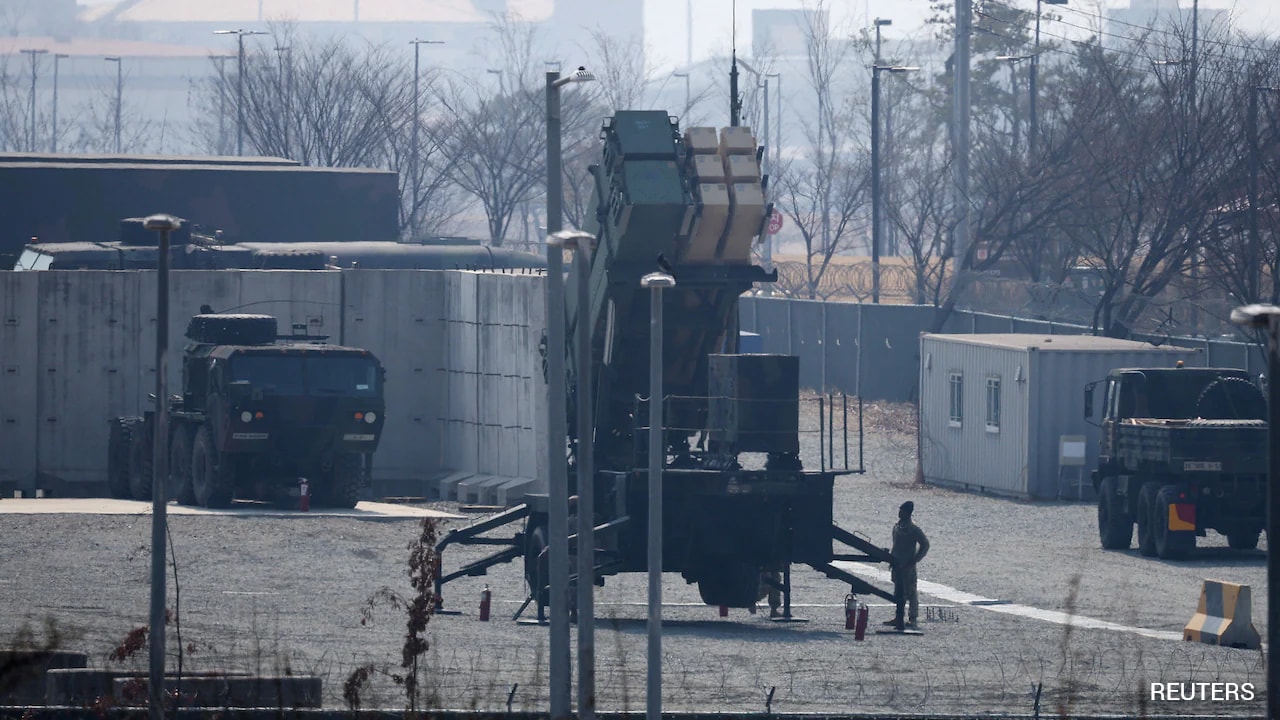
Running out of Patriot interceptors is a crisis. Claiming that the shortage itself explains why missiles are getting through is lazy analysis.
Every time a headline screams that Ukraine is out of US-made Patriot interceptors amid heavier Russian attacks, the conventional commentary follows the same tired script. Washington is stingy. Allies are dragging their feet. Factories are too slow. If only a few hundred more PAC-3 Missile Segment Enhancement (MSE) interceptors showed up on a cargo plane tomorrow, the skies over Kyiv and the energy grid would suddenly be safe.
That story is comforting because it gives pundits a neat villain and a simple shopping list. It is also fundamentally wrong about how modern air defense economics and missile warfare actually work.
You do not lose a ballistic and cruise missile war merely because a high-end point-defense magazine runs low. You lose it when you try to fight an industrial-volume attrition war with boutique, multi-million-dollar hit-to-kill interceptors while leaving the shooter, the launch site, and the cheap decoys untouched.
The Lazy Consensus Around Interceptor Scarcity
The standard take treats the Patriot interceptor shortage as the root cause of recent strike waves rather than a symptom of a deeper structural mismatch. When reports surface that stocks of Patriot missiles have dipped to single digits or near-zero ahead of heavy attacks, the immediate reflex is to demand emergency transfers from allied stockpiles or faster foreign military sales.
Even when Washington approves a massive package—such as the State Department determination in late October 2026 for a potential $2.1 billion sale of up to 500 PAC-3 MSE interceptors—the headline looks like salvation until you read the fine print. Approvals do not bend physics or build clean rooms overnight. New-build interceptors tied to multi-year backlogs and global demand do not materialize in time for this winter's heating season.
Worse, the "we just need more Patriots" narrative encourages a dangerous form of wishful thinking: the belief that defensive interceptors can scale linearly to match offensive salvos. They cannot. A single PAC-3 MSE interceptor costs roughly $4 million domestically and often $6 million or more in export terms depending on the contract structure. Firing two interceptors per incoming ballistic threat—standard doctrine when probability of kill is not 100%—burns through eight to twelve million dollars in a matter of seconds.
Compare that cost curve against monthly ballistic missile production estimates that have reached well over a hundred units per month, alongside waves of drones and maneuvering munitions. Even an order of roughly 315 PAC-3 MSE missiles can represent a huge slice of annual global output. Math is unforgiving. You cannot win an exchange-ratio contest when your ammunition costs millions per shot, takes years to ramp up, and is pulled in multiple directions across global theaters.
What Patriot Actually Is—and What It Isn't
Before arguing over who owns enough interceptors, we need to be precise about what the MIM-104 Patriot system actually does. Too many commentators talk about Patriot as if it were an umbrella over an entire country.
It is not. Patriot is a high-value, mobile surface-to-air and anti-ballistic missile system designed to defend specific, high-priority nodes—major cities, command centers, critical infrastructure—against demanding threats like tactical ballistic missiles. Older PAC-2 variants rely on blast-fragmentation warheads, while PAC-3 and PAC-3 MSE use hit-to-kill kinetic energy to destroy maneuvering ballistic threats at higher altitudes and ranges.
Having spent years working alongside defense planners, procurement specialists, and logistics analysts on missile defense architectures, I have watched organizations and governments repeatedly fall into the same trap: treating a precision scalpel like a broadsword. I have seen defense budgets and diplomatic capital burned chasing scarce, ultra-expensive interceptors while neglecting sensor integration, layered shorter-range tiers, and deep-strike suppression. When a system that excels at stopping a maneuvering ballistic missile is forced to carry the burden of constant saturation attacks, two bad things happen at once. First, you empty expensive launchers against targets that should have been handled—or prevented—differently. Second, every interceptor fired is one less available when a genuine, high-speed ballistic threat arrives.
There is also a diplomatic illusion worth dismantling. Allies holding Patriot batteries and interceptors—whether in the United States or across Europe—are not simply hoarding them out of spite. Many face their own readiness requirements, competing regional contingencies, and thin domestic reserves. Pretending that political goodwill alone can conjure hundreds of ready-to-fire PAC-3 MSE missiles out of thin air ignores industrial reality.
Imagine a Different Air Defense Equation
Imagine a scenario where a defender has 40 Patriot interceptors on hand and faces a coordinated strike package of 20 ballistic missiles, 30 cruise missiles or fast jet-powered drones, and dozens of cheaper decoys aimed at energy infrastructure.
Under the lazy consensus, the only variable that matters is whether the defender gets 40 more Patriot interceptors before midnight.
Now shift the lens. Even if the defender magically received 40 more interceptors, firing two per ballistic threat alone would eat up all 40 in a single wave—leaving nothing for the next salvo a week later. Meanwhile, the launcher trucks that fired those missiles remain intact, the factories building the next batch keep humming, and the defender's radar crew faces the grim calculus of deciding which substation, bridge, or district gets protected and which goes dark.
The real bottleneck in that scenario is not merely a missing crate of missiles. It is an architecture forced to fight purely on the defensive inside its own airspace, trading scarce high-end interceptors against repeatable strikes.
The Questions People Keep Asking—and Why They Miss the Point
Why is Ukraine running out of Patriot interceptors when allies keep pledging support?
Because diplomatic pledges and actual hardware on the ground live on two different clocks. A political communiqué or a multi-billion-dollar foreign military sale approval signals intent, not immediate combat stock. Global demand for Patriot interceptors is high, production lines take time to expand, and existing stockpiles across allied nations are finite. When delivery rates drop while launch rates rise, depletion is arithmetic, not a mystery.
Should Western allies simply transfer more Patriot missiles from their own stockpiles?
Where spare inventory exists without crippling a critical ally's own deterrence, transferring interceptors buys breathing room. Treating that as a complete solution, however, is a dead end. You cannot strip every allied magazine bare and expect a slow-moving industrial base to refill everyone at once. Stockpile transfers are a bridge, not a destination.
Does a Patriot shortage mean air defense is pointless without massive US deliveries?
No—and that fatalism is just as flawed as the "magic missile" myth. Effective air and missile defense is a layered system, not a single platform. Shorter-range systems, interceptor drones, electronic warfare, dispersed energy assets, and hardened shelters all play distinct roles depending on the threat profile. Patriot is irreplaceable for specific high-end ballistic engagements, not for every object flying through the sky.
Can domestic or European production replace Patriot anytime soon?
Not on a short timeline. Joint initiatives, co-production talks, and new European air- and missile-defense programs are important strategic steps toward long-term industrial autonomy and supply resilience. Building an integrated anti-ballistic missile capability—complete with sensors, command-and-control, guidance, and proven interceptors—takes years of testing and qualification. Anyone claiming a brand-new alternative will solve this winter's shortage is selling fiction.
Where My Contrarian Argument Has Teeth—and Where It Can Backfire
Let's be honest about the risks of pushing back against the "get more Patriots" orthodoxy.
First, downplaying the interceptor shortage can easily be twisted by bad-faith actors into an excuse to abandon air defense support altogether. That would be a blunder. A shortage of PAC-3 MSE interceptors is real, and running low degrades protection against the exact ballistic threats that cause severe destruction. Arguing that interceptors are not a silver bullet is not the same as saying they do not matter.
Second, shifting emphasis toward counter-battery or deep-strike suppression brings its own escalatory, intelligence, and operational hurdles. Finding mobile launchers, penetrating air defenses, and maintaining persistent targeting data across hundreds of kilometers is hard, risky work—and it does not stop a missile that has already left the rail.
Third, spreading limited resources across too many experimental fixes can dilute focus. Sometimes the unglamorous work of keeping existing batteries supplied, maintained, and tactically disciplined is what prevents catastrophic failure during a peak wave.
What Actually Works Instead of Chasing Silver Bullets
If you want to stop losing the cost and attrition war, stop treating the interceptor magazine as the whole strategy. Four shifts matter far more than another round of wishful headlines:
- Prioritize the source, not just the shot. Every interceptor you fire is a symptom of a launcher that was allowed to fire. Intelligence, targeting permissions, and long-range strike capabilities that threaten launch sites, logistics hubs, and production nodes attack the attacker's volume at the source.
- Match the interceptor to the threat—ruthlessly. Save high-cost, high-capability interceptors like PAC-3 MSE for targets and trajectories that genuinely require them. Burning top-tier missiles on low-cost or marginal targets is strategic self-sabotage.
- Invest in scalable, lower-cost layers and resilience. Pair high-end point defense with cheaper interceptors, mobile air-defense gun/missile systems, passive hardening, and decentralized grid architecture so a single hit does not cascade into a systemic collapse.
- Fix industrial throughput and contracting speed. Multi-year demand signals, standardized procurement terms, and expanded propellant and seeker capacity matter far more than one-off announcements. You cannot surge a factory floor with press releases.
The headline says Ukraine is out of Patriot interceptors. The real story is that any military relying on scarce, multi-million-dollar interceptors to win an industrial missile war has already let the opponent set the terms of engagement.