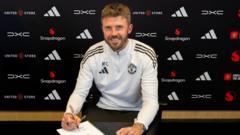
The waiting is finally over. Manchester United have stopped chasing big-name managers with massive egos and opted for tactical clarity. Michael Carrick is officially the permanent boss at Old Trafford.
It is the right move. For years, the club chased short-term fixes. They hired proven winners who didn't fit the club's DNA, and they paid the price with disjointed squads and toxic dressing rooms. Carrick offers something completely different. He knows the club inside out, understands modern tactical trends, and has earned this shot through brilliant results during his interim spell.
This isn't a romantic appointment based solely on his playing days under Sir Alex Ferguson. It's a calculated decision by the new sporting hierarchy. Carrick has shown a tactical flexibility and a calm leadership style that modern players respect. He doesn't panic. He doesn't blast his players in the press. He just wins football matches.
The tactical shift that secured Michael Carrick the Manchester United job
You can't survive at Old Trafford on vibes alone. Ole Gunnar Solskjaer found that out the hard way. Carrick succeeded because he brought immediate tactical structure to a team that looked completely lost.
During his interim period, Carrick abandoned the rigid formations that made United predictable. Instead, he implemented a fluid system that shifts depending on who has the ball.
- The 3-2-4-1 possession structure: When building from the back, one fullback tucks inside to form a double pivot, mimicking the systems used by Pep Guardiola and Mikel Arteta.
- Aggressive counter-pressing: United no longer drop into a low block against top opposition. They press in hunting packs, forcing turnovers high up the pitch.
- Restructured midfield roles: He unlocked the attacking potential of the central midfielders by giving them the freedom to make underlapping runs into the penalty box.
It's a modern approach. Fans saw glimpses of this during his time at Middlesbrough, where he took a struggling Championship side and turned them into one of the most watchable, high-scoring teams in the country. He proved that his philosophy scales up to the highest level during his unbeaten caretaker stint, which included crucial European victories and a tactical masterclass against Chelsea.
Rebuilding the broken culture from the inside
Tactics matter, but managing the Manchester United dressing room is a psychological minefield. We've seen world-class managers like Louis van Gaal and Jose Mourinho alienate squads with their heavy-handed approaches. Carrick is different. He belongs to the modern school of man-management.
He spent over a decade in that exact dressing room. He won five Premier League titles and a Champions League trophy. When he speaks, the players listen because he's been there and done it.
Insiders at Carrington report that Carrick's biggest impact has been on individual confidence. He doesn't overcomplicate his instructions. He talks to players like adults, explaining the "why" behind every drill and tactical tweak. Young players are thriving under him because he gives them clear boundaries but total creative freedom on the pitch.
Addressing the skeptics who wanted a bigger name
Every managerial appointment comes with risk. The critics will tell you that Carrick lacks elite-level experience. They'll say United should have gone for a flashy continental manager with a cabinet full of European trophies.
That argument ignores recent history. Flashy names brought United their worst post-Ferguson finishes. Thomas Tuchel, Mauricio Pochettino, and Antonio Conte were all linked with this job at various points over the last few years. None of them possessed the deep understanding of United's institutional expectations that Carrick has.
Look at Real Madrid with Zinedine Zidane, or Barcelona with Pep Guardiola. Sometimes the best man for the job is the one who already knows where the light switches are. Carrick isn't an apprentice anymore. He's a fully formed coach who has done his time in the lower leagues, studied under elite managers, and developed his own distinct footballing identity.
The immediate transfer priorities for the summer window
Carrick has the job. Now he needs the tools. The current squad is talented but terribly unbalanced, built by three different managers with completely conflicting philosophies.
To make this system work permanently, the recruitment team must deliver on three specific profiles this summer.
First, a genuine holding midfielder who can shield the back four alone. Carrick's system relies on fluid movement ahead of the ball, which means the defensive anchor must possess elite positional discipline and a passing range that can break opposition lines.
Second, a dynamic, ball-playing center-back. If United are going to play a high defensive line and dominate possession, they need defenders who don't panic under pressure and can sprint back to cover space when a counter-attack happens.
Finally, a clinical right-sided forward. For too long, United's attack has been heavily skewed to the left flank, making them easy to defend against. Carrick needs a winger who can stretch the pitch and provide natural balance to the frontline.
The club must move quickly. Pre-season is where tactical ideas are cemented, and Carrick needs his new signings through the door before the squad jets off on tour. The time for dithering in the transfer market is officially over.