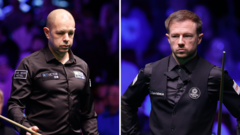
Jack Lisowski just did the near-impossible. He didn't just beat John Higgins to reach the Welsh Open final; he dismantled a man often called the "God of Snooker" in his own backyard. If you've followed Lisowski’s career, you know the script by now. He’s the most talented player never to win a ranking title. He’s the guy who makes the game look like modern art until the pressure mounts. But something felt different in this 6-4 semifinal victory. This wasn't just a flurry of flashy pots. It was a gritty, calculated statement of intent.
The snooker world has waited years for Jack to stop being the "next big thing" and start being a champion. Facing Higgins, a four-time World Champion who treats the Welsh Open like his personal playground, is usually where the Lisowski flair hits a brick wall. Not this time. By setting up a final clash with Barry Hawkins, Lisowski hasn't just earned a shot at a trophy. He’s earned the right to be taken seriously as a closer.
Standing up to the tactical mastery of John Higgins
Beating John Higgins in a long-format match requires more than just potting skill. You have to outthink a genius. Higgins is the ultimate tactical grinder, the type of player who can suffocate an opponent’s rhythm until they start making "boredom" errors.
Early in the match, it looked like Higgins might do exactly that. The Scotsman has a way of making the table feel small. However, Lisowski showed a level of patience that's often been missing from his game. Instead of taking on 30-70 recovery shots, he played the safety game. He waited. When the openings came, he didn't just nibble at them; he devoured them.
His break-building was, as usual, world-class. But the real story was the way he handled the tenth frame. Leading 5-4, the "old" Jack might have twitched. He might have over-screwed a red or lost the cue ball in the baulk colors. Instead, he stayed composed under the lights in Llandudno. He closed the door on a legend. That takes a specific kind of mental toughness that many critics—myself included—weren't sure he possessed.
The Barry Hawkins hurdle and the weight of six lost finals
Now comes the hard part. Reaching the final is a feat, but for Lisowski, it’s also a trigger for some pretty painful memories. He’s been here six times before in ranking events. Six times he’s walked away with the runner-up check.
Barry Hawkins is not an easy opponent to break that streak against. Hawkins, known as "The Hawk," is one of the most consistent professionals on the circuit. He doesn't have the flamboyant ceiling that Lisowski has, but his floor is incredibly high. He rarely beats himself. For Lisowski to win, he has to maintain the tactical discipline he showed against Higgins while letting his natural scoring flow.
- Lisowski's Final Record: 0 wins, 6 losses.
- The Psychological Gap: The difference between a "great player" and a "winner" is often just one frame of confidence.
- The Hawkins Factor: Barry has the experience of winning big titles and won't be intimidated by Jack's speed.
Most people get Lisowski wrong. They think he needs to "slow down" to win. I disagree. He needs to trust his instinct but sharpen his shot selection. In the semifinal, he didn't play slowly; he played smartly. There's a massive difference.
Why the Welsh Open crown matters for the seasons ahead
Winning in Wales isn't just about the Ray Reardon Trophy or the £80,000 top prize. It’s about the hierarchy of the sport. We’re currently seeing a shift in snooker. The "Class of 92" (O'Sullivan, Higgins, Williams) are still winning, but the door is creaking open for the middle-generation players to take over.
If Lisowski wins this, the "best player never to win a title" monkey is off his back forever. You only have to look at players like Mark Allen or Judd Trump to see what happens once that first major dam breaks. The floodgates usually open.
The crowd at the Venue Cymru clearly wants to see the underdog come through. Jack is arguably the most watchable player in the game today. His cue power is frightening. His ability to spin the white ball around three cushions to land perfectly on a color is something very few players can replicate. When he's "on," he's untouchable. The question has always been whether he can stay "on" for two sessions in a high-stakes final.
What to watch for in the final session
The final against Hawkins will likely be a game of tempos. Hawkins will want to keep things methodical. He’ll try to tie Jack up in safety battles and hope the younger man grows frustrated. Lisowski needs to keep the game "open."
Watch the long potting percentages in the first four frames. If Jack hits over 90%, he’ll breeze it. If he drops to the 70s, Hawkins will grind him down. It’s that simple.
You should also keep an eye on the safety exchanges. In the past, Jack would play a loose safety and give away a cheap chance. Against Higgins, his safety was tight, leaving the "God" of the game with nothing but scraps. If that version of Lisowski shows up against Hawkins, the six-final losing streak ends tonight.
Stop worrying about the flashy trick shots. Watch the way Jack places the lead ball. Watch his body language when he misses a tough red. If he stays level-headed, we're witnessing the birth of a new champion.
Get to a screen and watch this final. It’s not just a game of snooker; it’s a career-defining moment for a player who has spent far too long in the shadows of the greats. Jack Lisowski has outplayed a god. Now he just has to outplay his own history.