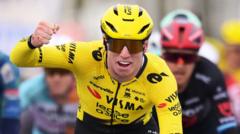
The narrative arc of professional cycling often relies on the passing of a torch, but what happened on the roads of Belgium this week was less a handoff and more a hostile takeover by the next generation. Matthew Brennan’s victory in the GP Denain and his subsequent dominance in the Belgian circuit races isn't just another win for a British rider. It is the tactical validation of a development system that has moved beyond the "marginal gains" era into a period of raw, calculated aggression. By mirroring the winning patterns of Mark Cavendish while operating within the hyper-modern framework of Team Visma-Lease a Bike, Brennan is proving that the drought of British sprinting talent was merely a transition period.
The Belgian Proving Ground
Belgium serves as the sport’s most honest judge. It does not care about your pedigree or your power-to-weight ratio if you cannot handle the crosswinds and the frantic positioning battles of the final five kilometers. When Brennan crossed the line, he wasn’t just faster than the field; he was more composed.
This victory comes at a time when the cycling world is obsessed with multi-disciplinary stars. However, Brennan represents a return to the specialist’s craft, albeit with a modern engine. The race was defined by a series of late attacks that threatened to derail the sprinters' teams, yet Brennan’s positioning remained clinical. He stayed shielded until the exact moment the resistance broke. This wasn't luck. It was the result of a developmental pipeline that prioritizes race intelligence over mere physiological data.
Cracking the Development Code
For years, the British cycling scene struggled to produce a direct successor to Cavendish. There were plenty of fast finishers, but few possessed the spatial awareness required to survive the "washing machine" effect of a Belgian peloton. The difference now lies in the scouting and recruitment strategies of top-tier European squads.
Visma-Lease a Bike didn't sign Brennan by accident. They identified a rider who could maintain high torque under extreme fatigue—a specific physiological trait that separates a good amateur from a professional winner. While many teams focus on a rider’s 20-minute power, the Belgian races are won in the 20-second bursts that occur after four hours of relentless pounding.
The Cavendish Blueprint
Comparing any young rider to Mark Cavendish is usually a recipe for unfair pressure. In this case, the technical similarities are too glaring to ignore.
- Low Aerodynamic Profile: Brennan manages to keep his torso significantly lower than his rivals during the maximum effort phase.
- Late Deployment: Like Cavendish in his prime, Brennan trusts his kick enough to wait, refusing to catch the wind a second too early.
- Navigational Instinct: He finds gaps that don't appear to exist, moving through the bunch with a fluidity that suggests he sees the race three steps ahead.
These traits are often described as "instinct," but in the modern era, they are drilled. The British youth systems have shifted their focus toward technical crits and track endurance, which builds the precise bike-handling skills Brennan utilized to navigate the narrow, rain-slicked sectors of the Belgian course.
The Institutional Shift
The success of Brennan highlights a growing divide in how professional teams manage talent. On one side, you have the traditionalists who believe in a slow burn. On the other, you have the "Total Cycling" approach seen at Visma and UAE Team Emirates, where age is irrelevant if the metrics and the results align.
Brennan’s integration into the senior ranks has been accelerated because the gap between the U23 level and the ProTour has narrowed. The training loads for teenagers now mirror what was expected of seasoned veterans a decade ago. This creates a "plug-and-play" athlete. When Brennan stepped up to compete against established pros in Belgium, he didn't look like a guest. He looked like the foreman.
The Cost of Excellence
We must acknowledge the grueling reality of this path. To produce a winner like Brennan, dozens of other talented riders are pushed to their breaking points. The intensity of the current development cycle means that by the time a rider hits twenty-one, they have already faced the pressure of a seasoned professional.
This leads to an uncomfortable question for the sport: Is the shelf life of the modern cyclist shrinking? If you can win at nineteen, will you still have the mental fortitude to fight for position in a gutter in your thirties? For now, the British fans don't seem to care. They have a winner, and he’s winning in the hardest way possible.
Why the Sprint Matters Again
For a few seasons, the "pure" sprint finish seemed to be dying. Course designers were adding more climbs to prevent the predictable bunch finishes of the early 2010s. Yet, races like the GP Denain prove that the sprint is evolving rather than disappearing.
Brennan’s victory was not a simple drag race on a wide motorway. It was a chaotic, technical scramble that required him to absorb multiple surges before the final bend. The "new" sprint is a test of durability. The winner isn't necessarily the person with the highest peak wattage, but the person who lost the least amount of energy getting to the red flame.
The Logistics of the Win
The final kilometer in Belgium is a masterpiece of controlled violence.
- The Squeeze: The road narrows, forcing the lead-out trains to overlap.
- The Hesitation: A gap opens on the left as a rival rider bails out.
- The Committal: Brennan recognizes the stall and launches his move before his lead-out man is even done.
This level of decisiveness is what separates Brennan from the "forever-prospects." He doesn't wait for the perfect lead-out because the perfect lead-out rarely exists in the chaos of the classics. He uses the chaos as a tool.
Beyond the Podium
As the dust settles on the Belgian cobbles, the industry's focus shifts to the future. Brennan has secured more than just a trophy; he has secured a seat at the table for the major Classics. The trajectory is clear, but the obstacles are mounting.
The peloton now knows his name. He will no longer be allowed the anonymity that helps a young rider slip through the cracks. From here on, he will be marked. Every move he makes will be shadowed by riders looking to negate his kick. This is where the real career begins—the transition from the hunter to the hunted.
Watch the way he handles the pressure of the upcoming spring calendar. If he continues to ride with this level of tactical arrogance, the British cycling revival won't just be about grand tours anymore. It will be about the brutal, beautiful world of the one-day specialists.
Go find the overhead footage of the final 200 meters. Look at the way Brennan’s bike remains perfectly centered while the riders around him are swaying under the strain. That stability is the mark of a rider who isn't just winning, but is in total control of the environment.