In 1900, a British soldier hunkered down in the red dust of the South African veldt probably wasn't thinking about the stock market. He was likely thinking about his boots, the whistling Mauser rounds of the Boers, or the gnawing emptiness in his stomach. But tucked into his kit was a small, rectangular tin that would eventually become a more stable investment than the very empire he was fighting to defend.
Gold is a classic hedge. Real estate is tangible. But today, the smartest money in the room is looking at a century-old bar of Cadbury’s chocolate.
The story doesn't begin in an auction house. It begins with Queen Victoria. By the turn of the twentieth century, the Boer War was dragging into a grueling, bloody mess. The soldiers were exhausted. To boost morale, the Queen decided to send a personal gift to every one of her "brave soldiers" serving in South Africa: a half-pound tin of vanilla chocolate.
But there was a hitch.
The Moral Dilemma of the Quaker Chocolatiers
The three primary chocolate manufacturers of the era—Cadbury, Fry, and Rowntree—were owned by Quakers. They were pacifists. To them, the war in South Africa was an unnecessary tragedy, and they wanted no part in profiting from it. They initially refused the commission.
The Queen, however, was not a woman accustomed to the word "no." A compromise was reached. The companies would supply the chocolate at cost, and to distance themselves from the "war effort," they refused to put their branding on the tins. They wanted the chocolate to be anonymous.
The Queen insisted otherwise. She wanted the boys to know they were eating the best. Eventually, the branding stayed, and the tins were produced, featuring the Queen's regal profile and her own handwriting embossed on the lid: "I wish you a happy New Year."
For the soldier on the ground, this wasn't just a snack. It was a piece of home. It was a luxury in a land of dry biscuits and salted beef. Many soldiers, moved by the gesture or perhaps simply too sentimental to eat a gift from their sovereign, tucked the tins away. They survived the trenches. They survived the voyage back across the Atlantic. They survived the Blitz in the 1940s, sitting quietly in the back of dresser drawers and attic trunks.
The Chemistry of Survival
You might wonder why a piece of chocolate from 1900 hasn't turned into a puddle of goo or a toxic petri dish. The answer lies in the Victorian approach to preservation. This wasn't the air-whipped, milk-heavy confection we grab at the grocery store checkout today.
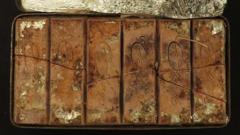
Victorian chocolate was dense. It was high in cocoa solids and low in moisture. Encased in a hermetically sealed tin, protected from light and air, the chocolate underwent a slow metamorphosis. Over 126 years, the fats migrate to the surface—a process called "blooming"—giving the bar a white, dusty appearance. It looks like chalk. It smells like a dusty library.
But it is still, remarkably, chocolate.
When one of these tins recently surfaced for sale, the collectors didn't see a snack. They saw a time capsule. The estimate for such a find is now climbing into the thousands of dollars. We are witnessing the birth of a new kind of "brown gold."
The Invisible Stakes of Sentiment
Why would someone pay $3,000 for a bar of chocolate they can never eat?
Consider the hypothetical case of Private Arthur Penhaligon. He is nineteen. He has never been further than five miles from his village in Devon until he is shipped to a scorched landscape half a world away. He receives his tin in January 1900. He opens it, smells the vanilla—a scent from a world that makes sense—and decides he will save it for the day he gets home.
He makes it back. The tin sits on his mantel. His children are told not to touch it. His grandchildren find it after he passes. By the time it reaches an auction block in 2026, that tin is no longer just sugar and cocoa. It is a vessel for Arthur’s restraint, his fear, and his survival.
The value isn't in the ingredients. The value is in the "provenance of the soul."
In a world where digital assets vanish with a server crash and paper money fluctuates at the whim of a central bank, there is a profound, primal security in holding an object that survived a war. The tin is dented. The enamel is chipped. But the seal is unbroken.
The Market of the Tangible
We are currently living through a pivot in how we perceive value. For the last decade, we were told the future was ethereal—NFTs, crypto, and digital shadows. But lately, the pendulum is swinging back toward the dirt and the iron.
Collectors are hunting for things that have weight.
A Boer War chocolate tin is the ultimate "robust" asset because it represents a finite supply. They aren't making any more 1900-dated Queen Victoria gifts. Every tin that is opened by a curious child or lost in a house fire makes the remaining ones exponentially more precious.
It’s a strange irony. The Quaker families who didn't want to profit from the war have unintentionally created one of the most profitable war relics in history.
If you happen to be cleaning out an elderly relative's estate and you find a small, maroon-colored tin with a faded gold portrait of an old woman, don't throw it away. Don't try to pry it open to see if it still tastes like Cadbury’s. You are holding a piece of frozen time.
The chocolate inside is bitter now. It’s dry. It’s brittle. But the story it tells is the sweetest thing in the room.
In the end, we don't buy the chocolate. We buy the fact that against all odds, in a century of fire and change, something small and fragile managed to stay whole. We buy the endurance. We buy the tiny, tinned proof that even in the middle of a desert war, someone thought a soldier deserved a moment of sweetness.
Arthur Penhaligon is long gone. The Queen is a memory. The Empire has folded. But the chocolate remains, waiting in the dark, held together by nothing more than a Victorian seal and the stubborn refusal of history to let go.