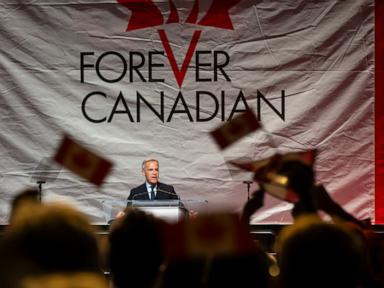
When Prime Minister Mark Carney stood before a pro-Canada rally in Edmonton in mid-October 2026, his final appeal against Alberta separation wasn't just a routine campaign stop. It was a high-stakes stress test for a federation already rattled by cross-border tariffs and foreign meddling.
Voters went to the polls days later on October 19, 2026, deciding whether Alberta should remain a Canadian province or start the formal constitutional process toward a binding referendum on leaving. Polling pointed toward a clear federalist victory, and preliminary results showed roughly 76% of voters rejected taking that first step toward separation. Yet surface calm often hides deeper fractures. A landslide vote to stay put did not erase decades of western grievance, nor did it silence activists who treat constitutional agitation as a permanent pressure valve.
Watch the mechanics of that October push closely and you see why Carney spoke with such urgency. He had grown up in Edmonton, rooted in the exact western soil where Ottawa's rules are routinely treated like an outside tax. Still, hometown credentials cannot override cold math. Alberta holds roughly five million people compared to roughly 16 million in Ontario and nine million in Quebec, a population gap that leaves western voters perpetually outnumbered in federal elections.
Why a Procedural Vote Felt Like a Crisis
On paper, the October 2026 ballot wasn't even a final exit vote. It asked whether Alberta should remain part of Canada or initiate the legal steps required under the Canadian Constitution to pursue a future binding referendum on separation.
Polls consistently showed strong majorities favoring staying in Canada. So why did Carney treat the vote like an existential alarm bell rather than a formality?
Because referendum politics rarely turn on final divorce papers alone. Organizers and political strategists often use preliminary ballots to measure momentum, build donor lists, and test how far frustration can be pushed. Even a soft "yes" share—say, thirty percent—gives separatist leaders a megaphone to claim the status quo is cracking.
Carney went straight at that temptation. Speaking in Calgary and Edmonton, he warned voters not to treat the ballot as a protest chip or a bluff against Ottawa. Once a province starts pulling at constitutional threads, capital gets nervous, negotiations drag out for years, and commercial certainty evaporates.
A vote against Canada is a dangerous bluff that will lead to years of deep uncertainty and lost opportunities for Albertans and Canadians.
That warning carried extra weight because the referendum followed a massive citizen petition drive—more than 400,000 verified signatures collected by Thomas Lukaszuk and his allies—pushing back against secession and forcing the question onto the public stage. What began as fringe agitation had hardened into a formal test of loyalty.
Oil, Representation, and Western Grievance
To understand why Alberta separation keeps resurfacing even when polls say most residents want to stay, look at the economic engine driving the province. Mining, quarrying, and oil and gas extraction accounted for roughly a quarter of Alberta's GDP in 2025. When federal climate rules or pipeline disputes slow resource development, the friction hits paychecks, municipal budgets, and local pride all at once.
Years of Liberal rule in Ottawa compounded that anger. Many Albertans argue that policies shaped in eastern population centers penalize Western energy while taxing Western wealth. Even after Carney won the federal election in 2025 and leaned on his Alberta roots, skepticism toward federal authority remained stubbornly high.
The Myth of the Clean Break
Separatist campaigns love clean arithmetic. They add up federal taxes sent out of Alberta, subtract federal transfers coming back in, and argue the province would come out ahead on its own.
Real constitutional exits rarely work like a spreadsheet. Consider a hypothetical example of a mid-sized inland exporter that relies on neighboring jurisdictions for rail corridors, ports, and cross-border pipelines. Even if the exporter has high domestic output, leaving a national union without guaranteed transit treaties can trigger customs delays, regulatory re-licensing, and higher borrowing costs before a single new trade pact is signed.
For a landlocked producer like Alberta, geography is destiny. Pipelines, rail lines, and power grids cross provincial and international borders. Leaving Canada wouldn't magically hand Alberta coastal shipping lanes or automatic access to U.S. markets; it would force complex, years-long negotiations over debt, pensions, Indigenous treaties, currency stability, and infrastructure access.
External Pressures and Strange Bedfellows
Domestic grievances didn't operate in a vacuum ahead of the October 2026 vote. Cross-border trade friction with Washington—including steep U.S. tariffs on select Canadian goods and heated rhetoric from American leadership—had already put Ottawa on edge. Carney argued that foreign actors were watching for internal cracks they could exploit, warning crowds that outsiders were trying to divide the country so they could dominate it.
Researchers tracking information operations also flagged converging narratives from Russian- and American-linked sources aimed at amplifying Alberta unrest as voting neared. High-profile foreign commentary added fuel to the fire, including social media posts from Elon Musk cheering on the idea of Quebec, Alberta, and Saskatchewan separating.
At the same time, domestic politics produced unusual alignment. Premier Danielle Smith shared the stage with Carney in Alberta, pointing to recent shifts in federal-provincial cooperation and infrastructure announcements while opposing the push toward separation. Federal Conservative leader Pierre Poilievre likewise urged Albertans to stay inside Confederation rather than walk away.
| Factor | Federalist Case | Separatist Argument | Practical Reality |
|---|---|---|---|
| Economic scale | Larger national market and shared trade leverage | Retaining more resource revenue locally | High resource share creates boom-bust exposure |
| Political voice | Seat at the federal table and cross-country allies | Escape from central Canadian voting weight | Small population share limits federal control |
| Infrastructure | Integrated national rules and cross-border backing | Direct bargaining power over pipelines and land | Landlocked status makes transit pacts vital |
| Timeline | Immediate stability and predictability | Potential long-term autonomy | Constitutional processes take years of dispute |
Even so, unity speeches don't erase underlying tension. Critics on the federalist side worry that Ottawa still moves too slowly on approvals that matter to Western industry, while separatists insist that a single loss at the ballot box won't stop their organizing.
What Comes After a Seventy-Six Percent No
A roughly 76% rejection of starting the separation process gave Carney and pro-unity campaigners the decisive headline they wanted. It deprived separatists of a mandate and showed that most Albertans weren't ready to gamble their livelihoods on a constitutional leap into the unknown.
Yet political veterans know better than to treat a referendum defeat as a permanent cure. Before the vote, Angus Reid Institute polling found that a solid majority of Albertans—62%—expected the separatist movement to keep grinding on regardless of the outcome. Separatist organizers wasted no time saying they planned to stay active, and with another provincial election approaching in 2027, grievances over energy rules, cost of living, and federal overreach remain ready-made campaign fuel.
Closing the Gap Between Rhetoric and Delivery
Speeches about shared history only go so far if residents feel ignored between elections. For Ottawa, the real work after a unity vote is proving through concrete policy—faster project decisions, predictable rules, and honest dialogue—that staying in Canada delivers tangible results rather than lectures.
For Alberta's leaders and voters, the lesson is equally sharp: protest votes carry real economic costs, and turning frustration into lasting leverage requires smart statecraft inside the federation rather than illusions of an easy exit. Watch how federal ministers handle energy and trade over the coming year, because that is where the next real test of Alberta separation will be decided.