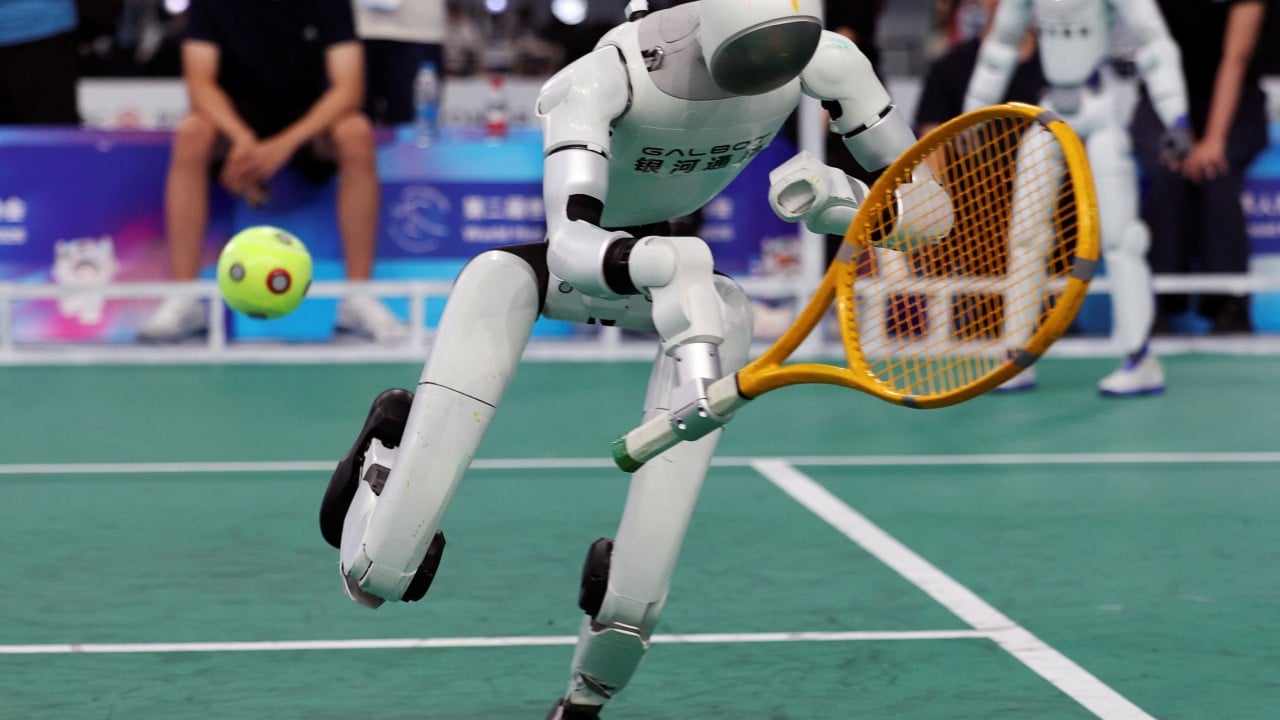
Watch a humanoid robot smack a tennis forecourt or jog down a synthetic track at a showcase event, and the applause practically writes itself. Spectators gasp at the bipedal balance. Tech journalists pen breathless columns about the dawn of general-purpose labor. Corporate boards panic-buy R&D tickets to avoid missing out on the mechanical revolution.
It is all smoke, mirrors, and expensive theater.
I have watched venture syndicates burn nine figures trying to shoehorn two-legged metallic bodies into environments built for wheeled forklifts and stationary arms. The recent wave of humanoid sports competitions and speed trials celebrated at global tech expos does not represent a breakthrough in automation utility. It represents an expensive detour fueled by marketing departments that prefer circus tricks over economic reality.
Stop cheering for robots playing tennis. You are celebrating a solution to a problem that nobody in industry actually has.
The Kinematic Fallacy In Bipedal Design
Nature did not invent bipedalism because it is efficient. Nature invented bipedalism because our primate ancestors needed to keep their hands free while traversing broken terrain and carrying offspring. Bipedal motion is an engineering nightmare. It requires constant micro-corrections, massive energy consumption, high torque density in fragile ankle actuators, and a complex sensory-motor feedback loop just to keep from falling flat on its face.
When a humanoid robot rallies a tennis ball across a net, engineers do not showcase general utility. They showcase a monument to brute-force programming and closed-loop motion capture. Every single joint is tuned for that exact court surface, that exact lighting condition, and that exact ball trajectory.
Change the lighting, swap the tennis ball for a slightly deflated volleyball, or add a three-degree slope to the court floor, and the multi-million dollar athlete turns into a heap of smoking titanium and carbon fiber.
Industry veterans love to pretend that mastering a bipedal tennis swing means the robot is ready to stock grocery shelves or lay bricks on a muddy construction site. That logic holds up only if you know nothing about the physics of real-world labor. Real factories do not need machines that can mimic Roger Federer. They need machines that can lift a four-hundred-pound pallet of drywall sixteen hours a day without overheating, tripping over a stray cable, or requiring a PhD team to reboot its operating system every forty minutes.
Why Sports Arenas Lie To You
Competitive showcases for robots rely on a fundamental trick of perception. They put machines in controlled, predictable environments—flat tracks, marked boundaries, uniform lighting—and measure them against metrics designed for human bodies.
This creates a dangerous feedback loop for capital allocation.
- The Metric Trap: Measuring a robot by how fast it runs a hundred meters ignores the fact that wheeled and tracked rovers do the same job with a fraction of the energy and zero risk of balance failure.
- The Generalist Mirage: Achieving competence in a single scripted sport does not translate to zero-shot generalization in an unpredictable warehouse aisle.
- The Actuator Bottleneck: Human muscles store and release elastic energy efficiently. Electric motors do not. Every sprint test masks severe thermal degradation that would fry commercial gear within a single shift.
I have sat in executive briefing rooms where engineering leads admitted their bipedal prototypes could not run for more than ten minutes without cooling fans screaming at maximum capacity. Yet, the press release went out praising the machine's athletic prowess. The gap between a PR stunt and a commercial deployment is wider than the Grand Canyon, but stock markets keep funding the bridge to nowhere.
The Economics Of Form Factor Fanatidsm
Why do labs keep building humanoids if wheels and quadrupeds are objectively better at ninety percent of physical tasks?
Anthropomorphism. Humans are deeply, irrationally narcissistic. We want our technology to look like us because it validates our ego and makes science fiction scripts feel closer to reality.
If you build a delivery robot that looks like a motorized ice chest on four wheels, nobody writes a viral post about the future of humanity. If you build a metal facsimile of a teenager that can awkwardly shuffle across a stage and pick up a water bottle, you secure another round of venture funding.
The market punishes pragmatism and rewards theater.
Imagine a scenario where a manufacturing plant replaces its assembly line arms with bipedal humanoids just to prove a point about future-proofing. Within a week, floor managers would mutiny. The maintenance overhead alone—calibrating delicate hip joints, replacing stripped harmonic drives after minor slips, managing thermal loads—would bankrupt a mid-sized logistics firm.
Wheeled automated guided vehicles and stationary multi-axis arms dominate modern manufacturing for one brutal reason: they work cheaply, reliably, and quietly in the background. They do not need to play tennis to earn their keep.
What Actually Works In Real Automation
If you want to understand where physical AI is actually winning, look away from the athletic tracks and look toward the dull, unglamorous corners of supply chains.
- Fixed-Base Manipulation: Arms bolted to heavy steel foundations that move payloads at high speeds with repeatable precision.
- Omnidirectional Mobile Bases: Low-profile platforms that slide under shelves, rotate on a dime, and never waste energy fighting gravity to stay upright.
- Task-Specific End Effectors: Grippers designed for irregular shapes, soft objects, or fragile produce, ignoring human hand geometry entirely.
None of these technologies look impressive on a TikTok reel. None of them belong in an exhibition match against a human athlete. But they move trillions of dollars of goods every single day without breaking a sweat or needing a software patch to walk across a carpet.
The obsession with human-shaped machines is a symptom of an industry running out of low-hanging fruit. When algorithmic gains plateau, marketing teams pivot to hardware aesthetics to keep the valuation bubble inflated.
Let the robotics labs play their games. Let them celebrate every clumsy smash shot and scripted sprint record. While they burn capital trying to make a machine look like an Olympic athlete, the rest of the industrial world will keep using wheels, tracks, and stationary arms to quietly eat their lunch.
Stop buying the hype. Utility does not need a face.