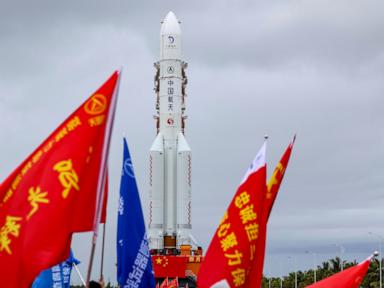
The recent decision by the China Manned Space Agency to defer the uncrewed Chang'e-7 lunar mission exposes the rigid operational bottlenecks governing deep-space exploration. Rather than a simple administrative setback, the postponement highlights the compounding vulnerabilities of attempting high-cadence launches toward the Moon's south pole from low-latitude coastal sites. Deconstructing this delay requires examining three intersecting variables: atmospheric constraints at the launch origin, orbital mechanics governed by lunar topography, and the strict risk thresholds of modern interplanetary architecture.
The Meteorological Cost Function at Wenchang
Operating from the Wenchang Space Launch Site on Hainan Island provides significant payload advantages due to Earth's rotational velocity near the equator, but it exposes heavy-lift vehicles to severe maritime weather systems. The Long March 5 rocket requires tightly controlled wind shear profiles, ground humidity levels, and temperature ranges during propellant loading and liftoff. When regional tropical disturbances or depressions materialize in the Gulf of Tonkin, surface and upper-level atmospheric vectors shift beyond the structural tolerances specified for cryogenic core stages. Read more on a related topic: this related article.
The mechanism of postponement operates through a strict safety protocol. If atmospheric data indicates that launch vehicle structural load limits could be compromised by unexpected gusts or electrical activity during the multi-hour fueling sequence, mission directors face a binary choice. Proceeding violates the baseline engineering margin of safety. Retracting the vehicle to the assembly building preserves hardware integrity but forces a confrontation with orbital mechanics.
The Orbital Mechanics Bottleneck of Polar Destinations
Unlike equatorial or mid-latitude lunar missions, which enjoy wide launch windows spanning multiple weeks each month, polar expeditions operate under severe geometric constraints. Chang'e-7 targets the lunar south pole—specifically the rim and permanently shadowed regions of craters like Shackleton. This destination requires insertion into a precise lunar polar orbit that aligns with the target landing site's illumination and thermal profile. More journalism by TechCrunch highlights related views on this issue.
The relative positions of Earth, the lunar nodal line, and the destination landing site dictate a narrow temporal corridor. The orbital mechanics governing this trajectory mean that missing the primary daily launch opportunity often invalidates the entire multi-day window. If local weather disruptions prevent liftoff within this narrow band, orbital plane alignment drift makes the targeted polar entry energetically unfeasible without prohibitive propellant penalties. Consequently, missing the instantaneous launch window forces a structural reset until the orbital geometry realigns weeks or months later.
Strategic Implications for the Interplanetary Timeline
The postponement of a flagship mission intended to survey water ice and deploy specialized robotic components, including a hopping probe, tests the resilience of national space roadmaps. Both state programs and commercial entities pursuing lunar infrastructure face the same physical constraints: ground systems are bound to terrestrial meteorology, while mission destinations are bound to immutable celestial mechanics.
When environmental factors force a scrub, the secondary economic and logistical impacts ripple across subsequent manifests. Spacecraft subsystems maintained in operational readiness must undergo recertification, propellant storage life limits are tested, and tracking network allocations require rescheduling.
Reset the tracking schedules for deep space communication networks, extend environmental control monitoring for integrated spacecraft stacks currently sitting in vehicle assembly buildings, and re-evaluate launch window availability matrices for subsequent orbital alignment cycles.