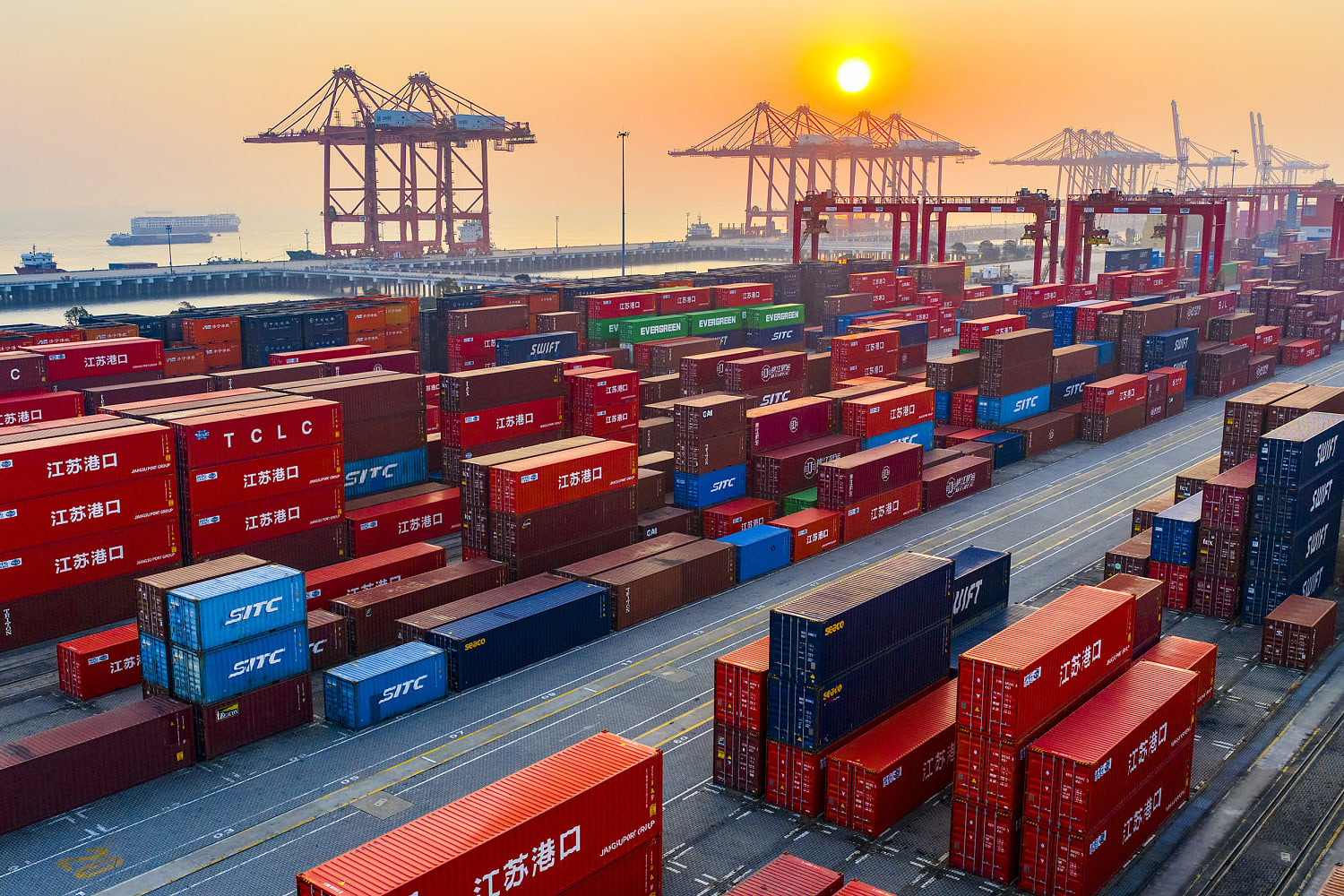
The recent Supreme Court decision regarding the limits of executive power over tariff adjustments has effectively handed a strategic windfall to Chinese exporters. By curbing the flexibility of the U.S. government to broaden trade penalties under Section 232 of the Trade Expansion Act, the judiciary has inadvertently created a predictable, rigid environment for the very foreign competitors it was intended to constrain. For decades, the "national security" loophole allowed Washington to pivot quickly and slap duties on steel, aluminum, and intermediate goods. Now, that pivot is broken.
What the court viewed as a necessary check on executive overreach, the global market views as a green light for supply chain circumvention. When a legal framework becomes static, it becomes exploitable. China’s state-backed industrial complex does not fear high tariffs; it fears the uncertainty of changing ones. By narrowing the window in which the President can modify these duties, the court has provided Beijing with a roadmap for long-term planning that bypasses American barriers with surgical precision.
The High Cost of Judicial Rigidity
Trade wars are won through agility. When the Supreme Court ruled that the executive branch cannot indefinitely expand or modify tariffs beyond a strict statutory timeline, it stripped the U.S. trade representative of their most potent psychological weapon: the threat of the unknown.
Under the previous interpretation, an importer bringing in Chinese components through a third party like Mexico or Vietnam faced the constant risk of an overnight tariff adjustment. That risk acted as a deterrent. Now, the clock is visible to everyone. If the administration fails to act within the precise, narrow windows dictated by the court’s interpretation of Section 232, the opportunity is gone.
This is not a theoretical loss. The immediate impact is felt in the "tariff engineering" sector. Chinese firms are masters of shifting the final 10% of a product's value to a neutral country to escape "Country of Origin" labels. Without the ability for the U.S. to rapidly redefine what constitutes a circumvention, these products flow into the American heartland virtually untouched.
Why Fixed Timelines Favor State Economies
The American economy is a collection of private interests. The Chinese economy is a coordinated machine. This distinction matters when the law imposes strict time limits on government action.
To initiate a tariff expansion, a U.S. agency must now navigate a bureaucratic obstacle course that is easily monitored by foreign lobbyists. While the Department of Commerce spends months or years gathering data to justify a new duty, Chinese manufacturers can amortize their risks. They know the exact date the gate closes. They can flood the market before a ruling or move production lines to Cambodia before the legal ink is dry.
We are seeing the rise of the "permanent workaround." Because the Supreme Court has signaled that the President’s power is not a blank check, foreign entities are now emboldened to challenge every new trade restriction in the Court of International Trade. Each challenge drags on for years. During those years, the tariffs are often stayed or tied up in escrow, allowing the flow of cheap, subsidized goods to continue unabated.
The Myth of the Level Playing Field
Proponents of the ruling argue that it restores the "rule of law" and provides certainty for American businesses. This is a half-truth that ignores the reality of global competition. While a handful of U.S. importers may enjoy lower costs in the short term, the industrial base loses its protective shield.
The rule of law only works when both sides play by the same rules. Beijing does not have a Supreme Court that will strike down an export subsidy because it violates a 1960s-era statute. They operate on a command-and-control basis. By forcing the U.S. into a reactive, slow-motion legal process, the court has effectively disarmed the country in a fast-moving economic conflict.
The Southeast Asian Laundry
The most glaring evidence of this shift is visible in the trade data coming out of the ASEAN bloc. Since the tightening of executive tariff authority, imports from Malaysia, Thailand, and Vietnam into the U.S. have skyrocketed. On paper, these countries are becoming manufacturing powerhouses. In reality, they are often functioning as a massive "laundry" for Chinese raw materials.
Solar panels are the classic example. When the U.S. attempted to crack down on Chinese solar cells, the production simply moved across the border into neighboring nations. Under the new judicial constraints, the U.S. administration is finding it nearly impossible to expand the scope of original tariff orders to include these "new" products. The court requires a level of procedural perfection that is difficult to achieve when a competitor is actively camouflaging its operations.
- Logistical redirection: Goods are shipped in bulk to transshipment hubs.
- Minimal processing: Adding a screw or a label to qualify for a new origin certificate.
- Price dumping: Absorbing the cost of shipping to maintain a dominant market share.
This isn't just about steel or solar. It’s about the entire stack of advanced manufacturing. If the executive branch cannot move at the speed of the market, the U.S. industrial policy is essentially a dead letter.
The Congressional Vacuum
The true culprit in this story isn't just the judiciary; it is a paralyzed Congress. The Supreme Court essentially told the executive branch, "If you want more power to fight trade wars, go ask Congress."
But Congress hasn't passed significant, modernized trade legislation in decades. They have outsourced their responsibility to the White House, and now that the White House has been reined in, there is a vacuum. This vacuum is where American manufacturing goes to die.
Lobbyists for major retailers and tech firms—many of whom rely on cheap Chinese components—are thrilled. They see the ruling as a way to keep their margins high. But for the worker in a domestic foundry or a semiconductor plant, the ruling is a death knell. It means the government is no longer able to defend them against the "sharp power" of a state-led economy that ignores market signals.
Strategic Malpractice in the New Cold War
We are currently in a period of intense geopolitical friction where trade is the primary battlefield. In any other conflict, you wouldn't tell your general that they can only move their troops between the hours of 9:00 AM and 5:00 PM, and only after filing a three-month notice with the enemy. Yet, that is exactly what the legal system has done to U.S. trade policy.
The "winner" of this ruling isn't the American consumer, who will still face inflation driven by other factors. The winner is the Ministry of Commerce in Beijing. They now have the one thing they value most: a predictable adversary. They can see the punches coming from miles away because the law now requires the U.S. to announce exactly where it is going to hit, and when.
The era of the "unpredictable" trade policy is over. In its place is a slow, methodical, and ultimately toothless system of paper-pushing. While Washington patting itself on the back for "restoring constitutional order," the rest of the world is moving on, shipping crates of subsidized goods through the massive holes in the American legal net.
If the goal was to protect the American economy, the strategy has failed. The court has preserved the letter of the law while sacrificing the spirit of national competitiveness. The result is a domestic market that is more vulnerable than ever, facing a rival that doesn't need to win in an American court to win in the global marketplace.
Stop looking at the stock market for a reaction. Look at the shipping manifests in the South China Sea. That is where the real verdict is being delivered.
Audit your supply chain for these legal vulnerabilities now, because the government no longer has the tools to bail out domestic industries when the next wave of "third-country" imports hits the shore.