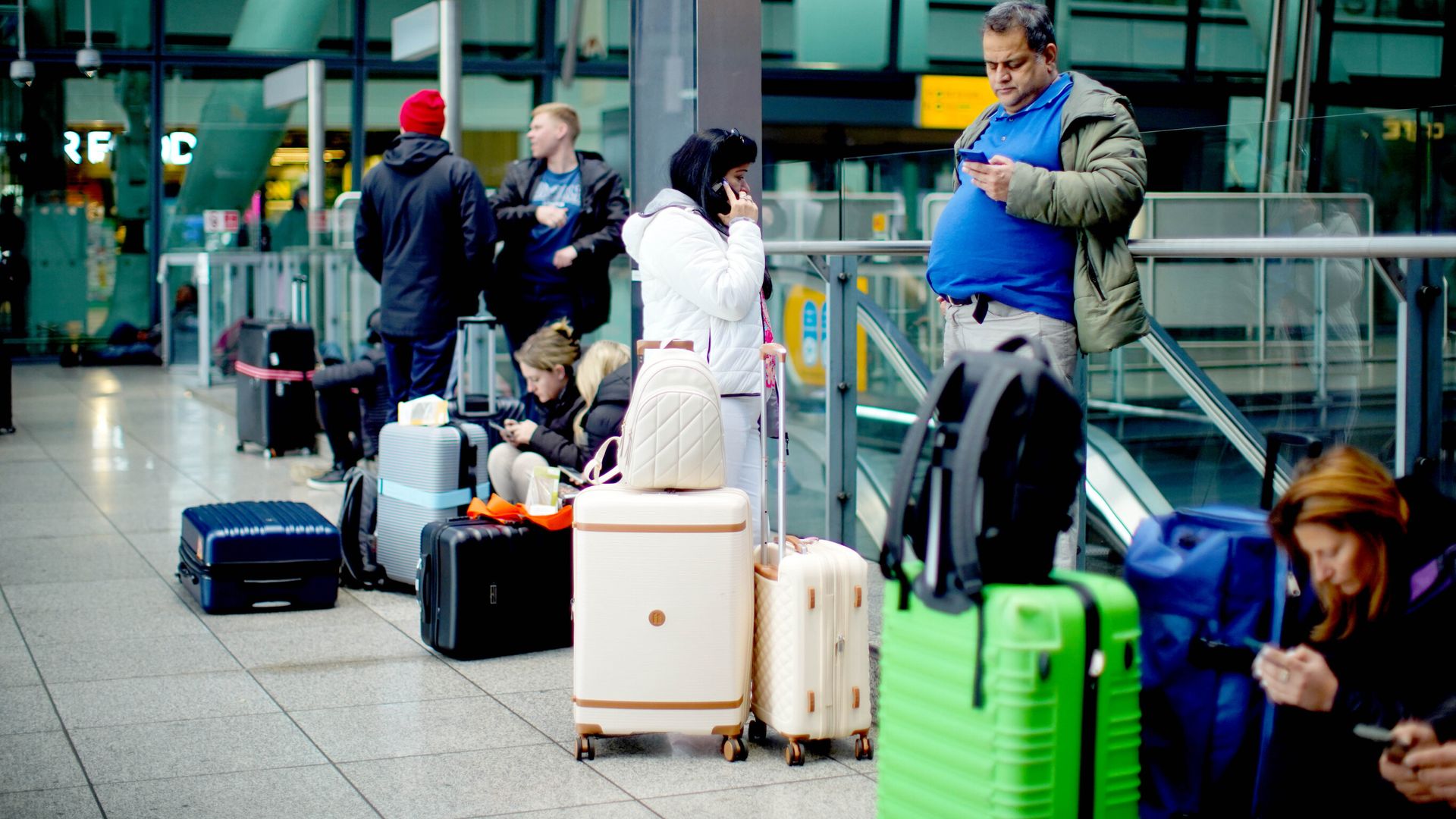
The recent wave of Iranian missile and drone strikes has done more than just scar the tarmac at Dubai International Airport. It has effectively paralyzed the primary artery of global aviation. Within forty-eight hours of the initial launches, over 4,500 flights across the Gulf region were cancelled or indefinitely diverted, leaving half a million passengers stranded in a logistical nightmare that the industry was not prepared to handle. This is not a temporary scheduling glitch. It is a fundamental collapse of the "hub-and-spoke" model that has made cities like Dubai and Doha the centers of the traveling world.
When a major transit point like DXB—the world’s busiest airport for international passengers—takes a direct hit or faces a closed airspace, the ripples are felt from London to Sydney. Carriers are now forced to make a brutal choice: fly massive, fuel-heavy detours over African or Central Asian airspace, or cancel operations entirely until the geopolitical dust settles. For an industry already operating on razor-thin margins and recovering from years of global volatility, this disruption represents a multi-billion-dollar hemorrhage that no insurance policy fully covers.
The Physical Reality of the Dubai Disruption
The images of smoke rising from the perimeter of Dubai International Airport tell only part of the story. While initial reports focused on the visible damage to secondary structures and taxiways, the real crisis lies in the sophisticated navigation and safety infrastructure that keeps a plane landing every 90 seconds. Precision is everything in aviation. If a radar array is knocked offline or if GPS jamming becomes a persistent feature of the local environment, the airport ceases to be a high-volume hub and becomes a dangerous bottleneck.
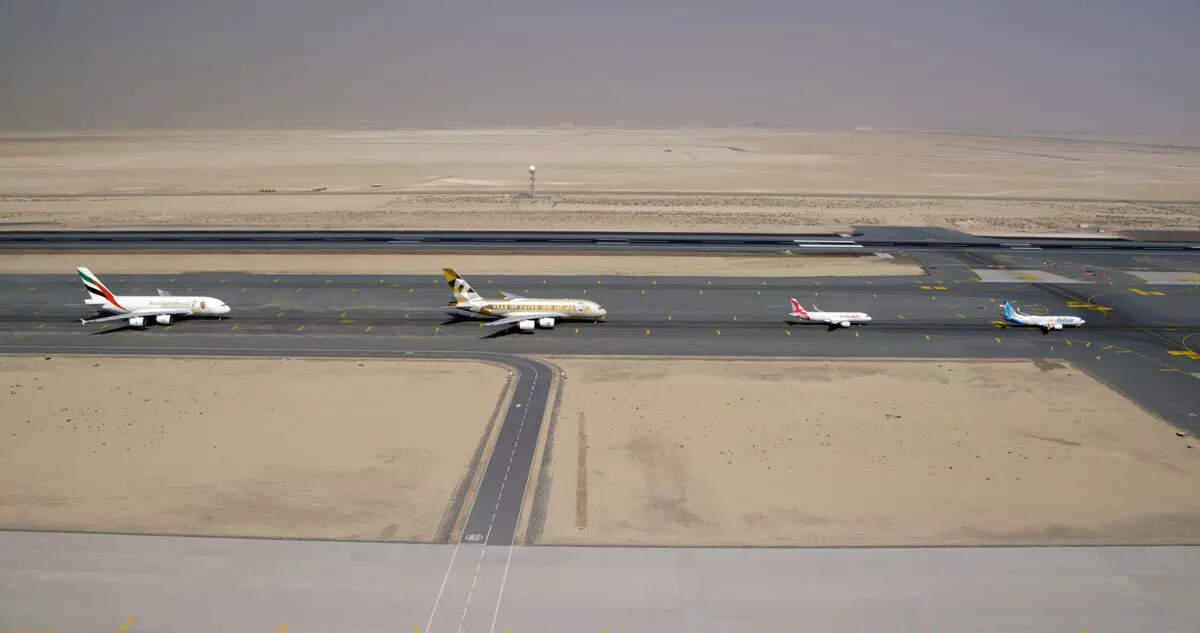
Operations at DXB rely on a seamless flow of traffic that enters from a few narrow corridors. Iran’s military posture has effectively "fenced in" these routes. When the missiles flew, the response from the General Civil Aviation Authority (GCAA) was immediate: a total grounding of departures. This created a literal traffic jam on the taxiways, with fueled aircraft sitting idle for ten hours or more while pilots timed out of their legal duty hours.
The damage to Dubai’s infrastructure, though reported as "manageable" by state-owned media, has triggered a massive downgrade in the airport’s operational capacity. It is one thing to patch a crater in a runway; it is quite another to recalibrate the trust of international carriers who are now reassessing whether the Persian Gulf is a safe place to park $300 million airframes overnight.
Why the Hub Model is Now a Liability
For two decades, the strategy for Emirates, Qatar Airways, and Etihad has been to funnel the world through a single, glittering point in the desert. It was a brilliant business move that capitalized on geography. But geography is a double-edged sword. By concentrating such a massive percentage of global long-haul traffic into a zone that is now an active firing range, the industry has created a single point of failure.
Consider the route from Frankfurt to Singapore. Historically, the most efficient path cuts directly through or near the current conflict zone. With that path compromised, airlines must now "reroute the world."
- Fuel Consumption: Detouring around Iranian and Yemeni airspace adds between 90 and 150 minutes of flight time to a standard ultra-long-haul journey.
- Payload Restrictions: To carry the extra fuel needed for these detours, planes must fly lighter. This means bumping cargo or, in some cases, leaving twenty to thirty passenger seats empty to stay within weight limits.
- Crew Logistics: Flight crews have strict legal limits on how long they can stay in the cockpit. These new, longer routes often push a standard crew over their limit, requiring an extra set of pilots on board, which further drives up costs and reduces cabin space.
The "efficiency" of the Gulf hubs has evaporated overnight. What was once a ten-hour flight is now a twelve-hour slog, and the cost of that extra time is being passed directly to the consumer in the form of "war risk" surcharges and skyrocketing base fares.
The Invisible War on GPS
Beyond the physical missiles, a more insidious threat has emerged: widespread electronic interference. Pilots flying through the corridors near the Strait of Hormuz have reported consistent "GPS spoofing." This isn't just a loss of signal; it is a sophisticated attack where the aircraft’s navigation system is tricked into thinking it is miles away from its actual position.
In one instance, a wide-body jet nearly entered unauthorized airspace because its primary navigation displays were fed false coordinates. This level of interference makes automated landings impossible and forces pilots to rely on older, ground-based radio beacons—technology that many modern hubs have moved away from in favor of digital precision. If Dubai and the surrounding regions cannot guarantee the integrity of the sky's digital signals, Western regulators like the FAA and EASA may soon ban their carriers from the region entirely, regardless of whether the missiles stop flying.
The Economic Aftershock for Global Trade
Aviation isn't just about people; it’s about the high-value cargo that sits in the "belly" of those passenger planes. Electronics, pharmaceuticals, and specialized machinery move through Dubai because it is the fastest way to get goods from East to West. With thousands of flights disrupted, the global supply chain has hit a wall.
We are seeing a desperate scramble for sea-air alternatives, but those are slow and already congested. The disruption in Dubai has effectively severed the digital economy’s nervous system. When a laptop manufacturer in Taiwan can’t get components to a distribution center in Europe because the "Dubai bridge" is broken, the price of consumer goods begins to climb in cities thousands of miles away from the Middle East.
The Strategy of Forced Avoidance
Iran knows that it does not need to destroy every plane to win this round of the shadow war. It only needs to make the region "uninsurable."
Insurance syndicates in London are already re-rating the entire Gulf. The moment a region is designated a "peril zone," the premiums for hull insurance and passenger liability triple. For many mid-tier airlines, these costs make the routes unprofitable. We are currently witnessing a tactical "clearing of the skies" where only the state-backed giants can afford to keep flying, and even they are doing so at a massive loss.
The counter-argument from some analysts is that the industry will simply adapt, as it did during the closure of Russian airspace. But the comparison is flawed. You can fly around Russia by going over the North Pole or through the Middle East. If you lose the Middle East, there is no "easy" way around. You are forced into the narrow, crowded corridors of Africa or the expensive, long-way-round Pacific routes.
The Mirage of a Quick Recovery
There is a persistent hope among travelers that once the headlines fade, the flight boards will turn green again. This is a misunderstanding of how aviation safety works. Even if a permanent ceasefire were signed tomorrow, the "normalization" of the airspace would take months.
Every square inch of the flight paths must be re-vetted. Wreckage from intercepted drones—often referred to as "sky junk"—poses a lethal threat to jet engines. Furthermore, the psychological impact on the traveling public cannot be fixed with a press release. The image of Dubai as a safe, neutral playground has been fundamentally compromised.
Airlines are now looking at "de-risking" their networks. This means shifting more flights to hubs like Istanbul, Singapore, or even back to direct long-range flights that bypass the Gulf entirely. The era of the "unquestioned Middle East hub" is over. We are entering a period of fragmented aviation, where safety is no longer assumed and the shortest distance between two points is a luxury few can afford.
The next time you book a ticket, look closely at the flight path. If it passes through the 40-degree latitude of the Middle East, you are no longer just a passenger; you are a participant in a high-stakes geopolitical gamble. The disruption we are seeing today isn't a glitch in the system. It is the new system.
Check your carrier’s "War Risk" disclosure before finalizing your next long-haul booking to see exactly how much you are paying for the detour.