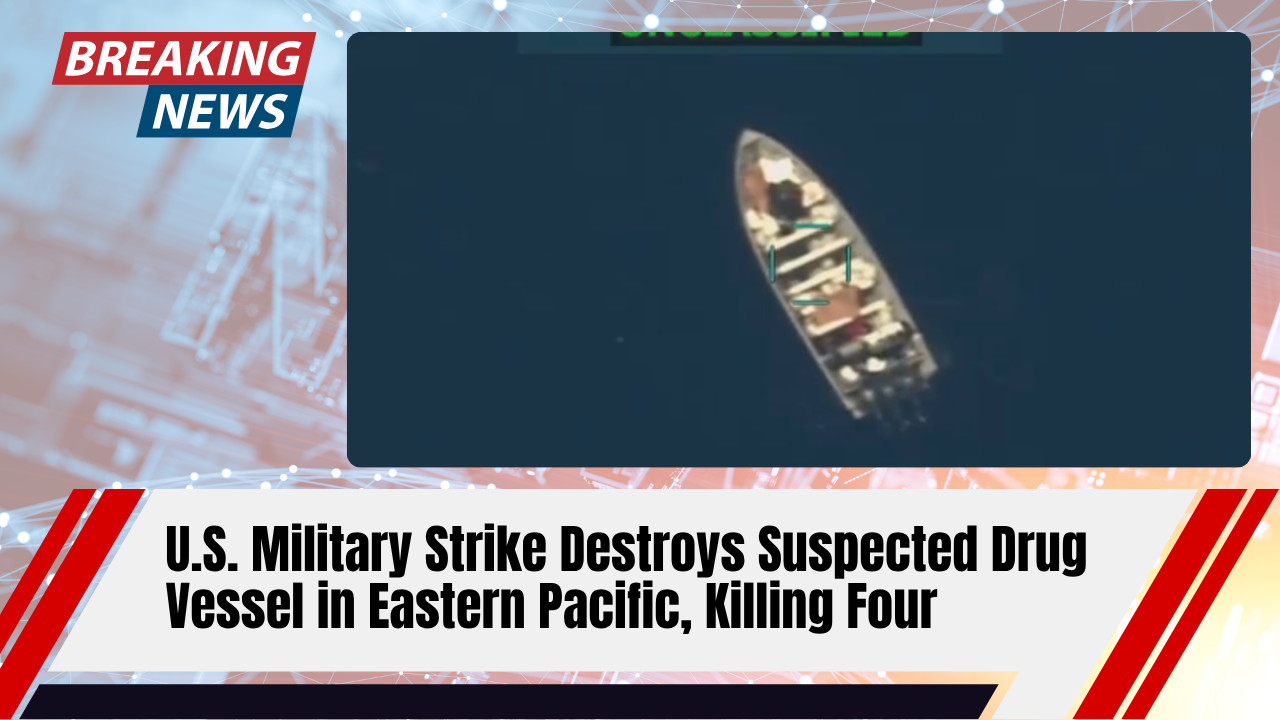
The headlines are singing the same tired tune. "US Military Eliminates Threat." "Precision Strike Neutralizes Hostiles." We see the grainy infrared footage, the blooming fireball of a direct hit, and the body count—three dead on a nameless vessel in the Eastern Pacific. The Pentagon gets its pat on the back, and the public moves on to the next distraction.
They are missing the forest for the trees.
This isn't a victory. It is an admission of failure. If you are firing a multimillion-dollar missile at a converted fishing boat to stop three guys from moving contraband or weapons, you aren't winning the war. You are losing the math. While the establishment press treats these strikes as a sign of strength, any insider with a grasp of modern attrition knows we are watching the slow-motion bankruptcy of the traditional kinetic model.
The Asymmetry Trap
Military analysts love to talk about "deterrence." It’s a comfortable word that lets them sleep at night. But let’s look at the actual physics of this engagement.
On one side, you have a U.S. Navy asset—likely a billion-dollar destroyer or a high-end littoral combat ship. On the other, a vessel that likely cost less than a used mid-sized sedan. We used a weapon system that requires a decade of R&D and a specialized supply chain to destroy a target that can be replaced by the adversary in forty-eight hours.
The media focuses on the "three killed." They should be focusing on the Unit Cost Ratio.
Imagine a scenario where a billionaire spends $5,000 on a custom-made flyswatter every time he sees a mosquito. He’ll kill a lot of mosquitoes. He’ll also eventually run out of money while the swamp continues to produce billions more insects. This is the "Asymmetry Trap." By engaging these low-tier threats with high-tier kinetic solutions, the U.S. military is essentially subsidizing the exhaustion of its own magazine depth.
The Intelligence Blind Spot
The consensus view is that this strike was a triumph of intelligence. "We knew where they were, and we hit them."
If the intelligence was actually superior, we wouldn’t have needed the fireball.
Real dominance in the Eastern Pacific doesn't look like a kinetic explosion. It looks like financial strangulation. It looks like signal jamming that turns the vessel into a floating brick before it even leaves the coast. It looks like an automated interdiction that doesn't require a news release.
The fact that we are still resorting to "kinetic solutions"—the military's polite term for blowing things up—proves that our non-kinetic capabilities are either lagging or being ignored in favor of the optics of a successful "hit." Bureaucracies love a body count because it’s a metric they can put on a slide deck. They can’t show "The 15 shipments that didn't happen because we disrupted their crypto-wallets" quite as easily.
The Myth of the Precision Strike
We’ve been sold a lie that "precision" equals "effectiveness."
Standard news outlets will tell you that killing three people on a boat "disrupts the network." It doesn't. In the world of maritime smuggling and asymmetric warfare, three people are a rounding error. These networks are decentralized, flat, and highly redundant.
In a centralized organization, killing the leadership matters. In the Eastern Pacific, we aren't fighting a centralized organization. We are fighting a hydra of independent contractors. When you strike a vessel, you aren't "dismantling a cell." You are just creating a job opening.
The "precision" of the strike is actually its biggest weakness. It is a localized solution to a systemic problem. It is like trying to cure a systemic infection by putting a band-aid on one visible pore.
The Logistics of Exhaustion
Let’s talk about the interceptors.
The U.S. currently faces a massive bottleneck in missile production. Our defense industrial base is optimized for quality, not quantity. We build the best hardware in the world, but we build it slowly.
When the military brags about a strike in the Eastern Pacific, they aren't mentioning that the missile used might take two years to replace. The adversary’s boat takes two weeks.
- Cost of Missile: $2 million+
- Cost of Target: $50,000
- Replacement Time (US): 18–24 months
- Replacement Time (Adversary): 14 days
This is the "Math of Defeat." If we continue to celebrate these individual tactical wins, we are ignoring the fact that we are being baited into a war of attrition we aren't built to win. The goal of our adversaries in these regions isn't necessarily to land the cargo; it's to force us to spend $2 million to stop $50,000. Every time we pull the trigger, they win a little bit more.
The Ghost of "Safety"
The public wants to feel safe. The government wants to provide that feeling. Kinetic strikes are the ultimate "theater of safety." They are loud, visible, and final.
But this strike actually increases the risk to regional stability. It forces the adversary to innovate. When you use a sledgehammer to kill a fly, the next generation of flies learns how to hide in the cracks. We are seeing an evolution in semi-submersible technology and autonomous drone vessels specifically because our current "precision" strikes have made traditional surface smuggling too "noisy."
By patting ourselves on the back for this hit, we are ignoring the reality that we are training our enemies to be better. We are providing them with the ultimate R&D feedback loop. They send a boat, we blow it up, they analyze how we found it, and they build the next one to avoid that specific sensor.
Stop Measuring the Wrong Things
If you want to know if the U.S. is actually winning in the Eastern Pacific, stop looking at the body count. Stop looking at the "vessels destroyed" stat.
Look at the Cost Per Interdiction.
Look at the Supply Chain Latency for replacement munitions.
Look at the Signal-to-Noise Ratio in maritime domain awareness.
If the Cost Per Interdiction is rising, we are losing. If the munitions gap is widening, we are losing.
The three people killed in this strike are irrelevant. They were pawns in a game of global resource depletion. The real casualty of this engagement wasn't on that boat; it was the strategic reserve of the United States military, which is being bled dry one "successful" strike at a time.
The next time you see a headline about a "successful strike," don't cheer. Ask how much it cost us to buy that temporary feeling of security, and ask who is actually winning the long game of math and time.
We are firing golden bullets at paper targets and wondering why the paper keeps coming.