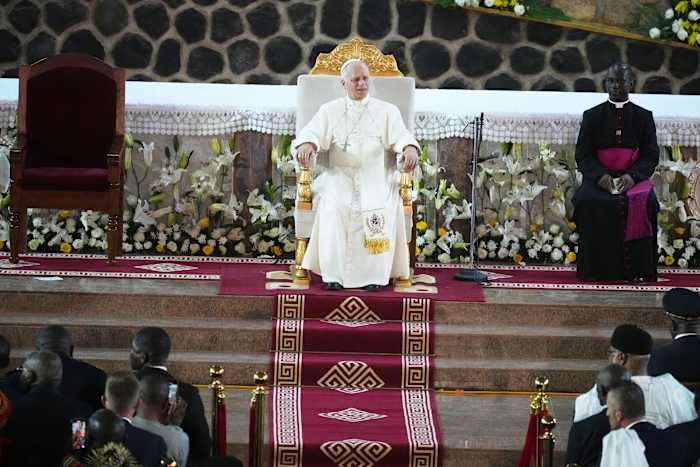
Pope Francis did not travel to the Northwest and Southwest regions of Cameroon simply to offer a spiritual pat on the back. He went there to throw a rhetorical grenade at the feet of the world’s most powerful actors. By decrying the "tyrants" who trade human lives for mineral rights and political dominance, the Pontiff has effectively shifted the narrative of the Anglophone Crisis from a localized ethnic skirmish to a global case study in predatory exploitation.
The conflict, often called the "Ambazonia" war, has simmered since 2016. It began with lawyers and teachers protesting the imposition of the French legal and educational systems in English-speaking territories. It exploded into a scorched-earth campaign that has displaced over 700,000 people and killed thousands. While the international community often looks away, the Pope’s recent intervention highlights a grim reality. This is not just a civil war. It is a resource grab masked by flags and anthems.
The Geography of Exploitation
To understand why the "tyrants" refuse to let go of the separatist regions, one must look beneath the soil. The Gulf of Guinea is not just a scenic coastline; it is a vital artery for global energy markets. Cameroon’s oil and gas reserves are concentrated precisely where the secessionist movement is strongest.
When the Pope speaks of those who "ravage the Earth," he is pointing at the nexus of state corruption and multinational interests. The Yaoundé government depends on oil revenue to maintain its forty-year grip on power. Meanwhile, separatist factions—fractured and increasingly desperate—often resort to kidnapping and "ghost town" strikes that paralyze the local economy. The civilians are caught between the hammer of a central government that views them as suspects and the anvil of rebels who view them as leverage.
Why the Vatican is Breaking Protocol
Traditional diplomacy usually favors the status quo. The Holy See typically maintains a cautious distance from separatist movements to avoid alienating sovereign states. However, the sheer scale of the humanitarian disaster in Bamenda and Buea has forced a change in strategy. The Catholic Church is the only institution in Cameroon with a footprint larger than the state itself. Its bishops have been kidnapped, its priests harassed, and its schools turned into battlegrounds.
The Pope’s rhetoric marks a departure from standard "calls for peace." By using the word "tyrants," he acknowledges that the violence is top-down. This isn't a misunderstanding between neighbors. It is a systematic extraction of wealth that requires the suppression of a population to remain profitable. The Vatican knows that "peace" without a change in how resources are shared is just a temporary ceasefire that favors the oppressor.
The Failure of the International Gaze
Western powers have been remarkably quiet about Cameroon compared to other global conflicts. France, the former colonial master, maintains deep ties with President Paul Biya’s administration. The United States provides security assistance under the banner of counter-terrorism, specifically targeting Boko Haram in the North, yet those same military resources often find their way to the Anglophone front lines.
This silence is transactional. If the separatist regions were to gain independence or even significant autonomy, the existing contracts for timber, oil, and cocoa would be thrown into legal chaos. For the global "tyrants" the Pope alluded to, a stable dictatorship is often preferable to a messy, unpredictable democracy. The human cost—villages burned to the ground and a generation of children out of school—is treated as an unfortunate line item on a balance sheet.
The Mechanics of the Conflict
The war is fought through two primary mechanisms: attrition and disinformation.
On the ground, the military utilizes "cordon and search" operations that frequently result in the extrajudicial killing of young men suspected of being "Amba boys." In retaliation, separatists use improvised explosive devices (IEDs) and target anyone seen as collaborating with the state. This cycle creates a vacuum of trust where the only remaining authority is the Church.
In the digital space, the war is just as fierce. Both sides employ massive networks of social media influencers to spread propaganda. You will see photos of atrocities shared widely, only to find they were taken years ago in a different country. This makes it nearly impossible for the average citizen to know who to believe. By stepping into this fray, the Pope is attempting to re-establish a "ground truth." He is signaling that the objective reality is the suffering of the poor, regardless of who pulls the trigger.
The Economic Paradox of the Separatist West
The irony of the "impoverished" West is that it is the breadbasket of the nation. The fertile volcanic soil around Mount Cameroon produces the vast majority of the country’s export crops. Yet, the infrastructure in these regions is shambolic. Roads are often impassable during the rainy season, and healthcare is a luxury.
This disparity is the "exploitation" the Pope spoke of. The wealth flows out of the Anglophone regions and into the pockets of the elite in Yaoundé or the bank accounts of foreign shareholders. When people have nothing left to lose, they pick up a rifle. The "war" is the symptom; the "exploitation" is the disease.
A Hard Truth for the Church
While the Pope’s words are powerful, the Church in Cameroon is not a monolith. There is a deep divide between the Francophone clergy and their Anglophone counterparts. Some bishops in the West have been accused of being too sympathetic to the separatist cause, while others in the capital are seen as too cozy with the Biya regime.
For the Vatican’s message to have a lasting impact, it must first bridge this internal chasm. If the Church cannot speak with one voice within Cameroon, its ability to act as a mediator on the world stage is severely diminished. The "tyrants" know this and have been adept at playing different religious factions against each other.
The Strategic Value of "Moral Outrage"
In a world governed by Realpolitik, moral outrage is often dismissed as sentimental. However, for a leader like Paul Biya, who cares deeply about his international standing and his "Man of Peace" image, the Pope’s public rebuke is a tactical nightmare. It emboldens the African Union and the United Nations to take a harder line on human rights abuses that they previously ignored.
The Pope is betting that by naming the villains, he can shift the cost-benefit analysis for those in power. If the reputational damage of the war starts to outweigh the profits from the resources, the "tyrants" might finally be forced to the negotiating table. This isn't about theology; it’s about leverage.
The Humanitarian Abyss
Behind the geopolitical maneuvering, the statistics are staggering. Over 4,000 schools have been closed or destroyed. A decade of education has been erased for an entire demographic. This creates a fertile breeding ground for future radicalization. If a child cannot go to school, and their parents cannot farm their land, the only employment available is violence.
The "ravaging of the Earth" is not just environmental; it is social. The fabric of Cameroonian society is being shredded. Traditional rulers, known as Fons, have been forced to flee their palaces. The social hierarchy that has held these communities together for centuries is collapsing under the weight of the war.
The Path to De-escalation
Any real solution requires more than a handshake. It requires a fundamental restructuring of how Cameroon manages its wealth.
- Federalism: A return to the two-state federation that existed at independence is the most common demand from moderates.
- Resource Sovereignty: Ensuring that a significant percentage of oil and agricultural revenue stays in the regions where it is produced.
- General Amnesty: A credible process for fighters to lay down their arms without fear of execution.
- International Monitoring: A neutral body to oversee human rights and ensure that "peace" isn't just a cover for more arrests.
The Pope’s visit has provided a window of opportunity. The world is briefly looking at a corner of Africa it usually ignores. But windows close quickly. If the international community does not follow the Vatican’s lead and apply direct pressure on the financiers of this war, the "tyrants" will simply wait for the news cycle to move on.
The blood in the streets of Bamenda is the price being paid for the world's indifference. We can no longer pretend this is an internal matter of a sovereign state. When the extraction of resources fuels the slaughter of civilians, it becomes a global crime. The Pope has called the perpetrators by their true name. The question is whether the rest of the world has the courage to do the same.
The time for diplomatic niceties has passed. You cannot negotiate with a fire while you are still pouring gasoline on it. The extraction must stop, the guns must be silenced, and the wealth of the land must finally serve the people who live upon it.