Environmental journalism loves a simple tragedy. Find a massive government project, find a drop in local groundwater levels, and write a mournful obituary about nature fighting back against hubris. The narrative writes itself. Green belts cause droughts. Massive reforestation sucks the aquifers dry. The trees are eating the water.
It sounds smart. It sounds like an ecology 101 cautionary tale. And it is entirely wrong.
I have spent years watching bureaucrats and green NGOs hyperventilate over every fluctuation in regional water tables while missing the forest for the nonexistent trees. The lazy consensus dominating coverage of China's Great Green Wall is that planting billions of trees in arid zones is a hydrologic blunder—a tragic miscalculation trading future water security for immediate sand dune stabilization.
That argument treats a complex biological engineering campaign as if it were a suburban lawn sprinkler system. It ignores physics, it ignores scale, and most importantly, it ignores what happens when the Gobi Desert actually wins.
The Groundwater Fallacy
Let us dismantle the core panic: the idea that afforestation is stealing water from human populations and draining deep aquifers.
Critics point to falling water tables in northern provinces and blame the roots. They map out evapotranspiration rates and scream about resource depletion. But this critique commits a foundational error in spatial economics and hydrologic accounting. It assumes water is a static pool sitting in a bathtub, and every drop a tree drinks is a drop stolen from a farmer's tap.
Water does not work that way in hyper-arid transition zones. Unchecked deserts do not preserve water; they evaporate it through capillary action from shallow saline tables, turning entire regions into dead, hyper-saline salt flats that yield zero economic or ecological value. The sand does not hoard moisture. The sun bakes it out of the earth relentlessly.
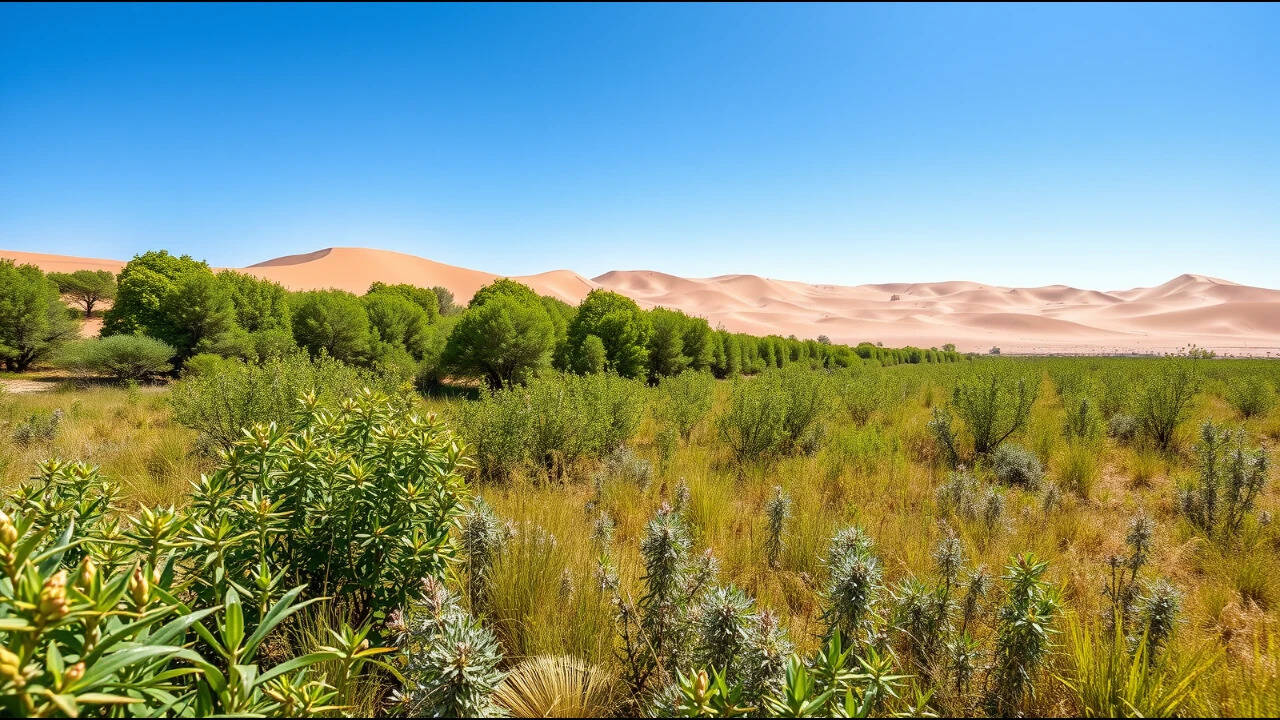
When you plant drought-hardy species like Haloxylon ammodendron (saxaul) or specific tamarisks, you are not pumping municipal reservoirs dry. You are intercepting active wind erosion, anchoring topsoil, and fundamentally altering the local microclimate.
Let us be precise about the mechanics. Trees increase surface roughness. Surface roughness slows down high-velocity wind vectors. Slower winds drop their particulate load instead of scouring agricultural topsoil away and carrying it all the way to Beijing or Seoul. The shade cast by a canopy drops surface soil temperatures by several degrees, drastically cutting down the brutal, evaporative sun-stripping that drains naked soils.
Are these trees consuming water? Yes. Are they wasting it? Only if you measure the value of land strictly by how many gallons of water you can pump out of it before the well turns brackish.
The Alternative is Total Collapse
Let us look at the alternative world the critics prefer. Imagine a scenario where China listens to the western editorial boards, stops planting, pulls back the forestry workers, and lets nature take its course.
What happens?
The Gobi expands southward at rates that swallow entire townships. Dust storms—the legendary yellow dragons—intensify, choking urban centers, collapsing solar energy grids under inches of abrasive silt, and destroying millions of hectares of marginal grazing land. The economic cost of inaction is measured in tens of billions of dollars annually in respiratory illness, agricultural devastation, and infrastructural maintenance.
When a region turns to moving sand dunes, the water problem does not get solved; it gets abandoned. Aquifers underneath active shifting deserts become useless anyway due to extreme mineral contamination and lack of recharge pathways.
The Great Green Wall is not a decorative landscaping project. It is a massive hydraulic and atmospheric stabilization bulkhead. You do not judge a seawall by how much ocean water it blocks from your basement; you judge it by whether your house is still standing after the hurricane.
To call reforestation a failure because local water tables drop in specific counties is like complaining that chemotherapy causes hair loss while ignoring that the patient is surviving stage-four cancer. It is micro-accounting applied to macro-survival.
The Uncomfortable Truth About Ecological Engineering
Of course, the program has made mistakes. Early phases relied on monocultures of fast-growing poplars that drank too greedily and died off in massive swathes when pests or droughts hit. I have seen satellite data from the early 2000s showing vast checkerboards of dead timber—a textbook bureaucratic overreach where regional officials planted quotas instead of ecosystems.
The Chinese Academy of Sciences knew this before the critics did. They course-corrected. Modern phases of the Three-North Shelterbelt Program abandoned the monoculture trap. They shifted to indigenous shrubs, deep-rooting grasses, and mosaic planting strategies designed to match local carrying capacities down to the micro-watershed.
This is where the critics display their intellectual dishonesty. They cite data from the flawed, heavy-handed planting initiatives of thirty years ago and apply it as a blanket condemnation of today’s highly sophisticated, science-driven ecological restoration matrix.
Let us acknowledge the real downside: managing millions of hectares of semi-arid forest requires constant monitoring, intelligent water-rights reallocation, and a willingness to let certain over-stressed zones revert if nature pushes back too hard. It is expensive, labor-intensive, and fraught with trial and error.
Stasis is not an option. You either manage the water balance aggressively, or you watch the landscape turn into a lifeless sandbox where nobody lives, nobody farms, and water becomes irrelevant because humanity has already packed up and left.
The Real Question
The media keeps asking whether China's trees are straining water supplies.
That is the wrong question.
The right question is: how much water are you willing to spend to keep an entire civilization's northern breadbasket from blowing away on the wind?
The desert does not negotiate. It does not compromise. It consumes. Every gallon of water utilized by a drought-resistant shelterbelt is an investment in atmospheric defense.
Stop treating the earth like a pristine museum exhibit where human intervention is inherently sinful. Nature in the Anthropocene is a managed asset. You manage it, or it buries you.