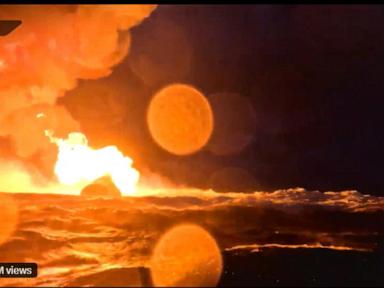
Everyone threw a party because a massive steel cylinder didn't detonate on the pad. The media ran breathless headlines celebrating a monumental victory. They called it a successful orbital flight test. They pointed to the fiery, controlled chaos of a splashdown in the Indian Ocean as proof that humanity is boarding the bus for Mars tomorrow morning.
It is a fairy tale for people who do not understand physics, engineering, or how rockets actually fail. Discover more on a related issue: this related article.
I have watched hardware worth eight figures turn into expensive confetti on concrete pads. I have spent decades listening to executives confuse survival with operational capability. Surviving an explosive descent with missing control flaps and structural thermal tile loss is not success. It is lucky telemetry.
If your car loses two wheels, shreds half its body panels, and rolls into a ditch while managing to stay on the road for three minutes, you do not tell your insurance adjuster that you completed a successful test drive. You accept that you barely escaped a catastrophe and go back to the drawing board. More reporting by MIT Technology Review delves into comparable views on the subject.
SpaceX achieved a milestone, yes. They gathered invaluable flight data. But calling that flight a complete success creates a dangerous delusion that masks the brutal engineering reality standing between us and an operational, reusable heavy-lift architecture.
The Myth of the Splashdown Celebration
Let us look at what actually happened during that flight test. The vehicle lifted off, cleared the tower, and survived Max-Q—the point of maximum aerodynamic pressure. That was genuinely impressive. The sheer thrust of thirty-three Raptor engines roaring in unison is a technical marvel that few other companies on Earth could pull off.
Then the problems began.
Several engines flamed out prematurely. The ship rolled uncontrollably during stage separation because hot-staging mechanics did not perform with the pristine precision simulations promised. By the time the vehicle reached re-entry, it was battered, tumbling slightly, and missing vital protective shielding. The flaps were literally melting off the fuselage.
Yet, when the vehicle managed to punch through the atmosphere and trigger its landing burn just above the ocean surface before tipping over and exploding, the internet erupted in applause.
Why? Because the bar for SpaceX has been set so low by traditional aerospace timelines that simply not destroying the launch pad is treated like a moon landing.
This mindset is toxic. It rewards milestones over mastery. Reusability is the entire economic thesis of Starship. If you cannot recover a vehicle in a state that allows it to fly again within days with minimal refurbishment, you have built an extremely expensive, oversized single-use rocket. And an expendable rocket built out of heavy stainless steel with thousands of ceramic tiles is nothing more than a very heavy, very inefficient dead weight.
The Stainless Steel Fallacy
Let us dismantle the material choice that everyone loves to praise.
The lazy consensus is that Elon Musk is a genius for ditching carbon composites in favor of cheap, heavy stainless steel because it handles cryogenic temperatures well and costs pennies per pound.
Here is what the fanboys leave out: weight is the enemy of orbit. Every single pound of structural mass you add to your airframe is a pound you cannot carry as payload. When you scale a rocket to the gargantuan proportions of Starship, stainless steel demands a massive thermal protection system. Those fragile black tiles covering the hull are a maintenance nightmare.
I have seen advanced manufacturing floors try to manage brittle thermal protection systems at scale. It is a logistical sinkhole. Every flight requires months of painstaking inspection and replacement of thousands of individual tiles. That destroys the airline-style rapid turnaround model that Starship proponents love to preach.
If you need a battalion of technicians to glue tiles back onto your ship after every single sub-orbital hop, your reusability model is broken. You have traded fuel costs for labor costs, and labor costs will eat you alive.
The Raptor Engine Reliability Problem
Let us talk about the engines. Thirty-three Raptor engines running on full-flow staged combustion. On paper, it is the most advanced rocket propulsion cycle ever conceived. It squeezes every drop of performance out of methane and oxygen.
In the real world, complexity breeds failure.
Every additional engine you strap to a booster is another single point of failure. If you lose one engine out of nine on a Falcon 9, the guidance computer adjusts, and the mission succeeds. Lose three or four engines out of thirty-three on a Starship booster, and the acoustic shockwaves, asymmetric thrust vectors, and propellant feedline dynamics create a cascading failure scenario that turns your vehicle into shrapnel.
The media loves to talk about thrust-to-weight ratios. They rarely talk about vibration profiles and thermal fatigue. Running thirty-three high-pressure combustion chambers a few feet apart creates an acoustic environment so violent it can rip titanium brackets apart at the molecular level.
Solving that requires brute-force iteration. Blow one up, build two more. It is a valid strategy if you have billions of dollars in venture capital or government contracts to burn. But let us not pretend it is clean, elegant engineering. It is a demolition derby disguised as an aerospace program.
The Regulatory and Environmental Blind Spot
There is another massive oversight in the current narrative: the geography of heavy-lift launches.
Starstarship launches from South Texas. It requires closing down public beaches, disrupting local ecosystems, and rattling windows for miles around. The initial launch blew concrete chunks across wildlife refuges.
The popular consensus treats environmental pushback as mere red tape held up by bureaucrats who hate progress. That is a dangerous simplification. When you scale up launch cadences to the hundreds per year required to build a Martian colony, the acoustic and chemical footprint on local biomes becomes unsustainable.
If you ignore the ground-level friction of your operations, the state will eventually do it for you with court orders, injunctions, and canceled permits. Innovation does not happen in a vacuum. If you destroy your launch site every time you test an orbital prototype, your flight rate is zero, no matter how many hulls you have stacking up in the high bay.
The Uncomfortable Truth About the Timeline
Everyone wants to know when we are going to Mars.
The honest answer? Not in your lifetime, at least not under the current architectural paradigm.
Getting a heavy metal tube into Earth orbit is step one of a thousand-step journey. Step two is orbital refueling—transferring hundreds of tons of super-chilled cryogenic liquid methane and oxygen from one spacecraft to another in the vacuum of space. We have never done this at scale. The boil-off rates, fluid slosh dynamics, and thermal coupling challenges are staggering.
Step three is landing that same massive vehicle on a celestial body with a thin atmosphere like Mars, where parachutes are practically useless and you must rely entirely on retro-propulsion to kill your velocity without digging a crater.
When you look at the delta-v budgets, the life support longevity, and the radiation shielding requirements, Starship as it currently flies is an experimental freighter. It is a stepping stone. It is not the final answer.
Stop Drinking the Kool-Aid
We need to stop evaluating aerospace progress through the lens of hype videos and corporate press releases.
SpaceX has achieved extraordinary things. They forced a stagnant, complacent defense industry to modernize. They proved that vertical landing is possible. They built an incredible talent pool.
But cheering for a controlled structural breakup as a triumph of engineering lowers the standard for the entire industry. Real progress requires brutal, unvarnished honesty about what failed, why it failed, and how far we actually are from true, airline-like reusability.
The next time you see a headline celebrating a rocket that blew up over the ocean after losing half its steering control, do not cheer. Ask why the thrusters failed. Ask why the tiles melted. Ask what the repair bill looks like.
Demand better engineering. Refuse to settle for expensive pyrotechnics disguised as progress.