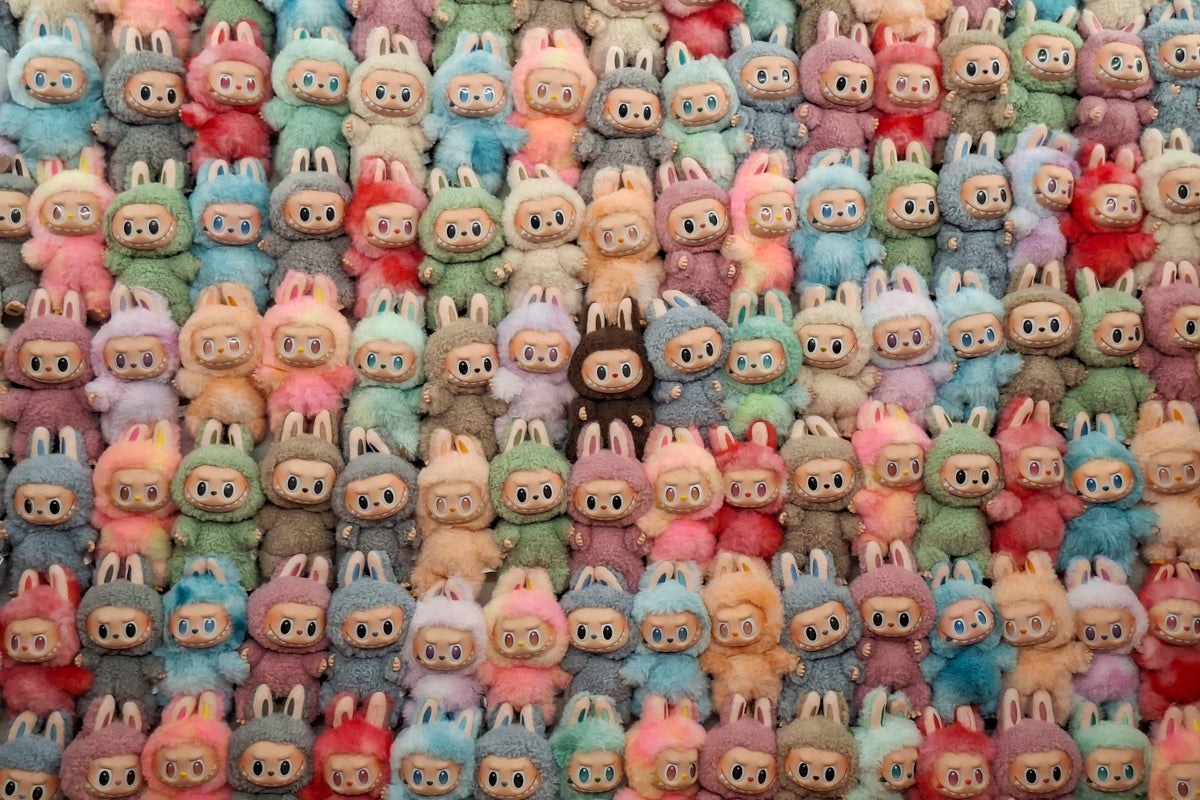
The frenzy has evaporated, leaving behind a trail of overpriced plastic and investor anxiety. After a meteoric rise that saw Pop Mart’s valuation soar on the back of a single, snaggle-toothed monster named Labubu, the Chinese toy giant is now facing a reckoning in the United States. Sales in the American market—previously the company’s golden child for overseas expansion—plunged by 45% in March 2026. This isn't just a seasonal dip or a minor supply chain hiccup. It is the sound of a speculative bubble finally popping as the Western consumer tires of the "blind box" gimmick and the manufactured scarcity of a single character.
While the company attempted to project confidence during its late-March earnings briefing, the internal numbers tell a more harrowing story. In January and February, US sales were still riding the fumes of a 2025 viral explosion, posting gains of 130% and 41% respectively. Then, the floor fell out. The suddenness of the March collapse suggests that Pop Mart hasn’t built a brand in America; it has merely captured a trend. Read more on a connected issue: this related article.
The Labubu Dependency Trap
Pop Mart’s problem is one of structural fragility. The company spent the better part of 2025 leaning into the Labubu craze, a character from "The Monsters" series created by artist Kasing Lung. When celebrities like Lisa from BLACKPINK began sporting Labubu charms, the US market went into a delirium. Revenue from "The Monsters" skyrocketed by over 600% globally, and for a moment, it seemed Pop Mart had found the "Mickey Mouse" of the designer toy era.
But Mickey Mouse is an institution supported by a century of storytelling. Labubu is a plushie with a cool aesthetic and zero narrative weight. In the US, where the "kidult" market is increasingly crowded by established heavyweights like Funko and Medicom, a character without a soul-deep connection to the consumer is a disposable asset. Once the social media flex—showing off a "secret" or "chase" figure—loses its status-symbol luster, the demand vanishes. More journalism by The Motley Fool delves into related perspectives on this issue.
The data reveals a stark contrast in consumer behavior. In China, Pop Mart maintains a roster of diverse IPs like Skullpanda, Dimoo, and Molly, which enjoy a relatively stable, loyal following. In the US, the brand is essentially "The Labubu Store." When the US consumer walks into a flagship in Times Square and doesn't see the specific viral monster they saw on TikTok, they don't pivot to a different Pop Mart character. They simply walk out.
The Blind Box Fatigue
Western shoppers are notoriously less patient with the blind box model than their East Asian counterparts. The excitement of the "unboxing" experience is a finite resource. In a cooling economy, the "loot box" mechanics of designer toys—where a customer pays $16 to $28 for a chance at the toy they actually want—begin to feel less like a game and more like a tax on the hopeful.
The Odds Against Growth
- Chase Rarity: Most series offer a 1-in-144 chance of finding a secret figure.
- Resale Saturation: The secondary market on platforms like eBay and Mercari is currently flooded with "commons," driving the perceived value of the collection down.
- Counterfeit Explosion: The rise of "Lafufu" and other high-quality fakes has eroded the premium aura Pop Mart worked so hard to cultivate.
When a collector can buy a convincing knockoff for $5 or a genuine "common" figure for $8 on the secondary market, the $20 blind box at the official retail counter becomes an irrational purchase. Pop Mart is currently fighting a two-front war against waning interest and an aggressive gray market that it helped create by keeping supply artificially low during the peak of the hype.
Failed Diversification and the Content Vacuum
Pop Mart executives have frequently cited Disney as their North Star. They want to transition from a toy company to an "IP powerhouse," diversifying into theme parks, games, and apparel. They recently launched collaborations with Uniqlo and explored high-end lifestyle products.
However, Disney’s merchandise sells because people love the movies. Pop Mart is trying to work backward, selling the merchandise and hoping to manufacture the love later. The company has teased short films and animation projects, but these are lagging years behind the retail expansion. In the US market, where content is king, a toy without a story is just a piece of decor.
The strategy of "IP-centric diversification" is currently failing in the West because there is no IP to speak of—only a visual style. Without a narrative anchor, the transition into clothing or home goods feels like a desperate attempt to slap a logo on anything that stays still long enough.
The $33 Billion Reality Check
The market's reaction has been swift and unforgiving. Pop Mart has seen roughly $33 billion in market value erased as investors realize the US expansion might not be the infinite growth engine promised in 2024. The company’s aggressive store rollout—adding 42 locations in North America in a single year—now looks like over-leveraging into a shrinking bubble.
Retail productivity is the metric to watch. Opening a flagship on Fifth Avenue is a bold branding move, but it comes with astronomical overhead. If the "per-store" sales continue to slide as they did in March, these physical locations will transform from brand ambassadors into financial anchors.
The company is now resorting to massive share buybacks to stabilize its stock price, a classic move for a firm that has run out of ideas for organic growth. For Pop Mart to survive this US "boo-boo," it must move beyond the "ugly-cute" aesthetic of Labubu and prove it can create a character that Americans will still care about six months after the TikTok trend ends. As it stands, the company isn't building a kingdom; it’s tending to a graveyard of last year's obsessions.
The next twelve months will determine if Pop Mart is a permanent fixture in the global toy industry or merely the most expensive fad of the mid-2020s. Investors and collectors alike are no longer buying into the mystery. They are looking at the box, and for the first time, they don't like what's inside.