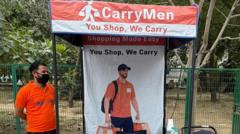
On-demand porter services attempting to scale in Delhi’s premium shopping districts face an existential cultural barrier that technology cannot easily breach. The premise seems straightforward on paper. Customers visiting sprawling, crowded retail hubs like Connaught Place, Khan Market, or South Extension pay a fee to hired hands who carry their shopping bags, freeing them to browse unburdened. Yet, the commercial reality of human shopping bag carriers in India’s capital reveals a stark disconnect between tech-driven convenience models and the entrenched socio-economic dynamics of urban Indian retail. It is not a logistics problem. It is a psychological one.
The Mirage of the Affluent Shopper
Startups looking to formalize the informal labor sector often miscalculate how affluent urbanites interact with service providers. In Western capitals, paying a premium for hands-free shopping aligns with a culture accustomed to gig-economy taskers. In Delhi, the market structure is fundamentally different.
High-net-worth individuals rarely carry their own bags to begin with. They travel with personal drivers who double as logistics support, waiting in air-conditioned sedans to collect purchases after each boutique stop. For this demographic, a smartphone application offering a temporary porter is entirely redundant. The asset is already on the payroll, parked fifty meters away.
That leaves the middle and upper-middle-class consumers who frequent these markets. This segment possesses the disposable income to shop, but they harbor a distinct resistance to paying a transparent, metered fee for physical labor. Historically, luxury in Indian retail is built on embedded service, not add-on costs.
When a customer spends a significant sum at a premium apparel store, they expect the establishment to manage the friction of delivery. Premium retail brands understand this implicitly. Store attendants frequently walk customers to their vehicles to deposit heavy items, embedding the labor cost directly into the product margin. Attempting to unbundle this service and charge for it via an independent platform alienates the exact consumer who values the status of being pampered.
The Economic Friction of Low-Margin Gig Labor
To understand why formal bag-carrying services struggle to survive, one must analyze the unit economics of the informal labor market in Delhi.
+-----------------------------------+-----------------------------------+
| Metric                            | Estimated Value                   |
+-----------------------------------+-----------------------------------+
| Target Platform Hourly Fee        | ₹150 - ₹250 ($1.80 - $3.00 USD)   |
| Average Customer Engagement Time  | 2.5 Hours                         |
| Platform Commission Rate          | 20% to 25%                        |
| Worker Net Earnings Per Trip      | ₹300 - ₹450                       |
+-----------------------------------+-----------------------------------+
The math quickly breaks down when applied to real-world market geography. A porter cannot simply teleport from one customer to another.
Markets like Connaught Place are designed as massive concentric circles. Navigating these spaces on foot to locate a client takes time. If a worker spends forty-five minutes waiting for a user to finish trying on clothes, that worker is losing money. The platform must charge enough to make the labor worthwhile for the provider while keeping the price low enough to prevent the consumer from just carrying the bag themselves.
Physical effort has a psychological price ceiling. A shopper carrying two pairs of shoes and a handbag will quickly calculate whether avoiding mild discomfort is worth the cost of a premium coffee. Most of the time, the answer is no. The pain point is simply not acute enough to sustain a standalone business model.
The Problem of Trust and Asset Security
A shopping bag in South Extension is not merely cargo. It often represents thousands of rupees in high-end cosmetics, electronics, or designer textiles. Handing these goods over to a gig worker encountered through an app requires an extraordinary amount of institutional trust.
- The Risk of Substitution: Shoppers worry about high-value items being swapped for counterfeits during the trip.
- The Problem of Crowds: In chaotic market environments, keeping visual contact with a hired porter is incredibly difficult.
- Liability Ambiguity: If a designer dress is stained or lost while in the porter's possession, resolving the compensation claim creates an administrative nightmare for the platform.
Traditional coolies at railway stations operate within a highly regulated, culturally understood ecosystem with fixed jurisdictions and uniform identification. A gig-economy porter lacks this historical validation. The average shopper feels an undercurrent of anxiety when their expensive purchases leave their physical possession, destroying the very sense of relaxation the service promises to deliver.
Spatial Realities of Delhi Shopping Districts
The architectural layout of Delhi’s retail hubs presents a massive operational hurdle for on-demand pedestrian logistics.
Khan Market features narrow, congested alleyways where foot traffic moves at a crawl during peak evening hours. Introducing a fleet of hired porters navigating these tight corridors with bulky bags increases friction for everyone in the market. The environment does not scale for pedestrian couriers the way a wide, linear shopping avenue in Paris or New York might.
In contrast, modern shopping malls in Noida and Gurugram have solved the bag problem through infrastructure rather than labor. These mega-malls offer centralized concierge desks, locker systems, and hands-free shopping initiatives managed by the mall operators themselves. Purchases are tagged and sent directly to a central pickup zone or valeted straight to the customer’s car.
The standalone app trying to deploy human porters into traditional open-air markets is fighting a losing battle against these highly organized, climate-controlled corporate ecosystems. The mall environment internalizes the cost of convenience to keep the shopper inside the building longer. The open-air market app asks the shopper to foot the bill for an infrastructure deficit.
Status Anxiety and the Aesthetics of Shopping
Retail in India is explicitly tied to social signaling. The act of walking through a premium market holding distinct, high-end branded bags is part of the consumer experience for a specific segment of shoppers. It announces purchasing power to peers.
By transferring those bags to a hired porter walking three paces behind, the consumer alters the social dynamic of the space. While some may view it as a sign of affluence, a significant portion of Delhi’s younger, tech-savvy demographic views the practice as uncomfortably performative or archaic. The optics matter.
This cultural hesitation creates an unpredictable adoption curve. Middle-class consumers who want to experience luxury shopping often prefer to retain the physical markers of their purchases. Meanwhile, ultra-wealthy consumers who genuinely desire discretion avoid the public markets altogether, choosing private appointments or home trunk shows. The service finds itself trapped in a demographic dead zone, appealing to neither the demographic that needs it nor the demographic that can afford it.
The Fragmented Alternative
Instead of adopting formal porter apps, consumers have organically optimized their own solutions.
Shopkeepers frequently arrange for their own staff to hold purchases while customers visit neighboring stores. Street vendors and local parking attendants are often tipped small amounts to watch over non-valuable items. This informal network operates on mutual recognition and immediate cash tips, completely bypassing the need for a digital interface, credit card linkages, or surge pricing algorithms.
The digital platform attempts to standardize an interaction that thrives on casual, hyper-local negotiation. By forcing a fluid, occasional necessity into a rigid application framework, startups introduce unnecessary steps to a simple transaction. A user must download the app, register, input payment details, pinpoint their location in a crowded market, and wait for an assignment, all to avoid carrying a five-kilogram bag. The friction of the solution outweighs the friction of the problem.
Redefining the Convenience Vector
If the concept of shopping assistance has any future in the capital, it lies in B2B integration rather than direct-to-consumer apps.
Market traders associations, rather than venture-backed startups, hold the key to viable execution. A unified market concierge service funded collectively by the merchants of Khan Market or Connaught Place could offer hands-free shopping as a complimentary perk to boost overall footfall. In this scenario, the individual shopper never sees a line-item charge for labor, and the porters receive a stable, guaranteed wage subsidized by the businesses benefiting from extended customer stay times.
Shifting the financial burden away from the consumer’s immediate transaction removes the psychological barrier to adoption. Until platform developers stop viewing Delhi’s historic retail hubs through the lens of generic gig-economy scalability, these services will remain a novelty. True convenience in luxury retail cannot be unbundled, metered, and charged by the hour to a consumer base that already expects the world for free.