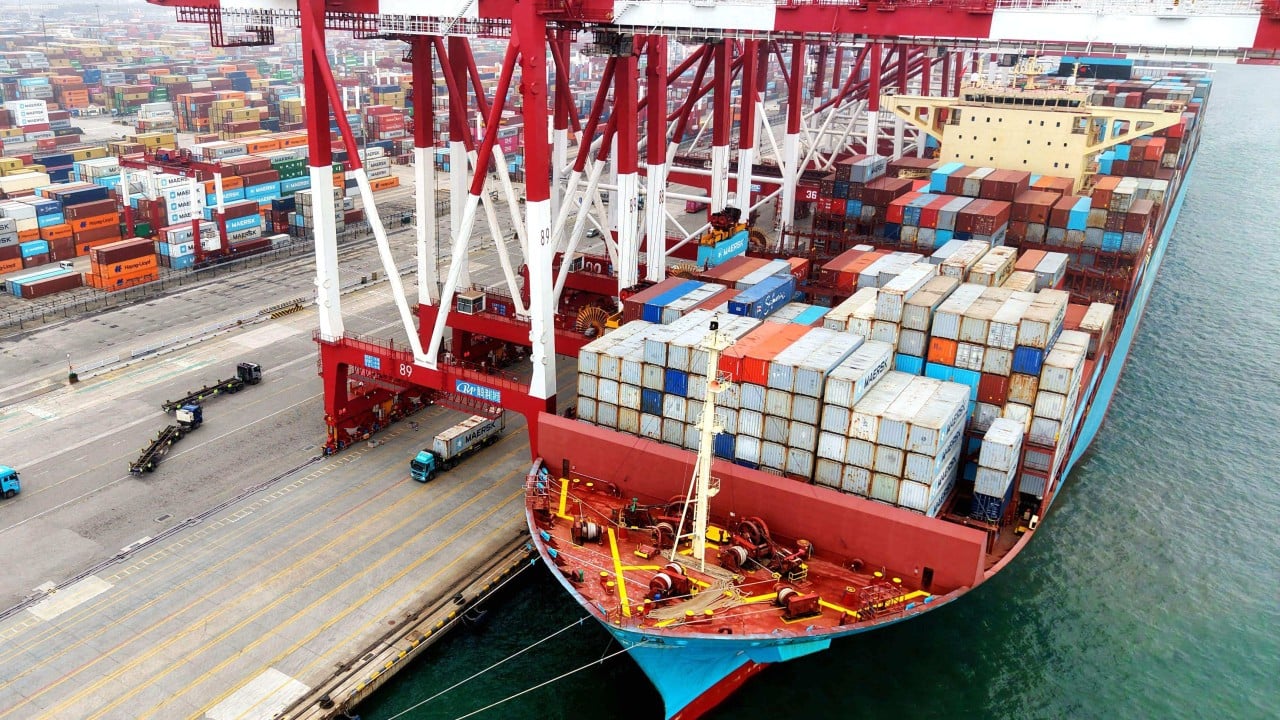
The financial press is panicking over Brussels and Beijing again. Headlines warn of a devastating trade war. Commentators track every diplomatic flight to Paris as if global capitalism hangs in the balance. They tell you that impending tariffs on Chinese electric vehicles will spark a tit-for-tat retaliation that decimates European industry.
It is a neat, dramatic narrative. It is also completely wrong.
The mainstream consensus treats these trade talks as a high-stakes poker game where Europe is trying to win. In reality, European policymakers are playing a game of controlled economic surrender. The theatrical hand-wringing over tariffs hides a brutal truth: the European Union cannot afford a real trade war with China, and Brussels knows it. The current posturing is not a strategy for victory. It is an exercise in damage control disguised as geopolitical defiance.
The Tariff Illusion
Mainstream analysis focuses entirely on numbers. Economists argue over whether a 20% or 35% tariff on Chinese electric vehicles will protect domestic manufacturers like Volkswagen or Renault. They assume that raising the price of an imported vehicle at the port magically levels the playing field.
This assumption ignores the staggering asymmetry in production costs. Chinese EV giants like BYD do not just benefit from state subsidies; they own their entire supply chains. They control everything from lithium mining to battery manufacturing and vertical integration.
According to data from industry benchmarks, Chinese automakers enjoy a cost advantage of roughly 10,000 euros per vehicle compared to European legacy brands.
A standard tariff does not close that gap. It merely eats into a margin that Chinese firms are perfectly willing to sacrifice to secure market share. If Europe slaps a 25% duty on a Chinese EV, the manufacturer absorbs the cost, trims its premium, and still undercuts a European vehicle that relies on fragmented, expensive supply chains.
I have watched automotive executives spend hundreds of millions trying to re-engineer platforms to shave off pennies per component. It is a hopeless battle when your competitor owns the battery gigafactory next door to the assembly line. Tariffs are a 19th-century tool trying to solve a 21st-century structural crisis.
Why Germany Will Always Blink
The media treats the European Union as a monolithic bloc standing firm against Beijing. This ignores the internal fractures that make a unified European trade policy impossible.
Look at Germany. The German economic model is built on exporting premium engineering to the Chinese middle class. Mercedes-Benz, BMW, and the Volkswagen Group generate a massive portion of their global profits within China.
European Automotive Exposure to China (Estimated Profit Dependence)
+------------------+-----------------------------+
| Company          | Profit Share from China (%) |
+------------------+-----------------------------+
| Volkswagen Group | 35% - 40%                   |
| BMW              | 30% - 35%                   |
| Mercedes-Benz    | 25% - 30%                   |
+------------------+-----------------------------+
When Beijing hints at retaliatory tariffs on large-engine European luxury cars, German executives do not call for stronger trade barriers. They call the Chancellery in Berlin.
France, which has far less exposure to the Chinese automotive market, can afford to push for aggressive tariffs to protect its domestic brands like Stellantis and Renault. But the EU cannot execute a coherent strategy when its largest economy is effectively an economic hostage to the counterparty. Every time talks turn serious, Germany blinks. Beijing knows this. Paris knows this. Only the pundits seem blind to it.
The Wrong Question About Overcapacity
Go to any mainstream financial site and you will see variations of the same question: How can Europe stop Chinese industrial overcapacity from crushing local markets?
The question itself is flawed. It assumes that "overcapacity" is a temporary market distortion that can be corrected through negotiation. It is not. It is a deliberate, foundational component of China's economic architecture.
When domestic consumption in China slowed, the state redirected capital into manufacturing, specifically targeting green technologies and advanced electronics. This is not a surplus that can be dialed back because of a tense meeting in Paris. It is an existential export drive.
Instead of asking how to block these goods, European leaders should ask why their own regulatory framework makes it impossible to compete.
Europe chose a path of heavy carbon taxation, high energy costs, and dense regulatory compliance. It attempted to transition to a green economy by penalizing old industries rather than building cheap new ones. China took the opposite approach: build massive, cheap capacity first, then let the scale drive down emissions and costs.
By complaining about overcapacity, the EU is effectively protesting that its competitor built a bigger factory. It is a confession of weakness, not a position of strength.
The Hidden Cost of Retaliation
Let us engage in a thought experiment. Imagine a scenario where the EU ignores German objections and imposes catastrophic, blanket tariffs across multiple sectors—solar panels, wind turbines, EVs, and raw materials.
The immediate result is not a resurgence in European manufacturing. The result is the immediate collapse of Europe's own climate targets.
Europe does not manufacture enough solar wafers or battery cells to sustain its own green transition. If you cut off cheap Chinese imports, the cost of installing solar arrays spikes. The price of buying an electric vehicle becomes prohibitive for the average consumer. The energy transition grinds to a halt because local supply cannot meet demand at an affordable price.
The downside to admitting this is uncomfortable: Europe is hooked on cheap Chinese capital and hardware to meet its own political promises. You cannot declare a trade war on the entity that supplies your infrastructure components without sabotaging your own domestic agenda.
Stop Trying to Save Legacy Auto
The conventional advice given to European policymakers is to shield legacy automakers until they can scale up their own EV production.
This advice is outdated. Legacy automakers are carrying billions in stranded assets—engine factories, transmission plants, and legacy labor contracts that make them fundamentally uncompetitive in an electrified world. Trying to protect them with tariffs is like subsidizing typewriter factories in 1995 to protect them from word processors.
If Europe wants a viable automotive sector, it must stop protecting the status quo.
- Scrap the broad import tariffs. They only provide a false sense of security that delays necessary restructuring.
- Condition market access on localized supply chains. Instead of taxing imported cars, mandate that any company selling over a certain threshold of vehicles in Europe must manufacture the battery cells and assemble the vehicles locally, using regional labor and clean energy grids.
- Accept the destruction of weak brands. Some legacy OEMs will fail. Let them. The capital and talent tied up in failing enterprises need to be redistributed to agile, software-first engineering firms that can actually compete.
This approach is painful. It means factory closures in the short term and political fallout for regional governments. But the alternative is worse: a slow, agonizing decline where European taxpayers subsidize uncompetitive industries while foreign rivals outpace them anyway.
The Paris talks are a performance. They exist to convince voters that leadership is managing the economy. But you cannot negotiate your way out of structural obsolescence. The trade war is already over, and the side that built the factories won.