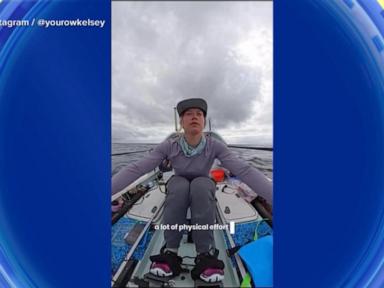
A 31-year-old river guide from New York named Kelsey Pfendler is currently passing the halfway mark of a 2,400-mile solo, unassisted row from California to Hawaii, aiming to become the first American woman to complete the crossing. Traveling in a 24-foot fiberglass Rannoch R25 boat named Lily, she is tracking hundreds of miles ahead of the current women's world record. Yet behind the viral social media videos and celebratory daily updates lies a punishing reality of extreme physical degradation and mental fracture that human bodies are fundamentally unequipped to handle.
Mainstream sports coverage routinely frames extreme endurance feats as simple narratives of grit and athletic triumphs. The reality of solo ocean rowing is much darker, functioning less like a traditional race and more like an extended experiment in sensory deprivation and mechanical maintenance.
The Physiological Cost of the Mid Pacific
To understand the crossing, you must look at the math of human physical decline under continuous, low-intensity duress. Pfendler, an experienced Grand Canyon river guide and former Team USA rafting competitor, is rowing up to 16 hours a day. Operating at this volume requires an intake of roughly 4,000 to 5,000 calories every 24 hours just to mitigate catastrophic muscle wasting.
The diet consists almost entirely of freeze-dried camp rations and dense, high-calorie snacks. Yet even this baseline fuel supply depends on mechanical stability. Early in her voyage, a weather front brought sub-zero wind chills and punishing headwinds that compromised her primary electrical systems, forcing her to temporarily ration her water maker and rely on a backup supply of 25 small water bottles. Without spare water to rehydrate her hot meals, her diet was reduced to dry tortillas and peanut butter while pulling an oar against a relentless westerly wind.
The physical toll is cumulative and structural.
- Salt sores: Continuous exposure to spray combined with the friction of the rowing motion creates deep, infected lesions where the skin meets the seat.
- Muscular atrophy: Because rowers spend months unable to stand upright or walk more than two paces within a cramped stern cabin, their legs experience profound muscle loss, meaning they frequently collapse upon returning to dry land.
- Caloric debt: The body burns fat reserves faster than the digestive tract can process freeze-dried food, resulting in systemic weight loss that saps raw strength during the final thousand miles.
The Mirage of Autonomy
The current women's record for this specific route was set by British rower Lia Ditton in 2020, stopping the clock at 86 days, 10 hours, and 56 seconds. While Pfendler's newer boat design and athletic baseline have kept her well ahead of that pace, the illusion of total isolation is managed by a network of modern technology.
A solo ocean rower is never truly disconnected from global logistics. Pfendler relies on satellite-linked weather routers on shore to plot trajectories through shifting pressure systems, uses an active autopilot system to maintain headings while resting, and carries automated personal locator beacons to summon international maritime rescue in the event of a capsize.
The psychological weight, however, cannot be offloaded to a shore team. During the initial week of the voyage, when headwinds threatened to push her boat back into the California coast, Pfendler averaged fewer than two hours of sleep per day. The resulting sleep deprivation triggers profound auditory hallucinations. The mechanical creaks of the hull, the slap of waves against the rudder, and the hum of the electrical systems regularly morph into the distinct sound of human voices, forcing solo athletes to actively negotiate with their own fracturing perception of reality.
The Commercial Reality of Extreme Adventure
Ocean rowing remains an exceptionally expensive, male-dominated discipline where access is dictated more by fundraising capability than pure athletic prowess. Securing a specialized ocean-going vessel, safety equipment, satellite communications, and logistics support costs upwards of eighty thousand dollars before an oar ever touches water.
This financial barrier has shifted the sport toward high-stakes public relations campaigns. To fund these voyages, modern rowers must double as digital content creators, sending back curated video snippets of dolphins and sunsets to keep sponsors and crowds engaged via satellite link. Earlier this year, another American rower, 25-year-old Taryn Smith, successfully utilized this playbook to become the first American woman to solo row the Atlantic, leveraging heavy social media engagement to boost her campaign.
Pfendler has tied her Pacific crossing to fundraising for the Whale Foundation, a nonprofit addressing mental and financial health within the Grand Canyon river guiding community. This pairing highlights a broader trend in extreme exploration, where the raw, dangerous pursuit of personal limit-testing must be repackaged with external social utility to find traction in the modern sports economy.
The open ocean remains the largest true wilderness on earth, indifferent to records, charity, or digital tracking. When the technical routing succeeds and the weather holds, the crossing is won. But when the electrical systems fail three hundred miles from the nearest coastline, the athlete is left with nothing but a pair of carbon-fiber oars and an empty horizon.