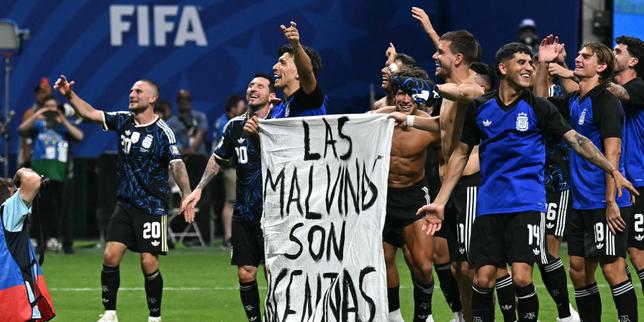
Lionel Scaloni is celebrating. The global football press is swooning. Following Argentina’s grueling path to consecutive World Cup trophies, the narrative has solidified into concrete: this team possesses an mythical, indestructible DNA. They fall behind, they suffer, they stage an "epic squared" comeback, and they lift gold. It makes for beautiful television.
It is also a complete misreading of elite football.
Praising a manager for mastermind comebacks is like praising a ship captain for brilliantly surviving icebergs he steered directly into. Argentina’s back-to-back triumphs do not validate Scaloni’s tactical genius. They expose a systemic flaw in how the Albiceleste manage football matches. Relying on emotional resurrections is not a sustainable blueprint; it is a high-wire act disguised as dominance.
The Myth of Cultivated Suffering
Football romanticism loves a martyr. The prevailing analysis of Argentina’s recent tournament runs focuses heavily on "la Nuestra" mixed with grit—the idea that this squad discovers its best self only when pushed to the absolute brink.
Let's look at the mechanics instead of the poetry.
When a team repeatedly relinquishes multi-goal leads or finds itself chasing games against tactically inferior opponents, it indicates a profound failure in game control. In elite tournament football, control is everything. You choke the life out of the ball. You manipulate space. You force the opponent to chase shadows until the clock runs out.
Argentina under Scaloni frequently does the opposite. They score, they retreat, they cede the midfield, and they invite chaos.
- Phase 1: Early Dominance. Fluid passing, sharp positional rotations, and exploiting half-spaces.
- Phase 2: The Unexplained Retreat. Dropping the defensive line fifteen yards deeper, abandoning the high press, and allowing opposition fullbacks to advance unchecked.
- Phase 3: The Inevitable Collapse. Conceding late goals due to sustained, unnecessary pressure.
- Phase 4: The Individual Rescue. A moment of transcendent brilliance from generational talents or a heroic penalty shootout display.
This is not a tactical masterclass. It is structural dysfunction rescued by world-class execution under pressure.
The Mathematical Insanity of Relying on Chaos
Football analysts frequently treat knockout tournaments as a test of character. Let's look at the math. Knockout football is inherently a low-sample-size environment. A deflection, a mistimed tackle in the box, or a refereeing error decides legacies.
When you intentionally or structurally allow matches to devolve into chaotic, transitional end-to-end spectacles, you are actively increasing the role of variance.
Imagine a scenario where a casino game gives you a 70% chance of winning if you keep the pace slow and structured, but drops to a 52% chance if the game gets fast and unpredictable. Scaloni’s tactical concessions repeatedly push Argentina into the 52% zone.
They have survived because their squad boasts an absurd concentration of technical brilliance and psychological resilience. But using the outcome to justify the process is a classic case of outcome bias. If Emi Martínez doesn't make a desperate, once-in-a-lifetime block with his out-stretched boot, or if a penalty shootout lottery swings the other way, the narrative flips instantly. Scaloni would be eviscerated for tactical naivety. The line between "epic glory" and "catastrophic collapse" is far too thin to be celebrated as a deliberate strategy.
The Cost of the Comeback Strategy
Winning this way extracts a massive physical and psychological tax. The human body can only sustain so many 120-minute wars of attrition before the bill comes due.
I have watched data analysts inside top European clubs dissect the physical load of tournament football. The drop-off in high-intensity sprint capacity between a standard 90-minute match and a match featuring extra time is staggering. By failing to kill games cleanly, Argentina burns through their physical reserves at double the speed of teams like the classic 2010 Spain or even the highly efficient 2018 French side.
Possession Control vs. Chaos Management
| Metric / Approach | The Control Blueprint (Spain 2010 / France 2018) | The Scaloni Chaos Blueprint |
|---|---|---|
| Midfield Behavior After Scoring | Increase pass volume, lower tempo, retain shape. | Direct transitions, vertical attacking, deeper defensive block. |
| Opposition Risk Level | Extremely low; opponent cannot score without the ball. | High; opponent dominates territory and crosses into the box. |
| Energy Expenditure | Low to moderate; ball movement does the work. | Extremely high; constant defensive shifting and desperate recovery sprints. |
| Dependence on Individual Brilliance | Moderate; system creates high-probability openings. | Absolute; requires elite execution to survive defensive collapses. |
The Flawed Questions We Ask About World Cup Winners
When fans ask "How do we build a team with Argentina’s mentality?", they are asking the wrong question entirely. Mentality cannot be manufactured in a training camp, nor should it be used as a primary tactical pillar.
The real question should be: How do we build a tactical framework so superior that we never require a miraculous comeback in the first place?
Pep Guardiola’s Manchester City or Carlo Ancelotti’s Real Madrid (in domestic campaigns) do not aim for epic comebacks. They aim for boredom. They aim to make the final twenty minutes of a football match look like a training session. That is the pinnacle of elite coaching. Turning a World Cup final or semifinal into an emotional roller coaster is an admission that you have lost control of the chessboard.
The Danger of the Blueprint
The football world loves to copy winners. Clubs across South America and Europe are already attempting to replicate this style—fusing passionate intensity with a willingness to suffer.
It will fail miserably for 99% of them.
Argentina possesses an ecosystem that cannot be duplicated. They have a core of players who grew up worshiping their talismanic leaders, creating a unique psychological unity. They have a goalkeeper whose psychological warfare during penalties actively alters the probabilities of the shootout. If you attempt to copy Scaloni's tactical elasticity without possessing the best individual footballers on the planet, you will not stage epic comebacks. You will simply get blown out.
Relying on comebacks is an indictment of game management. Celebrating it as the pinnacle of coaching is a delusion. The greatest teams do not need to show they can fight back from the dead; they simply refuse to die in the first place.
Stop praising the chaos. Demand control.