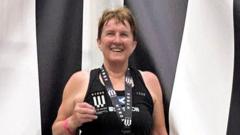
The modern fitness industry often treats the aging body like a depreciating asset. We are told to "listen to our bodies," a phrase that usually serves as a polite euphemism for doing less. But the recent performance of a Scottish grandmother at a Hyrox event in Glasgow has shattered the fragile glass ceiling of geriatric recovery. At 71 years old, after three separate hip replacements, Gina Little didn't just finish a race; she set a world record in her age category. This isn't just a feel-good story for the local evening news. It is a data point that challenges everything we think we know about orthopedic limits and the capacity for high-intensity recovery in the seventh decade of life.
Hyrox is a brutal test of functional fitness. It consists of eight rounds of a one-kilometer run, each followed by a functional workout like heavy sled pushes, rowing, or wall balls. For an athlete with a single joint replacement, the impact of eight kilometers on pavement is a significant concern for surgeons. For an athlete with three, it borders on the impossible. Yet, Little crossed the line in 1:44:09. To understand how this happened, we have to look past the surface-level inspiration and examine the collision of modern surgical hardware, aggressive rehabilitation protocols, and the psychological shift of the "Hybrid Athlete."
The Hardware Evolution
Orthopedic surgery used to be a salvage operation. Surgeons replaced a hip to return a patient to basic walking and a pain-free life, not to send them into a high-intensity interval training (HIIT) environment. The traditional thinking was simple. A prosthetic hip has a shelf life, usually measured in cycles. The more stress you put on it, the faster it wears out. Running was anathema to this model.
But the materials used in today’s hip replacements—highly cross-linked polyethylene and ceramic-on-ceramic surfaces—have changed the wear-rate calculus. We are no longer dealing with the brittle plastics of the 1990s. When a surgeon like those who operated on Little installs a new hip, they are often placing a component designed for a 25-year lifespan under normal conditions. The question for a Hyrox competitor is whether the bone-to-implant interface can handle the shear forces of a 100-kilogram sled push.
The answer lies in the biological integration of the metal. Modern titanium stems are porous, allowing the patient's own bone to grow into the surface of the implant. This process, called osseointegration, creates a bond that can be stronger than the original femoral neck. Little's success is a testament to this structural stability. If the bone hasn't fused perfectly with the metal, the repetitive pounding of a kilometer-long run would cause micromotions, leading to pain and eventual failure. She is proof that with the right surgical technique and patient physiology, the joint can become a permanent part of the kinetic chain rather than a weak link.
The Psychological Barrier to High Performance
The biggest obstacle to a 71-year-old athlete isn't the prosthetic hip. It is the social script. We expect our grandparents to walk, maybe garden, and perhaps play a bit of golf. We do not expect them to do 100 wall balls or 80 meters of burpee broad jumps. Little has completed over 600 marathons. She didn't start this journey as a sedentary retiree; she was already a seasoned endurance athlete before her joints failed. This history is critical.
The phenomenon of the "super-ager" in sport often involves individuals who have maintained a high baseline of metabolic health for decades. This builds a reservoir of mitochondrial efficiency that doesn't disappear just because a joint needs replacing. When Little entered the Glasgow Hyrox, she was competing against a clock and her own history, but she was also fighting the pervasive idea that "wear and tear" is an inevitable, unidirectional slide into frailty.
In reality, the body adapts to the stresses we place upon it. This is the law of progressive overload, and it doesn't stop applying once you hit 65. By training specifically for the functional movements of Hyrox—movements that mimic the basic requirements of human life like pushing, pulling, and squatting—Little reinforced the very musculature that supports her prosthetic hips. Strength training in the elderly is the most effective way to prevent falls and fractures. For Little, it was the key to setting a world record.
The Problem with Conservative Medicine
Traditional medical advice for post-operative hip patients remains remarkably cautious. Most surgeons still advise against high-impact sports. This caution is rooted in risk management; a surgeon is judged by the longevity of the implant, not the quality of the patient's athletic career. If a patient runs a marathon and the hip fails in five years, it is seen as a surgical failure. If the patient sits on a couch and the hip lasts twenty years, it is a success.
But we are seeing a growing rebellion against this metric. The quality-of-life argument is shifting. Athletes like Little are demanding that their doctors provide "sport-capable" joints. This requires a level of communication between surgeon and patient that didn't exist twenty years ago. It requires the athlete to be honest about their goals and the surgeon to be honest about the risks. The risk of revision surgery is real. But for a competitor like Little, the risk of a sedentary life is far greater.
The Training Protocol of a 71-Year-Old Hyrox World Record Holder
To understand how Little achieved a 1:44:09 finish, we have to break down the specific demands of the race. Hyrox isn't just about running. It's about "compromised running"—the ability to maintain a steady pace after your legs have been taxed by a heavy workout.
Little’s training focuses on consistency and volume. She doesn't just run; she trains for the transitions. In a typical session, an athlete might run a kilometer and immediately drop into 30 lunges. For a woman with three hip replacements, the lunges are arguably more dangerous than the running. They require deep hip flexion and stability in the sagittal plane.
Why the Sled Push is the Secret Weapon
The sled push is often the most feared station in Hyrox. It requires immense leg drive and core stability. For a hip-replacement patient, however, the sled push is a unique advantage. Unlike running, which involves significant impact forces, the sled push is a closed-chain exercise with low impact. It builds the gluteal and quadricep strength necessary to protect the hip joint without the jarring force of a foot-strike. By excelling at the strength-based stations, Little can mitigate the time she might lose on the runs where she has to be more mindful of her orthopedic limitations.
The Future of Longevity in Sport
We are entering an era where the chronological age of an athlete is becoming less relevant than their biological age. Little is the vanguard of a movement that refuses to accept the "end-of-career" status that usually follows major surgery. As joint replacement technology continues to improve, we will see more athletes in their 70s and 80s competing at levels previously reserved for the middle-aged.
This trend is not without its controversies. There is a fine line between pushing the limits of human performance and reckless endangerment of one's health. The medical community will have to grapple with how to guide these "extreme" patients. Should we be encouraging a 70-year-old to do burpees on a prosthetic hip? Or is the risk of a secondary fracture too high?
The answer is found in the results. Little didn't just survive the Glasgow event; she dominated it. Her recovery times between training sessions are shorter than those of many athletes half her age. This suggests that the mental fortitude required to complete 600 marathons has a physiological carry-over. The brain learns how to manage pain and exertion, and the body follows suit.
Lessons for the Average Athlete
Most people will never run 600 marathons or compete in a Hyrox world championship. But the lessons from Little’s journey are universal.
- Injury is not an exit strategy. A major surgery like a hip replacement is a milestone, not a stop sign.
- Strength is the ultimate insurance policy. The more muscle you carry, the more protected your joints are, whether they are original equipment or titanium replacements.
- Consistency trumps intensity. Little’s success is built on decades of movement, not a sudden burst of activity in her 70s.
When we look at the footage of Little crossing the finish line in Glasgow, we aren't just seeing an old woman who is fit for her age. We are seeing a high-performance athlete who has successfully integrated advanced medical technology with an unrelenting training philosophy. She is a reminder that the body is far more resilient than we give it credit for.
The real limit on our performance isn't the wear on our joints or the number of candles on our birthday cake. It is the narrative we choose to believe about what we are allowed to do. Gina Little chose to believe she could be a world record holder. And then she went out and did it.
Find a local functional fitness gym and ask about their masters' program. If a woman with three hip replacements can push a 100-kilogram sled across a concrete floor, you have no excuse for staying on the sidelines.