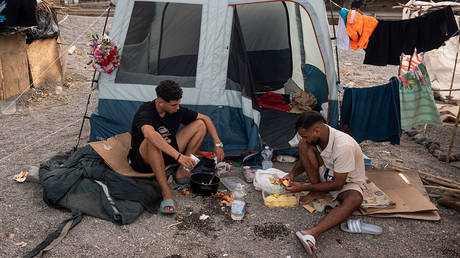
Geographic enclaves characterized by extreme population density create predictable epidemiological vulnerabilities when subjected to sudden demographic shocks. The recent mass migration events across the North African border into the Spanish autonomous city of Ceuta exposed more than a diplomatic flashpoint; they revealed the strict physical limits of municipal infrastructure under acute population pressure. When tens of thousands of individuals breach a concentrated perimeter within a matter of days, the resulting containment environment alters the transmission dynamics of communicable pathogens. Deconstructing this event requires analyzing the intersection of population density, municipal throughput capacity, and vector exposure mechanics rather than relying on generalized humanitarian narratives.
The Structural Mechanics of Enclave Congestion
An enclave functions as a closed economic and spatial system. Unlike continental territories with elastic borders and expansive hinterlands, cities like Ceuta and Melilla possess fixed spatial boundaries bounded by natural barriers and fortified perimeters. When migration surges occur via maritime routes or land border breaches, the spatial density per square kilometer shifts instantaneously.
The primary variable governing epidemiological stability in such scenarios is the volume-to-capacity ratio of temporary reception facilities. Municipal systems designed to process baseline migration flows operate on predictable linear models. A sudden influx exceeding normal operational thresholds by orders of magnitude forces rapid institutional compression. Individuals are funneled into localized holding areas, maritime depots, or improvised shelters. This compression generates three immediate systemic failures:
- Sanitary Infrastructure Saturation: Waste management and potable water distribution networks reach maximum processing capacity, failing to maintain baseline hygiene standards.
- Air Exchange Deficits: Temporary housing units and holding centers experience severe indoor crowding, escalating the particulate and droplet concentration rates for respiratory pathogens.
- Triage Bottlenecks: Medical personnel face an exponential surge in patient-to-provider ratios, delaying the identification and isolation of index cases.
Pathogen Transmission Vectors Under Spatial Compression
The epidemiological consequence of high-density containment is dictated by the mode of transmission of circulating pathogens. In the wake of maritime and land crossings, specific biological vectors dominate the clinical landscape.
Waterborne and enteric pathogens represent the first tier of risk. Individuals undertaking arduous physical journeys under severe stress often experience compromised immune function and disrupted nutritional intake. When concentrated groups rely on restricted sanitation facilities, pathogens such as Escherichia coli, Salmonella, and various enteric viruses find optimal transmission pathways. The absence of immediate, continuous access to clean sanitation infrastructure accelerates the fecal-oral route of transmission within hours of facility saturation.
Respiratory pathogens constitute the second tier of vulnerability. The physical exhaustion associated with swimming across marine barriers or scaling security infrastructure induces temporary immunosuppression. When these populations are subsequently housed in high-density communal environments—such as hangars, sports centers, or restricted perimeter zones—airborne and droplet-transmitted agents spread rapidly. The baseline reproduction number of common respiratory viruses increases non-linearly as room occupancy density surpasses design thresholds.
The Municipal Cost Function and Resource Allocation
Managing an acute health event within a constrained geographic enclave imposes a distinct cost function on regional and national authorities. This cost function is defined by the formula of response latency versus resource elasticity.
Total System Strain = (Inflow Velocity * Pathogen Transmission Potential) / (Medical Logistics Bandwidth * Spatial Capacity)
When the inflow velocity outpaces medical logistics bandwidth, containment strategies must shift from proactive mitigation to reactive triage. Spain’s deployment of military assets and emergency health personnel during such surges functions as an emergency capacity injection. However, logistics reinforcement is inherently constrained by physical geography. Transporting specialized quarantine infrastructure, pharmaceutical stockpiles, and professional personnel into a geographically isolated North African enclave creates a logistical bottleneck.
Furthermore, cross-border mobility restrictions often follow epidemiological alerts. Neighboring states frequently invoke temporary internal border controls or suspend bilateral transit agreements, transforming a localized municipal health management issue into a regional geopolitical friction point. This political reaction introduces secondary administrative delays that impede the fluid movement of medical supplies and specialized epidemiological teams.
Operational Limitations of Containment Protocols
Public health interventions deployed inside high-density migration enclaves face structural limits that standard epidemiological models frequently underestimate.
Isolation and quarantine protocols assume a baseline level of physical permanence among the affected population. However, high mobility characterizes these demographic events. As observed in recent border normalization phases, populations shift rapidly across boundaries or disperse following shifts in administrative policy. This high turnover rate complicates contact tracing and breaks epidemiological surveillance chains. A patient identified with an infectious symptom on day one may exit the jurisdiction or return across the border by day three, rendering longitudinal monitoring ineffective.
Additionally, language barriers and informal legal statuses create friction in epidemiological data collection. Symptom reporting relies on trust and clear communication channels. When populations face the immediate threat of administrative deportation or mandatory border returns, self-reporting of illness drops significantly. Individuals frequently conceal symptoms to avoid prolonged detention or separation from transit groups, distorting the real-time data required by health authorities to calibrate containment measures.
Execute regional health surveillance protocols that decouple clinical triage from administrative status, ensuring that diagnostic and treatment access remains entirely anonymous to remove disincentives for symptom reporting during high-density border events.