Volodymyr Zelenskyy is playing a dangerous game with history, and it's starting to alienate his most vital allies.
For years, Western capitals quietly ignored Ukraine’s domestic efforts to rehabilitate controversial World War II-era nationalist figures. The conventional wisdom was simple: Kyiv needed icons to boost morale against Russian aggression, so looking away from messy historical details was a necessary evil. But a line was just crossed, and the diplomatic blowback is hitting hard.
The latest moves by the Ukrainian president have sparked fierce anger from Israel and Poland. It isn't just about old academic debates anymore. This historical friction now threatens to undermine the very international coalition keeping Ukraine’s war effort afloat. By formally honoring historical groups linked to ethnic cleansing and Nazi collaboration, Kyiv is testing the limits of Western solidarity at the worst possible moment.
The Triggers That Sparked the Crisis
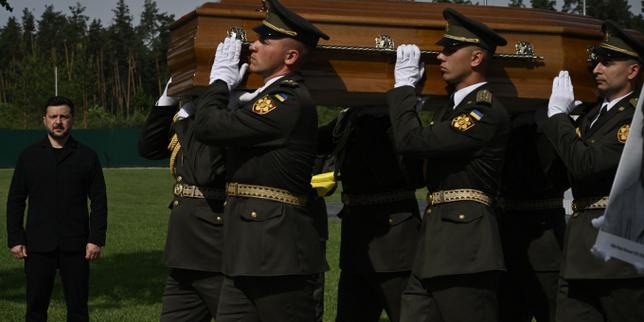
Two rapid-fire decisions from the Ukrainian presidency broke the fragile status quo. First, Zelenskyy presided over a high-profile state reburial ceremony for Andriy Melnyk. Melnyk, a major leader in the pre-WWII Ukrainian independence movement, notoriously pushed for collaboration with Nazi Germany during the early stages of the war. His remains, along with his wife's, were exhumed from Luxembourg and reinterred at the national military cemetery in Kyiv with full state honors.
Right after the reburial, Zelenskyy signed a decree officially renaming a highly decorated Ukrainian special forces unit. The new moniker explicitly brands them as "heroes of the UPA"—the acronym for the Ukrainian Insurgent Army.
To modern Ukrainians, the UPA represents fierce resistance against Soviet tyranny. To Poland and Israel, the acronym triggers memories of brutal, organized massacres.
Warsaw and Jerusalem Fire Back
The backlash was instant and uncommonly severe. Poland has been one of Ukraine's stanchest military and logistical lifelines since the 2022 invasion. Yet Polish President Karol Nawrocki openly threatened to strip Zelenskyy of Poland's highest civilian honor, the Order of the White Eagle, which was awarded to him in 2023.
Nawrocki didn't hold back. He stated that a committee will formally convene next month to review the honor, adding that Zelenskyy's latest actions show Ukraine is "not ready to be part of the European family." His rationale was blunt: you cannot glorify individuals who murdered women and children.
Polish Prime Minister Donald Tusk tried to cool the temperature but still issued a sharp warning. He noted that elevating these historical differences violates Poland's deep historical sensitivity and directly plays into the Kremlin's hands. The political damage is already spreading to legendary figures. Lech Wałęsa, the iconic former Polish president and Nobel Peace Prize laureate, announced on Facebook that he would stop wearing his Ukrainian flag pin, stating he felt personally insulted by the moves.
Meanwhile, Israel’s Foreign Ministry launched its own fierce protest. In a public statement on X, Israeli officials made it clear that there is absolutely no room for ignoring historical truths or erasing the memory of those slaughtered by Nazi collaborators. For a country that has carefully balanced its ties with Kyiv, this move pushed Israel past its comfort zone.
The Bloody History Ukraine Keeps Reinterpreting
To understand why Warsaw and Israel are this furious, you have to look at what the UPA and figures like Melnyk actually did.
The UPA carried out the Volhynia massacres between 1943 and 1945. During this campaign, nationalist forces systematically slaughtered around 100,000 ethnic Poles in what is now western Ukraine. The methods were notoriously horrific, aiming to ethnically cleanse the region to ensure an ethnically pure Ukrainian state after the war. Poland’s parliament formally recognized this slaughter as a genocide in 2016, a designation Kyiv still disputes.
Then there is the issue of the Holocaust. Melnyk’s faction of the Organization of Ukrainian Nationalists (OUN-M) openly collaborated with the Third Reich, hoping Adolf Hitler would grant Ukraine independence. Members of these nationalist factions frequently assisted Nazi forces in hunting down and executing hundreds of thousands of Ukrainian Jews.
When modern Ukrainian decrees blanket these groups under the generic label of "freedom fighters," it erases the victims completely.
Kyiv’s Defensive Counterpunch
Ukrainian officials aren't backing down. Instead, they accuse their neighbors of weaponizing history during an existential crisis. Andriy Sadovyi, the influential mayor of Lviv, lashed out at Polish leadership on social media, telling them to stop nitpicking the names of military units while Ukrainian soldiers are holding the largest frontline in Europe since 1945.
Serhiy Sternenko, an adviser to Ukraine's defense ministry, went even further. He accused Poland of deliberately inciting conflict against the very state acting as its shield against Russian imperialism.
The prevailing sentiment in Kyiv is one of frustration. They believe survival in 2026 trumps historical score-settling from 1943. But that mindset ignores a crucial reality: foreign aid is driven by public and political goodwill, and goodwill isn't an infinite resource.
The Real Danger of Historical Blind Spots
Zelenskyy’s strategy is clear but short-sighted. He wants to channel the raw, uncompromising energy of wartime nationalism to keep his troops motivated. The problem is that Western European and American support is built on the narrative that Ukraine is a modern, liberal democracy fighting for Western values. Glorifying mid-century fascists destroys that narrative.
It also hands Vladimir Putin a massive propaganda victory. For years, the Kremlin has falsely labeled the entire Ukrainian government as a "Nazi regime" to justify its brutal invasion. When Zelenskyy gives state burials to Nazi collaborators and names elite military units after groups that butchered Polish civilians, he gives Moscow's propaganda machine actual ammunition.
How Kyiv Can Fix This Right Now
Ukraine doesn't have to abandon its sovereignty or its defense to patch up these alliances. If Zelenskyy wants to stop the bleeding, his administration needs to take immediate, pragmatic steps to separate modern military valor from historical atrocities.
- Freeze the symbolic renaming decrees: Put a moratorium on renaming active military units after controversial WWII entities. Stick to naming units after modern battle honors like Mariupol, Bakhmut, or Kherson.
- Allow joint historical exhumations: Poland has repeatedly demanded the right to exhume and properly bury the Polish victims of the Volhynia massacres. Kyiv has dragged its feet for years. Granting immediate access to Polish archeologists would signal genuine goodwill.
- Involve international historians: Create a joint commission with Polish and Israeli historians to vet state-level memorials before they are made public.
Nationalism can be an effective shield in a defensive war, but it makes for terrible foreign policy. If Ukraine keeps alienating the very neighbors providing its ammunition and hosting its refugees, it may find itself fighting alone. Kyiv needs to realize that acknowledging historical crimes isn't a sign of weakness; it's exactly what a mature, European democracy does.