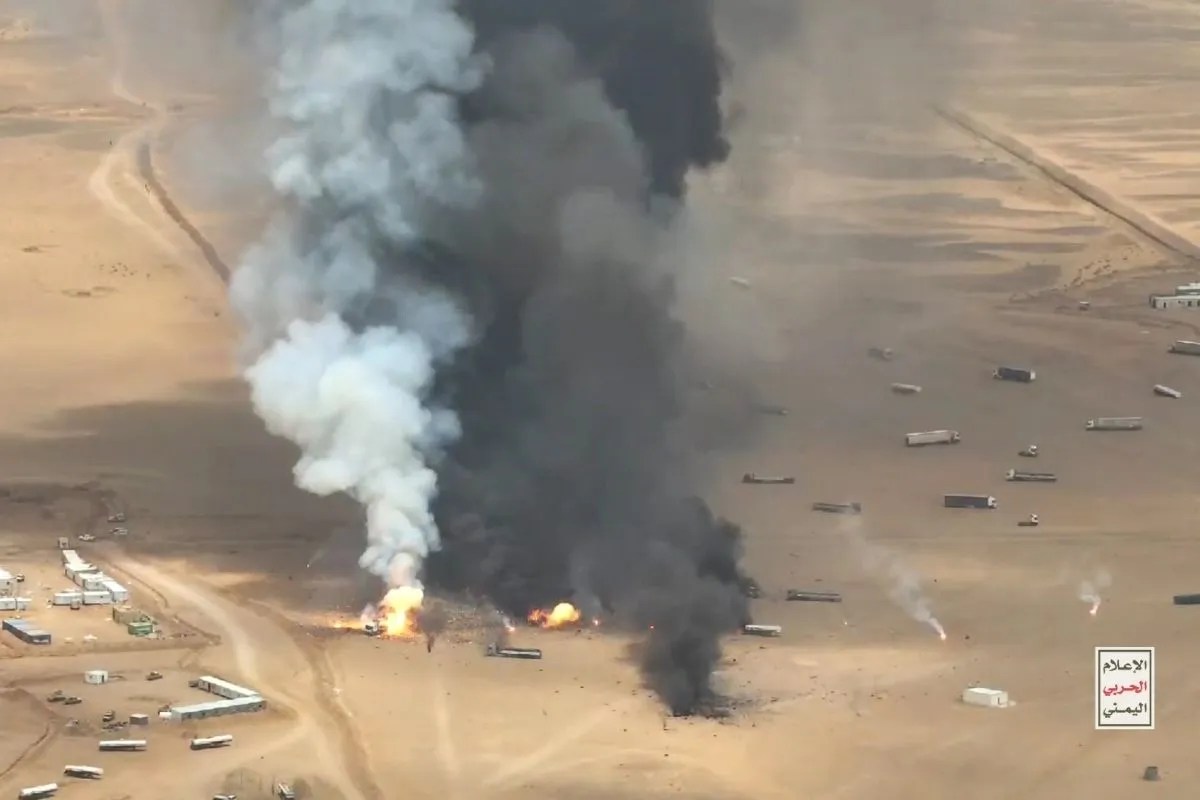
Standard headlines treat a strike on a military facility in Yemen as just another flare-up in an endless civil war, missing the structural reality that a single base attack alters deterrence thresholds across the Arabian Peninsula and the Red Sea. When Houthi forces and regional coalitions exchange strikes on bases, airports, and coastal positions, the conflict stops being a localized insurgency and becomes a coupled system of escalation.
To read what is actually happening beneath the "dangerous turn" narrative, a reader needs three analytical tools: a breakdown of the escalation mechanics behind base strikes, a separation of verified facts from contested claims, and an operational model for shipping, energy, and security exposure. The first priority is separating kinetic shock from structural consequence. For an alternative look, check out: this related article.
The Architecture of Escalation in Yemen
Competitor coverage typically flattens a base strike into a linear chain: one side hits a target, the other retaliates, and regional tension rises. That framing misses why military bases act as high-leverage nodes in asymmetric warfare. A base is not merely a cluster of barracks and runways; it is a command-and-control hub, a logistics staging point, and a political signal of sovereign reach.
The escalation dynamic in Yemen operates through four interacting mechanisms: Further analysis on this trend has been shared by USA Today.
- Asymmetric cost-exchange ratios: Low-cost drones and ballistic or cruise missiles allow a non-state or semi-state actor to impose high defensive costs and operational disruption against high-value infrastructure, airports, and military sites. Even when air defenses intercept incoming projectiles, the expenditure of expensive interceptors and the temporary closure of critical hubs create real friction.
- Geographic chokepoint leverage: Fighting along Yemen's Red Sea coast and near the Bab el-Mandeb Strait connects ground advances directly to global maritime trade. The strait is roughly 29 kilometers wide with narrower effective navigation channels, meaning coastal control or credible strike threats can force commercial vessels onto longer routes around the Cape of Good Hope.
- Command and coalition strain: Renewed offensive pressure and cross-border strikes test military command structures, force leadership adjustments, and expose friction over external military backing.
- Spillover coupling: Ground fighting in Yemen intersects with broader regional confrontation involving Iran and Gulf states, turning local tactical gains into bargaining chips across multiple fronts simultaneously.
Consider a practical example from maritime commerce. A shipowner does not wait for every vessel in a fleet to take direct fire before rerouting. If perceived risk rises around coastal launch zones and key straits, insurance premiums climb, transit times lengthen, and schedules slip across entire trade lanes. That behavioral shift happens at the level of risk pricing, long before a single shipping lane is physically blockaded.
Separating Verified Facts from Educated Hypotheses
A rigorous analysis cannot treat every battlefield claim as settled fact. In active conflicts involving military bases, airstrikes, and cross-border projectiles, information is contested from the outset. Coalition spokesmen emphasize degrading missile and drone workshops or tunnel infrastructure, while Houthi-aligned authorities report civilian casualties and strikes on industrial or commercial sites, often without independent verification.
The second analytical step is drawing a hard line between what is established and what is inferred.
Known Facts and Structural Indicators
- Renewed multi-front intensity: Fighting in Yemen has escalated markedly since late 2026 offensives began, involving clashes across governorates such as Taiz, Al-Jawf, Al-Bayda, and Red Sea coastal districts.
- Cross-border targeting: Houthi forces have conducted drone and missile attacks targeting sites in Saudi Arabia, including aviation and energy-related infrastructure, prompting retaliatory coalition air strikes inside Yemen.
- Maritime transit compression: Red Sea and Bab el-Mandeb transit volumes have remained well below pre-crisis norms even as oil flows through the strait have fluctuated with broader regional rerouting.
Educated Hypotheses and Contested Claims
- Exact casualty and damage tallies: Figures cited by warring parties—whether regarding military losses, interceptor success rates, or civilian fatalities at specific sites—frequently diverge and lack independent on-the-ground verification.
- Trajectory toward major urban capture: Analysts debate whether recent territorial shifts along coastal corridors and southern fronts will culminate in a decisive push on major population centers like Aden or remain a war of attrition aimed at strengthening negotiation leverage.
- External intervention limits: While diplomatic reporting indicates Gulf states seek stronger external military backing, Washington's reluctance to commit to direct large-scale intervention remains a variable subject to shifting political and regional pressures.
Why Regional Tension Spreads Beyond the Battlefield
Readers often ask why a clash over a military base in Yemen rattles markets and capitals far from Sanaa or Aden. The reason lies in network interdependence rather than physical proximity. Modern supply chains, energy markets, and security pacts link local flashpoints to distant balance sheets.
When military bases and strategic corridors come under pressure, the transmission runs through three channels. First is energy and freight repricing: chokepoints like Bab el-Mandeb carry crude, refined products, and container traffic, so any escalation near the strait forces logistics planners to weigh fuel burn, charter rates, and transit delays. Second is deterrence credibility: when a military base or major transport hub is struck or threatened, observers test how reliably air defenses, command chains, and allied commitments hold under sustained pressure. Third is negotiation leverage: actors rarely fight purely for territory in isolation; they use battlefield pressure to improve their standing before ceasefires or diplomatic settlements.
A tactical strike on a military base matters strategically when it changes what adversaries believe they can hit and what commercial operators believe they can insure.
📖 Related: What Falls From a Quiet Sky Over Abyei
Take an enterprise logistics manager running a regional distribution network. Even if their warehouses sit hundreds of miles from the Red Sea, a spike in maritime transit times or aviation disruptions in the Gulf forces buffer-stock adjustments, alternate routing, and cash-flow tie-ups. The military event becomes a working-capital problem.
Operational Playbook for Risk and Decision-Makers
Understanding the mechanics only creates value if translated into disciplined decision-making. Anyone tracking regional security, supply chains, or sovereign exposure can apply a five-step operational sequence whenever base strikes and regional tensions rise:
- Map exposure by chokepoint and node, not headline count. List every supplier, shipping lane, aviation hub, or facility exposed to the Red Sea, Gulf of Aden, or nearby airspace rather than reacting to daily skirmish reports.
- Track leading operational indicators over rhetoric. Watch port calls, vessel rerouting patterns, airspace closures, and air-defense alert cycles ahead of official communiqués.
- Separate tactical attrition from strategic inflection. Distinguish routine exchanges of fire from developments that alter control of coastal launch areas, airbases, or key transit corridors.
- Stress-test lead times and contingency buffers. Model extended transit durations and higher freight or insurance costs across critical inputs before bottlenecks force emergency spot buying.
- Anchor diplomatic expectations to leverage incentives. Assume parties will push for tactical advantage up to the point where negotiations or external constraints reshape their cost-benefit calculus.
Limitations and Blind Spots
This framework has clear limits. Intelligence on tunnel networks, mobile launchers, and covert supply routes is inherently incomplete, so external observers cannot verify how much strike capacity remains intact after any given raid. Political decisions in regional capitals and external powers can also reverse faster than logistics models predict, especially if a single high-casualty incident alters domestic politics overnight. Finally, rerouting around maritime chokepoints reduces exposure to localized attacks, yet it introduces longer voyage times, higher fuel consumption, and congestion elsewhere in global trade networks.
Strategic Action
Treat any escalation around Yemeni military bases and coastal corridors as an early-warning signal for maritime freight volatility and regional deterrence stress, and immediately audit supply-chain lead times, alternative routing options, and war-risk exposure across Red Sea and Gulf transit lanes before transit disruptions compound.


