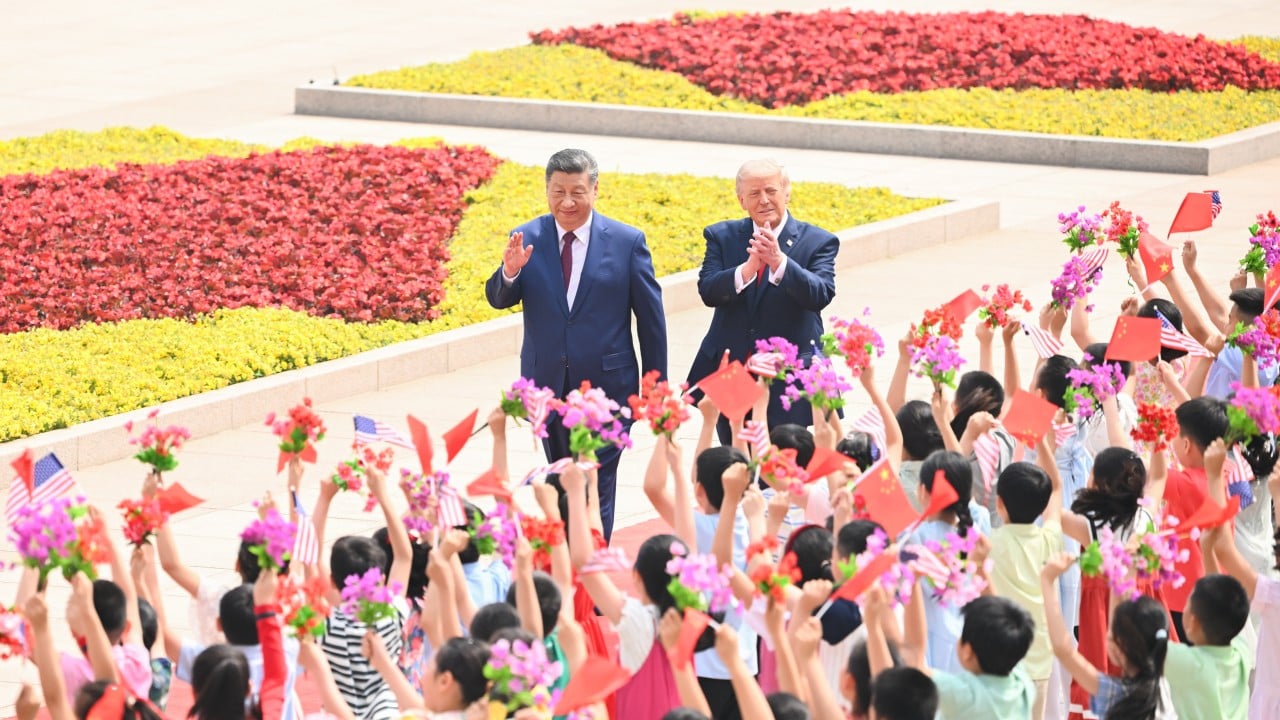
Donald Trump just touched down in Beijing for the first time since his return to the White House, and the cameras are capturing exactly what both sides want you to see. There are children waving flags, a red carpet that seems to stretch for miles, and plenty of talk about a "fantastic relationship" between two of the world's most powerful men. Trump is calling Xi Jinping a "great leader," and Xi is talking about avoiding the "Thucydides Trap"—the historical tendency for a rising power to clash with an established one. On the surface, it’s a masterclass in optimistic stagecraft.
But don't let the handshake photos fool you. Beneath the smiles at the Great Hall of the People, the structural reality of the US-China relationship is more fractured than it's been in decades. This summit isn't about solving the rivalry; it's about managing it so the whole thing doesn't go off the rails before the American midterm elections.
The Business Titans are Back in Town
If you want to know what this meeting is actually about, look at the passenger list on Air Force One. Trump didn't just bring diplomats; he brought the architects of the American tech and finance sectors. Elon Musk, Tim Cook, and Nvidia’s Jensen Huang are all there. This is a "Board of Trade" summit disguised as a diplomatic visit.
Trump’s first big ask is simple and predictably bold. He wants Xi to "open up" China so these tech giants can "work their magic." It sounds like classic Trump rhetoric, but there's a desperate edge to it. The US needs those rare earth minerals that China controls with an iron fist, especially as the American military depletes its stockpiles of precision-guided munitions in the Middle East.
On the flip side, China is starving for the very chips Jensen Huang’s Nvidia produces. They need high-end semiconductors to fuel their AI ambitions, which are currently hitting a wall due to US export bans. It’s a classic hostage exchange: we’ll give you the brains (chips) if you give us the brawn (minerals).
The Taiwan Elephant in the Room
While the business leaders talk about soybeans and Boeing jets, the real tension is simmering over Taiwan. In December, the Trump administration approved an $11 billion arms package for the island, but the hardware hasn't moved yet. Xi wants that package dead.
People close to the negotiations suggest Beijing is pushing for a massive shift in how the US talks about Taiwan. They don't just want the US to "not support" independence; they want an explicit statement of opposition. Trump has already hinted he’s willing to discuss the arms package with Xi. That’s a massive departure from decades of US policy. It signals that for the right price—perhaps a massive purchase of American agricultural goods to satisfy Trump’s base—the security of Taiwan might be on the table.
The Iran War and the Energy Crisis
You can't talk about this summit without mentioning the chaos in the Middle East. The Strait of Hormuz is currently a mess, and the US Navy is out there intercepting tankers. This is a direct hit to China, which is Iran’s biggest crude oil customer.
Xi is understandably furious that American blockades are choking off his energy supply. Meanwhile, Trump is dealing with soaring oil prices at home that are eating away at his approval ratings. They both have a massive incentive to fix the "Iran problem," but for completely different reasons. Xi wants his oil; Trump wants to look like the peacemaker who lowered your gas prices before you head to the voting booth in November.
Why the Optimism is Fragile
The "Busan truce" from last autumn was supposed to keep things quiet, but it’s a shaky peace. The US Supreme Court recently knocked down some of Trump’s "Liberation Day" tariffs, forcing the administration to scramble for new ways to keep the pressure on Beijing. China hasn't forgotten that. They’ve spent the last few years building up their "anti-foreign sanctions" toolkit. They aren't the same reactive power they were in 2017. They’re confident, they’re prepared, and they know Trump is on a deadline.
Common Misconceptions about the Summit
- "It’s a New Trade Deal": Honestly, it’s more of a ceasefire extension. A formal, comprehensive trade deal is years away, if it ever happens.
- "The Personal Relationship Fixes Everything": Trump loves the "strongman" vibe Xi puts off, but personal chemistry doesn't change the fact that both countries are competing for the same technological and military dominance.
- "Decoupling is Happening": Total decoupling is a myth. You can't decouple when Apple and Tesla are basically rooted in Chinese manufacturing soil.
What Happens When the Cameras Stop Clicking
The likely outcome of this week in Beijing is a series of symbolic wins. We’ll see announcements of "purchase commitments" for American corn and planes. We might see the formalization of a "Board of Trade" to handle non-sensitive business disputes. These are the "pretty bandages" I mentioned earlier.
But the underlying infection—the race for AI supremacy, the battle over the South China Sea, and the fundamental distrust between Washington and Beijing—isn't going anywhere. Both leaders are buying time. Xi needs time to fix a sputtering Chinese economy, and Trump needs time to secure his domestic legacy.
If you're looking for a sign of true long-term stability, don't look at the joint statements. Look at the rare earth export licenses and the delivery dates on those Taiwan-bound missiles. That’s where the real story is hidden.
Your Next Moves
If you're an investor or a business owner, don't get swept up in the "better than ever" headlines.
- Watch the Rare Earths: If China actually relaxes its licensing, it’s a sign of a real, albeit temporary, thaw.
- Diversify Your Supply Chain: The risk of a "snap-back" in tariffs is high, especially after the 150-day bridge tariffs expire this summer.
- Monitor AI Regulation: The communications channel being set up for AI is a space to watch for new export hurdles.
The summit provides a breather, but the race is still on. Don't get comfortable.
:max_bytes(150000):strip_icc():focal(819x186:821x188)/Murdaugh-Family-e90854a716884d608fb6fd925e18d840.jpg)
