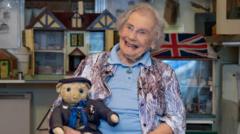
Time has a way of stealing things. It takes the sharp edges off memories, fades the vibrant reds of a favorite woolen coat, and quietly packs away the boxes of our youth into the dark corners of the attic. Most of us watch this happen with a quiet, helpless sigh. We accept the drift. We grow up.
Anne Errington did something entirely different. If you found value in this article, you might want to check out: this related article.
She held her ground. For more than a century, she preserved the exact pieces of a childhood that began before modern commercial aviation, before the Great Depression, and before the world was mapped in the ways we recognize today. While empires rose and fell, and centuries turned over like autumn leaves, Anne kept watch over a tiny universe made of wood, cloth, and painted tin.
To understand what she built is to understand the deep, aching human need to anchor ourselves to something that cannot change. For another angle on this event, see the recent coverage from Refinery29.
Picture a world in 1925. The radio was a wondrous novelty crackling in the corner of the parlor. Horse-drawn carts still shared cobblestone streets with sputtering motorcars. In a modest home, a little girl named Anne received a gift that would outlast almost every person she ever knew. It was not a digital screen or a fleeting trend. It was a dolls' house, populated by tiny residents with porcelain faces and hand-sewn garments.
Children play with toys and leave them behind. It is the natural order of things. The broken doll is tossed into the dustbin; the wooden block is lost beneath the floorboards. We trade our imaginary kingdoms for taxes, mortgage payments, and commuting schedules. We learn to be serious.
Anne refused the trade.
Decades passed. The dolls stayed. They did not age, even as the mirrors told a different story to the woman looking into them. They survived World War II in the dark safety of a cupboard. They survived the shifting tides of British suburbia, the rise of television, the birth of the internet, and the dizzying acceleration of a digital age that moves too fast to catch its breath.
When you live to be one hundred and one years old, you become a ghost in your own timeline. Friends vanish. Neighborhoods are paved over. The language itself mutates. In that vast, echoing expanse of time, Anne had her small companions. They were a bridge across an unbridgeable chasm.
Then came the museum.
It is easy to imagine a dusty archive when you hear the word museum. You think of glass cases, hushed tones, and the sterile smell of conservation labs. But Anne’s creation is something else entirely. It is a portal.
Located in Northumberland, the collection is a testament to what happens when personal nostalgia collides with historical preservation. Visitors do not simply look at miniature furniture; they step backward through a century. Every tiny chair, every minuscule teacup, every hand-stitched rug carries the fingerprints of an era that has otherwise dissolved into text books.
The physical reality of the museum is striking. There are miniature larders stocked with tiny provisions that mirror the rationing restrictions of wartime Britain. There are tiny brass fenders that caught the coal smoke of hearths long since gone cold. These are not merely toys anymore. They are artifacts of emotion.
Consider what it takes to care for something for a hundred years. It requires patience that borders on the sacred. It demands a refusal to let go of the things that anchor our identity. In an era obsessed with minimalism, decluttering, and throwing away anything that does not spark immediate utility, Anne’s life stands as a radical, beautiful rebellion.
She kept the dolls because they remembered when her mother was young. She kept the house because it held the echoes of laughter that the wind took away decades ago.
We live in a culture that worships the new. We upgrade our phones every two years, discard our wardrobes every season, and treat our own personal histories as drafts to be deleted. We chase momentum. Yet, standing in front of Anne’s dolls' house, a strange and powerful realization takes hold. We are starving for permanence.
We want to know that something we loved as children still matters. We want to believe that the essence of who we were at seven years old is not completely buried beneath the weight of who we had to become at seventy.
Anne Errington understood this without needing a philosophy degree. She simply lived it.
When the museum opened its doors, letting the public gaze upon the miniature world she had protected for a lifetime, it was not just an exhibition of vintage toys. It was an act of sharing a sanctuary. She invited strangers into the most intimate room of her memory.
The dolls stare out from their tiny windows with unblinking, painted eyes. They do not know that empires collapsed outside their walls. They do not know that the girl who dressed them grew old, watched the world transform beyond recognition, and eventually became a centenarian. They only know that they are safe. They are home.
And in the end, isn't that what we are all looking for? A corner of the universe where time stops its relentless march, where the dust of the world cannot settle, and where the things we loved when the world was wide and bright remain waiting for us, exactly as we left them.