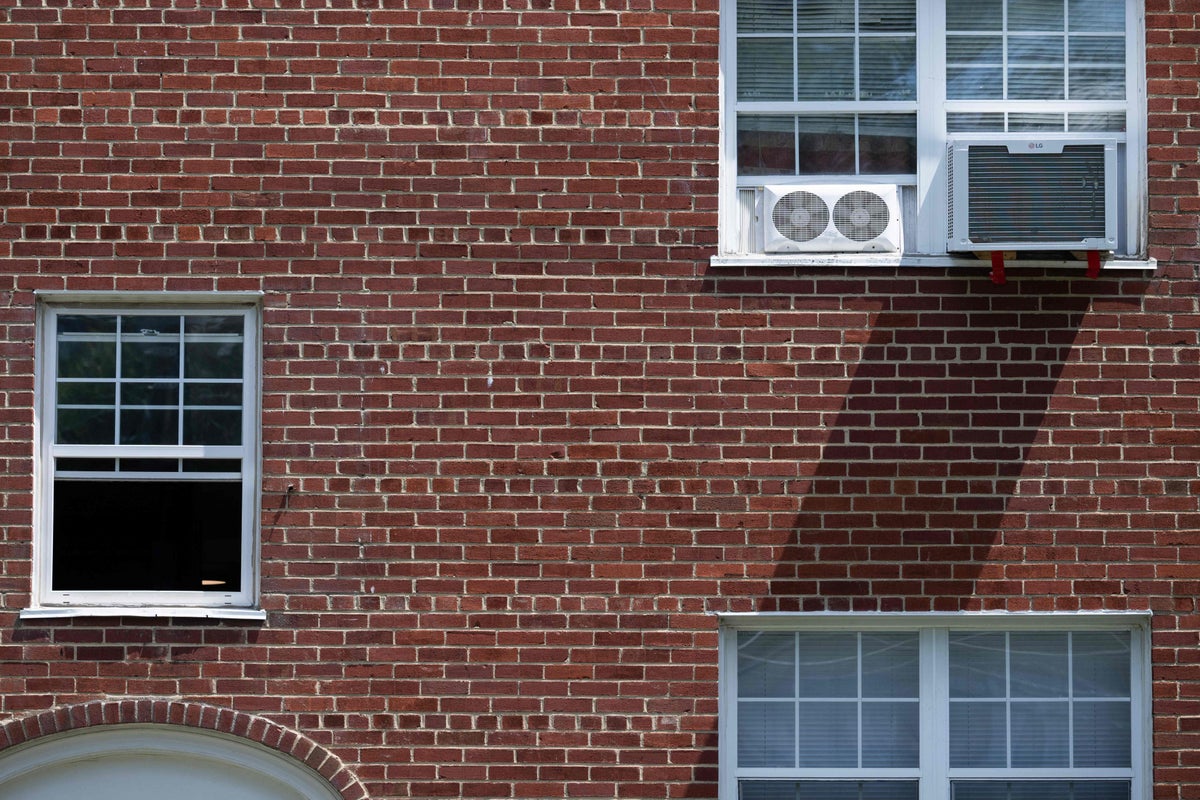
The stucco on the south-facing wall of Matteo’s apartment building in Milan has a specific, terracotta hue. For forty years, that color meant warmth. It meant the golden hour of Lombardy, the slow fade of a July afternoon into a crisp evening where you could sit on the balcony with a glass of local wine.
Not anymore. Don't miss our earlier article on this related article.
Lately, that terracotta wall feels like the side of an industrial kiln. By 3:00 PM, the brick absorbs heat until it radiates a heavy, breathless oppression straight into his living room. The air doesn't move. It sits on your chest. Shadows offer no relief because the pavement itself is cooking. Matteo, a schoolteacher who prided himself on surviving fifty summers with nothing more than a ceiling fan and a block of ice in a ceramic bowl, finally broke down. He went online, looked at his savings, and bought a machine he always associated with sterile American offices or sprawling malls in Dubai.
He bought a split-system air conditioner. If you want more about the context here, Business Insider provides an informative breakdown.
Matteo is not an anomaly. He is part of a massive, quiet migration of comfort. Across Spain, France, Italy, and southern Germany, millions of people are making the same concession. A continent that historically viewed residential air conditioning as an unnecessary, slightly decadent American luxury is rapidly bolting white plastic compressors to its historic facades.
This isn't just a story about a change in weather. It is a story about a tectonic shift in global business, where the desperation of a warming Europe is fueling an unprecedented gold rush for appliance manufacturers half a world away.
The Myth of the Temperate Continent
For generations, European architecture relied on a simple philosophy: build thick walls, shut the shutters during the day, and let the night air do the work. It was a beautiful, sustainable rhythm. It worked because the heat was a visitor, not a permanent resident. A heatwave meant three days of ninety-degree weather, followed by a thunderstorm that cleared the slate.
That rhythm is broken.
The heatwaves now arrive in June and refuse to leave until September. They have names like Cerberus and Lucifer. When the night-time temperature refuses to drop below 25°C (77°F) for two weeks straight, thick stone walls stop acting as insulation. They become thermal batteries, storing the agony and radiating it inward long after the sun goes down.
Let's look at the cold reality behind the sweat. Data from the European Environment Agency reveals that Europe is warming twice as fast as the global average. In cities like Madrid and Rome, the number of days requiring intensive cooling has doubled over the last three decades.
Yet, historical penetration of residential cooling in Europe hovered below 10 percent for decades. Compare that to the United States or Japan, where adoption sits comfortably above 90 percent. For a long time, Asian air conditioning giants looked at Europe and saw a fortress of stubborn tradition. Europeans didn't want the noise. They didn't want the draft. They didn't want the electricity bill.
Then came the summer of 2022, followed by the relentless scorchers of 2023 and 2024. The fortress walls didn't just crack; they crumbled.
The Electronics Giants Waiting in the Wings
While Europe sweltered, corporate boardrooms in Osaka, Seoul, and Zhuhai were watching the charts spike.
Manufacturing air conditioners is a game of immense scale and razor-thin margins. Companies like Daikin, Mitsubishi Electric, LG, and Midea operate factories that can churn out millions of units a year. For decades, their primary growth engines were the booming middle classes of Southeast Asia, China, and India.
Europe was always the holy grail—a wealthy market with massive purchasing power, if only they could be convinced to buy.
Consider what happened when the heat shifted from uncomfortable to dangerous. Demand didn't just rise; it bottlenecked. Supply chains that were used to shipping a modest number of premium units to southern Europe were suddenly asked to supply every hardware store from Naples to Berlin.
Daikin, a Japanese behemoth, didn't just ship more boxes from Asia. They poured over 300 million euros into expanding their manufacturing hubs in Belgium and the Czech Republic, realizing that the fastest way to win a climate race is to build the weapons on the ground. They understood that in a crisis, the company with the inventory wins.
When a homeowner is sitting in a 38°C (100°F) bedroom at midnight, they don't care about a three-week shipping delay for a specific model. They want whatever machine can be installed tomorrow.
The Chinese giant Midea followed a similar playbook, aggressive with pricing and heavily pushing smart, inverter-based systems tailored for European energy regulations. The result? Asian stock tickers became a direct reflection of European meteorological suffering. Every time the thermometer crossed 35°C in Paris, stock values in Tokyo and Shenzhen found a fresh breeze.
The Invisible Strains of a Cool Room
There is a deep irony humming inside every air conditioning unit. To understand it, we have to look at how these machines actually work.
An air conditioner does not create coolness. That is a common misconception. Instead, it acts as a heat pump in reverse. It grabs the heat from inside your bedroom and forcefully throws it outside, using a chemical refrigerant to bridge the gap.
Think about a row of twenty apartments on a narrow street in Florence. If every apartment installs a unit, forty or fifty degrees of collective heat are being pumped directly into the narrow alleyway outside. The air conditioner cools the individual but cooks the neighborhood. This creates what urban planners call the micro-urban heat island effect. Your compressor’s exhaust is making your neighbor’s apartment hotter, practically forcing them to buy a unit of their own.
It is a perfect, self-perpetuating business model. It is also an ecological tightrope.
Then there is the grid. European electrical infrastructure was designed for a winter peak. Power grids were built to handle the massive load of heating systems running in January. Summer was supposed to be a time of low demand, a period when power plants could go offline for maintenance.
Now, the peak is flipping. In July, millions of compressors kick on simultaneously at 2:00 PM, precisely when the sun is hottest and the grid is already stressed by ambient temperature. Countries like Greece and Italy have had to scramble to reinforce their distribution networks to prevent rolling blackouts. The very tool used to escape the climate crisis threatens to break the infrastructure meant to protect us from it.
The Premium on Silence and Discretion
Selling an air conditioner to an Italian or a Frenchman requires a completely different strategy than selling one to an American.
An American consumer is often content with a loud, vibrating box sticking out of a window frame, held together with duct tape and hope. To a European, that is an architectural crime. European windows open inward; they don't slide up and down. Furthermore, historical preservation laws in cities like Seville or Vienna mean you cannot simply drill a massive hole through a 300-year-old stone facade or hang a rusty metal box outside a baroque balcony.
This cultural barrier forced Asian manufacturers to innovate. They couldn't just sell cooling; they had to sell invisibility.
The focus shifted heavily toward "monoblock" units that require only two small vents through the wall, or ultra-thin premium split systems that blend into the interior design like a piece of minimalist artwork. Silence became the ultimate engineering metric. Brands like Mitsubishi invested heavily in acoustic engineering, designing fan blades that mimic the silent flight of an owl.
They also had to tackle the terrifying specter of European energy bills. With electricity prices in Europe skyrocketing over the last few years, running an old-school, power-hungry AC unit is a financial death sentence for a middle-class family. Manufacturers leaned heavily into inverter technology—essentially a cruise-control system for your compressor. Instead of turning on at maximum power and shutting off completely, an inverter unit sips electricity, maintaining a constant temperature with a fraction of the energy.
It was a brilliant pivot. By framing the air conditioner not as an environmental villain, but as an efficient, elegant piece of home technology, they managed to bypass the traditional guilt associated with high-energy appliances.
The New Vernacular of Home
Walk down a residential street in Madrid or Athens this evening. If you listen closely, underneath the sound of scooters and evening chatter, you will hear a new baseline hum. It is the low, steady vibration of thousands of fans spinning inside metal cages, transferring the interior misery of Europe into the global atmosphere.
Matteo’s living room is now a steady, pristine 24°C. He keeps the windows tightly shut, a habit that still feels deeply unnatural to his elderly neighbors who prefer to keep their doors open to the stairwell to catch a stray breeze. His apartment feels different now. It feels isolated from the city outside, a small, climate-controlled bubble of predictability.
He feels a complex mix of relief and unease. He can sleep again. His blood pressure has dropped. He can work from home without his fingers slipping on the keyboard from sweat. But he also knows that his comfort is being manufactured by a corporation across the globe, powered by a fragile grid, and paid for with a monthly bill that makes him wince.
The white box on the wall is no longer an appliance. It has become an essential piece of survival gear, a silent witness to the moment a continent had to redefine what it means to be home.