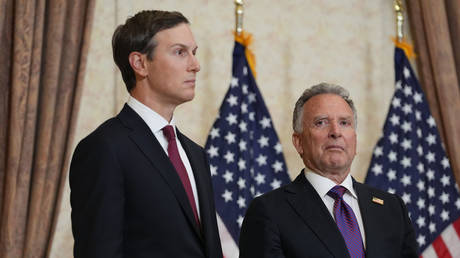
The winter air in Moscow carries a particular kind of silence. It is not the soft, insulating quiet of a gentle snowfall, but a heavy, compressed pressure that seems to freeze time itself against the grand, austere facades of the capital. Inside a private dining room tucked away from the icy draft of the streets, the clink of porcelain is measured. The stakes are immense. Yet, the men seated around the polished mahogany table speak in low, deliberate tones.
Jared Kushner and Steve Witkoff did not fly halfway across the globe for a casual winter tour.
When private citizens with deep ties to high-stakes American politics step onto the tarmac in Russia, the world watches. Analysts scramble for cable news segments, foreign ministries issue cautious statements, and the speculative machinery of international relations grinds into overdrive. But standard reporting misses the fundamental human architecture of these moments. Behind every diplomatic handshake, secret channel, or backroom negotiation lies an intricate web of personal ambition, historical weight, and the desperate, universal desire to alter the trajectory of a fractured world.
Consider the room.
On one side sits the legacy of American political royalty mixed with modern real estate pragmatism. On the other, the formidable, unyielding machinery of the Russian state, where every gesture is calculated and every silence speaks louder than a prepared speech. Why are they here? The easy answer points to grand geopolitical bargains, vast sums of capital, or whispered blueprints for peace. The truer answer is far messier. It involves the heavy friction between public optics and private reality.
For years, the narrative surrounding American emissaries in foreign capitals has been reduced to soundbites. We imagine dramatic movie scenes with briefcases and shadowy figures. The reality is far more tedious and, consequently, far more fragile. It is about endurance. It is about sitting across from someone whose worldview views your existence as an obstacle, and convincing them that a shared future serves both your interests.
Power is a lonely architecture.
When Kushner and Witkoff navigate the snowy labyrinth of Moscow, they carry the invisible ghosts of past administrations, broken treaties, and unfulfilled promises. They are attempting something that defies conventional diplomacy: operating outside the rigid, rusted gears of traditional statecraft. In some ways, this kind of informal outreach is the oldest trick in the book. Monarchs sent merchants; modern empires send trusted confidants.
The friction points are everywhere. Every word uttered in that room will be dissected in Washington intelligence briefings and scrutinized by European allies who fear being sidelined in any grand bargain. Trust is scarce. In its place, leverage reigns supreme. Witkoff brings the cold-eyed calculus of real estate development—where land is measured in value and deals are struck when the pain of not agreeing outweighs the pride of holding out. Kushner brings the intimate proximity to power, the quiet confidence of someone who has lived inside the white-hot center of the storm.
Yet, diplomacy is rarely just about the principals in the room. It is about the millions of people whose lives hang in the balance of their fatigue or their stubbornness.
Think of a family huddled in a cold apartment thousands of miles away from these oak-paneled rooms, watching the news ticker crawl across a television screen. To them, these men are mythical architects shaping a weather pattern they cannot control. They do not care about real estate portfolios or political maneuvering; they care about survival, predictability, and the return of a normal tomorrow. This is the moral tax of high-level diplomacy. The decisions made over expensive scotch in Moscow ripple outward until they hit the pavement in places far less shielded from the cold.
What drives men of immense wealth and privilege to subject themselves to the labyrinthine distrust of the Kremlin?
Ego plays its part, surely. The intoxicating thrill of moving nations on a chessboard is a drug few mortals can resist. But there is also something else. A profound realization that the official channels are broken. When institutions gridlock, when bureaucracies calcify into self-preservation machines, the burden often shifts to the personal network. It is chaotic. It lacks transparency. It bypasses congressional oversight and diplomatic protocol. But it moves.
And sometimes, movement is the only thing standing between escalation and catastrophe.
As the meeting stretches into the late evening, the city outside continues its quiet, frozen vigil. Streetlights cast long, distorted shadows across the snow. Back in Washington, the phones are ringing. In European capitals, diplomats are frantically drafting cables, demanding readouts that may never come.
The mystery of why they came to Moscow is not solved by a single leaked memo or a neatly packaged press release. It is found in the twilight zone between official policy and personal persuasion. It is the story of how history is rarely made in grand assemblies under the gaze of television cameras, but rather in the quiet, stifling air of a private room, where two opposing worlds test each other's resolve, waiting to see who blinks first.
The snow keeps falling. The silence holds. And the world turns, just a little bit differently than it did yesterday.


