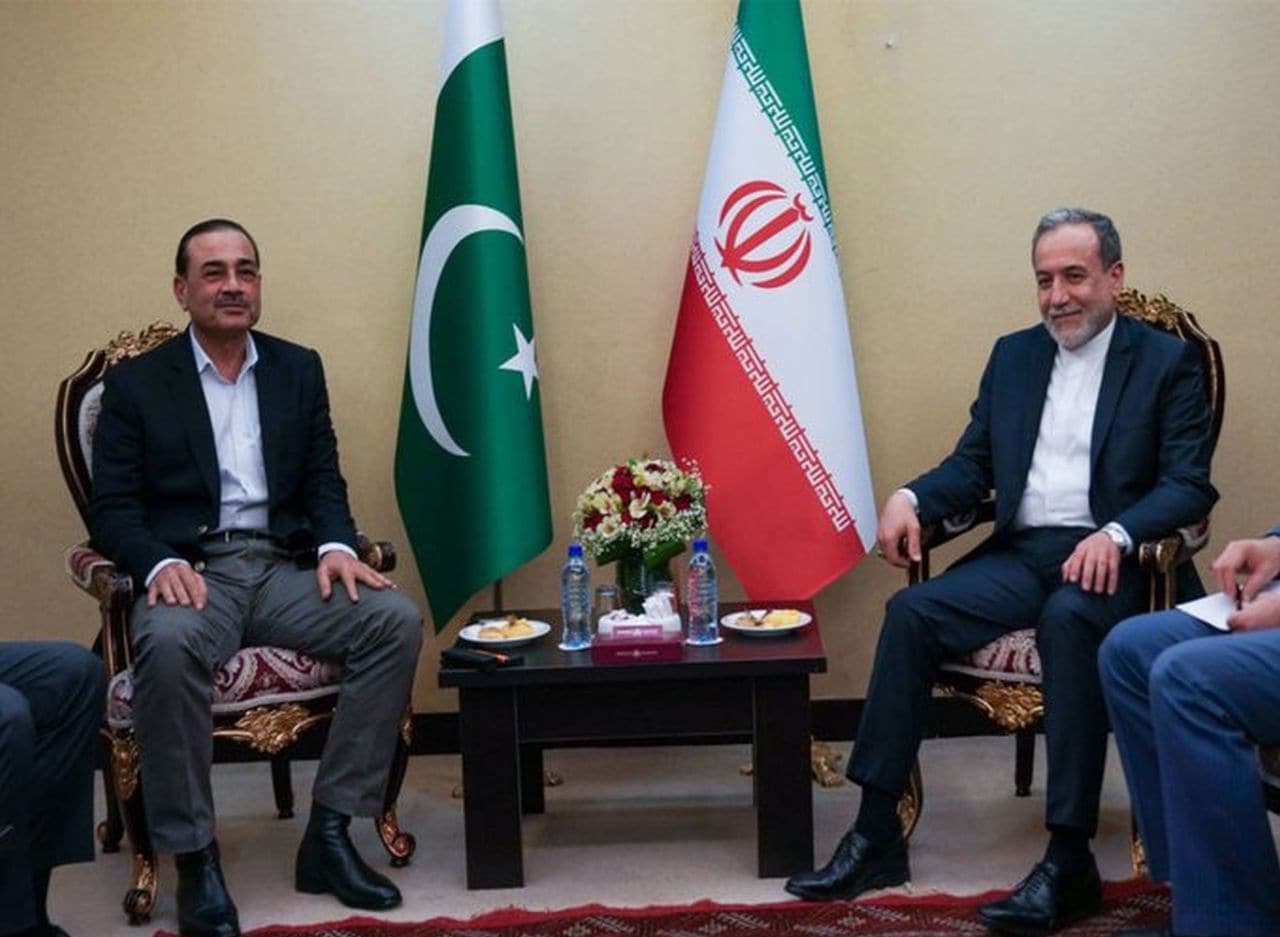
The teacup on the heavy mahogany table does not rattle, but it feels as though it should.
Behind closed doors in Tehran, the air carries a distinct weight. It is the friction of history meeting a volatile present. When Pakistan’s Army Chief, General Asim Munir, sat across from Iranian Foreign Minister Abbas Araghchi, the conversation was ostensibly about diplomatic cooperation and regional stability. That is the language of press releases. It is sanitized. It is safe.
But remove the diplomatic gloss, and the reality is far more raw. Two neighboring nations, deeply complex and historically cautious of one another, are watching a fire spread through their backyard. The West Asia conflict is no longer a localized crisis; it is a shifting tectonic plate threatening to swallow the certainties of the entire region.
To understand why a Pakistani military general is holding counsel with Iran’s top diplomat, you have to look past the crisp uniforms and the formal handshakes. You have to look at the map, and then you have to look at the people living on it.
The Borderlands of Anxiety
Consider a hypothetical merchant named Tariq. He lives in the rugged, sun-baked expanse of Balochistan, the massive province that bridges Pakistan and Iran. For generations, Tariq’s family has traded across this border. To him, the geopolitical machinations of Islamabad or Tehran are distant thunder. What matters is the quiet. When the border is quiet, trucks move, diesel flows, and families eat.
When the border grows tense, the air changes. Tariq notices fewer trucks. He sees more patrols. He feels a tightening in his chest.
For people like Tariq, this high-level meeting in Tehran isn't an abstract exercise in statecraft. It is a matter of survival. Pakistan and Iran share a nine-hundred-kilometer frontier. It is a landscape of jagged mountains and porous desert, notoriously difficult to police and historically plagued by militant groups acting as cross-border irritants. Just a year prior, the world watched in shock as the two nations exchanged unprecedented, short-lived missile strikes targeting militant hideouts inside each other's territory.
They looked into the abyss of open conflict, blinked, and stepped back.
Now, with the wider Middle East fracturing under the weight of the Israel-Gaza crisis, the escalating shadow war between Iran and Israel, and the constant threat of a regional conflagration, neither Islamabad nor Tehran can afford a unstable backyard. The meeting between Munir and Araghchi was a deliberate, calculated effort to ensure that whatever sparks fly from the West Asia conflict, they do not ignite the Balochistan border.
A Balancing Act on a Razor's Edge
Pakistan occupies a unique, agonizingly difficult position in the Muslim world.
On one hand, it shares a long border, cultural ties, and a shared faith with Iran. On the other hand, Pakistan’s economic survival is deeply tethered to Iran’s fierce regional rivals: Saudi Arabia and the United Arab Emirates. For decades, Islamabad has performed a high-wire act, trying to maintain a warm relationship with Tehran without alienating the wealthy Gulf monarchies that routinely bail out Pakistan's fragile economy.
Add to this mix Pakistan's complicated relationship with the United States, which views Iran as a primary adversary, and the geometric complexity of Pakistani foreign policy becomes clear. It is a rubik's cube where every turn alters the entire picture.
General Munir’s visit to Tehran is an acknowledgment of this delicate calculus. Pakistan cannot simply ignore Iran. When Israel launches strikes against Iranian targets, or when Iran retaliates with ballistic missiles, the shockwaves reverberate directly into Pakistani airspace and policy rooms.
The strategy here is not about forming a grand military alliance. It is about crisis management. It is about ensuring that communication channels are so wide, and so immediate, that a misunderstanding at the border never escalates into something catastrophic while the rest of the region is already burning.
The Human Toll of Abstract Strategy
It is easy to get lost in the vocabulary of geopolitics. We talk of deterrence, strategic depth, proxy networks, and diplomatic demarches. These words are designed to decouple decisions from their human consequences. They make the chessboard look clean.
But the chessboard is covered in dust and blood.
The conflict in West Asia has sent ripples of anxiety through Pakistan’s civil society. The country houses a diverse population, including a significant Shia minority. Sectarian fault lines, though quieter in recent years, are nerves that sit dangerously close to the skin. If the conflict in the Middle East takes on a purely sectarian hue, the internal stability of Pakistan could face severe tremors.
The leaders in Islamabad know this. The diplomats in Tehran know this.
When Araghchi and Munir spoke of "unity in the Islamic world" and "combating terrorism," they were addressing these internal anxieties just as much as external threats. They are attempting to project an image of calm solidarity to a public that is increasingly hyper-connected, deeply emotional about the Palestinian cause, and terrified of economic collapse.
Beyond the Handshake
What actually happens when the cameras leave the room?
The official statements tell us both sides agreed to enhance security cooperation, manage the borders effectively, and find common ground on regional peace. But the unwritten agreement is much simpler: Do not surprise me.
In the world of intelligence and military strategy, surprise is a liability. Pakistan wants guarantees that Iran's regional maneuvers will not inadvertently drag Pakistan into a conflict it cannot afford. Iran wants assurances that Pakistan’s close ties with the Gulf and the West will not allow its territory to be used against Tehran.
It is a relationship built not on deep, trusting affection, but on a clear-eyed, pragmatic understanding of mutual vulnerability. They are neighbors who cannot move houses. They are bound by geography to share the same air, the same storms, and the same droughts.
The sun sets over Tehran, casting long shadows across the concrete and stone of the ministries. General Munir returns to Islamabad. Minister Araghchi prepares for his next diplomatic fire. The statements are filed away into archives, and the news cycle moves on to the next explosion, the next speech, the next crisis.
But out on the border, where the dust settles on the tracks and the wind howls through the ridges of Balochistan, Tariq watches the horizon. He looks at the border post, noting the posture of the guards, checking the rhythm of the crossing. He does not know what was said in the grand rooms of Tehran. He only knows that for tonight, the trucks are still moving, the sky is clear, and the silence holds.