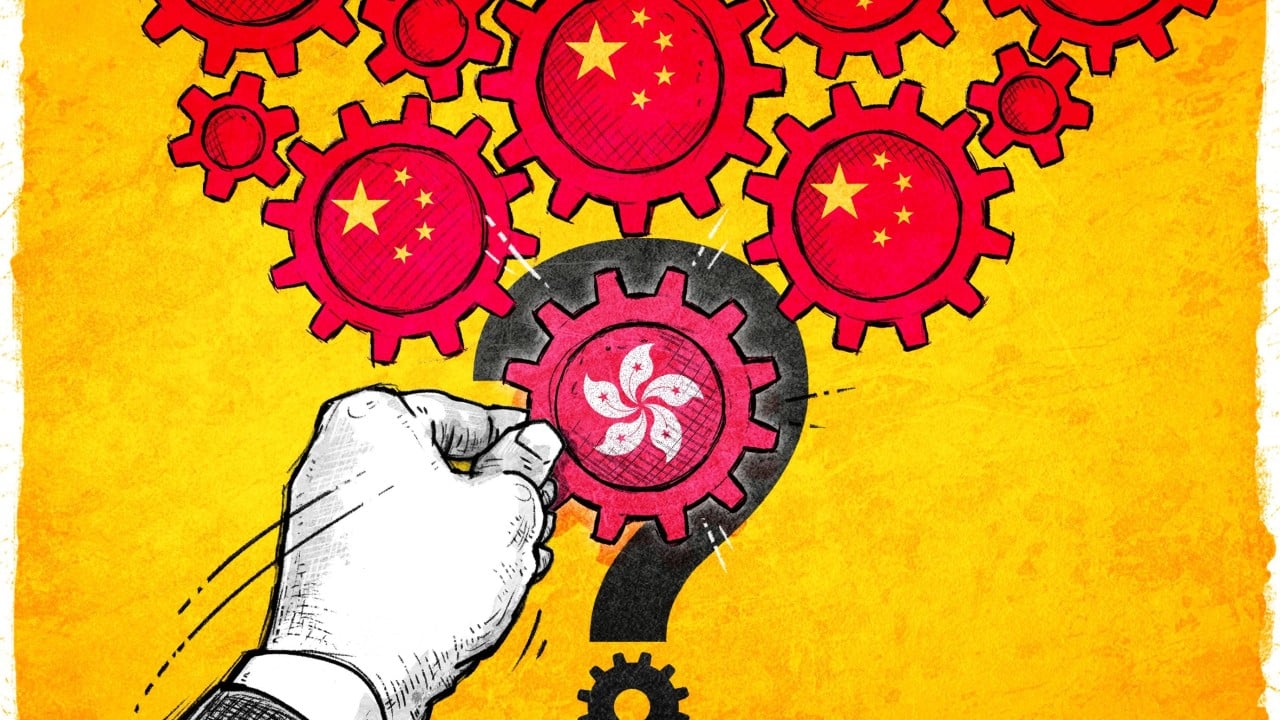
The mainstream financial press is obsessed with a single, lazy narrative: Hong Kong is losing its identity by integrating with mainland China. They wring their hands over the Greater Bay Area (GBA) initiative, viewing it as a desperate political capitulation rather than what it actually is—the most aggressive, calculated economic restructuring in modern financial history.
Commentators look at the slowing growth of traditional Western investment banks in Central and declare Hong Kong dead. They are looking at the wrong ledger. The old playbook of acting as a exclusive, Western-facing gatekeeper to an isolated Chinese economy is gone. It was a 20th-century anomaly, not a permanent economic law.
The real story isn't that Hong Kong is being absorbed. It is that Hong Kong is weaponizing its unique legal structure to dominate the next phase of global capital flow: cross-border digital assets, renminbi internationalization, and advanced manufacturing integration.
The Illusion of the Autonomy Risk
Listen to the consensus view, and you will hear that integration dilutes Hong Kong's legal distinctiveness. This argument ignores basic institutional economics. The value of Hong Kong to Beijing lies entirely in its difference, not its conformity.
If Beijing wanted another Shenzhen or Shanghai, it already has them. Hong Kong retains its common law system under the Basic Law, its own currency pegged to the US dollar, and its independent judiciary. This is not sentimentality; it is utility.
Consider the mechanics of the Connect schemes—Stock Connect, Bond Connect, and Wealth Management Connect. These are not tools of absorption. They are financial pipelines. They allow mainland capital to access international markets and international investors to access Chinese assets under Hong Kong regulatory oversight.
[Mainland China Capital] <---> [Hong Kong Regulatory/Common Law Conduit] <---> [Global Markets]
I have watched traditional asset managers pull out of the city because they could not adapt to this shift. They thought the game was about picking mainland stocks for New York investors. The new game is handling the trillions of dollars of mainland wealth looking for sophisticated global diversification. If you are waiting for 2005 to come back, you will go broke.
Dismantling the PAA Fallacies
The questions dominating search engines and panel discussions reveal just how backward the current analysis is. Let us answer them directly by exposing their flawed premises.
Is Shanghai going to replace Hong Kong?
No. This fear has been recycled since 1997, yet it fails to understand what makes a financial hub work. Shanghai operates under civil law and strict capital controls. Hong Kong operates under common law with free capital mobility. You cannot build a global offshore hub overnight simply by erecting skyscrapers.
The Total Trade in Services data consistently shows Hong Kong handling functions that mainland cities cannot touch due to capital account restrictions. Until the renminbi is fully convertible—which is not happening anytime soon—Shanghai and Hong Kong play entirely different positions on the field.
Will the Greater Bay Area dilute Hong Kong's wealth?
The premise here assumes wealth is a static pie. The GBA combines Hong Kong’s financial infrastructure, Shenzhen’s tech ecosystem, and Dongguan’s supply chains into an economic engine of over 86 million people.
Think of it this way: Hong Kong is the corporate headquarters and treasury department; the rest of the GBA is the R&D lab and factory floor. Silicon Valley would be useless without the capital of New York; New York would lack innovation without the tech of the West Coast. The GBA fuses these elements into a single geographic territory.
The Crypto Paradox They Did Not See Coming
Nowhere is the contrarian reality more obvious than in digital assets. While mainland China maintains a strict ban on cryptocurrency trading, Hong Kong has actively built a comprehensive regulatory framework for Web3 and virtual asset trading platforms.
This is not a contradiction. It is a deliberate strategy.
Hong Kong issued its first virtual asset service provider (VASP) licenses under a strict regime overseen by the Securities and Futures Commission (SFC). By creating a highly regulated, institutional-grade environment for digital assets, Hong Kong has become the designated laboratory for China’s digital currency experimentation.
The city is a key participant in Project mBridge, a multi-central bank digital currency (mCBDC) platform developed alongside the Bank for International Settlements (BIS). This project focuses on real-time, cross-border foreign exchange payments using central bank digital currencies.
[Project mBridge Platform]
   |-- Hong Kong Monetary Authority (HKMA)
   |-- People's Bank of China (PBOC)
   |-- Bank of Thailand (BOT)
   |-- Central Bank of the UAE (CBUAE)
While Western banks argue over spot ETFs, Hong Kong is rewriting the plumbing of global trade settlement. If you are tracking Bitcoin prices, you are missing the point. The true disruption lies in bypassing the traditional SWIFT network for bilateral trade settlement across Asia and the Middle East.
The Cost of the Pivot
Admitting the strategy is sound does not mean ignoring the friction. The transition is brutal for those caught in the middle.
The dominance of English as the sole language of high finance is fading; bilingual proficiency in English and Mandarin is now a baseline requirement for survival. Local retail and real estate sectors are undergoing painful corrections as consumption patterns shift toward Shenzhen, where living costs are significantly lower.
Furthermore, relying heavily on mainland capital exposes Hong Kong to the cyclical headwinds of the Chinese economy. When the mainland property market slows, Hong Kong feels the squeeze. This is the trade-off. You cannot tie yourself to the world's most dynamic growth engine without experiencing its turbulence.
Stop Mismanaging the Transition
If you are running an international business or managing an investment portfolio, stop reading op-eds lamenting the past. Change your operational framework immediately.
- Audit your regulatory exposure: Stop viewing Hong Kong as an isolated outpost. It is a conduit. Ensure your compliance teams understand both SFC regulations and mainland capital flow restrictions.
- Reposition your asset allocation: Shift from pure equity plays to structured cross-border wealth management products. The flow of wealth is moving from North to South (Mainland to Hong Kong), not just West to East.
- Utilize the GBA supply chain: If you are a tech entity, do not just use Hong Kong for fundraising. Establish your intellectual property protection under Hong Kong law while deploying your hardware manufacturing in neighboring Guangdong.
The integration of Hong Kong is not a story of decline. It is a masterclass in economic evolution. The city is shedding its skin as a general-purpose colony and emerging as the specialized financial capital of a massive regional economy. Those who call this a risk are simply incapable of reading the new balance sheet.