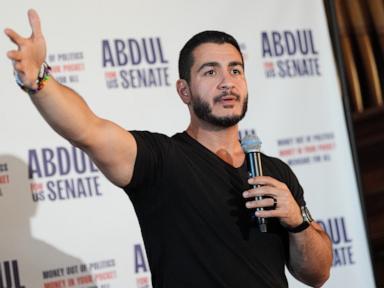
The air inside the community center smelled of industrial carpet, wet wool, and cheap coffee. It was October in Detroit, the kind of autumn afternoon where the wind strips the maples bare along Woodward Avenue and sends grit rattling against the storefront glass. Outside, the city was moving with its usual bruised resilience—delivery trucks double-parked, streetcar cables humming overhead, the low rumble of freight trains cutting through Corktown. Inside, a roomful of organizers and canvassers sat on folding chairs, staring at their shoes.
They were tired. Not the tired of a late night, but the deep, bone-weary exhaustion of people who had been knocking on doors since July, trying to convince a skeptical electorate that their votes still possessed a heartbeat.
Then the side door clicked open.
Security personnel didn't swarm; they simply adjusted their posture, creating a quiet current in the room. A tall, gray-haired man in a dark suit walked in, carrying his jacket over his shoulder with the easy grace of someone who no longer had to prove anything to anyone, yet still cared deeply about the outcome. Barack Obama. Beside him walked Abdul El-Sayed, young, sharp-eyed, and carrying the fierce energy of a physician turned public servant who believed, against considerable statistical odds, that public policy could still heal a community.
When Obama took the microphone, he didn't boom. He didn't offer a soaring stump speech designed for the evening news clips. Instead, he leaned into the podium, lowered his voice, and spoke about the unglamorous mechanics of democracy. Midterms, he reminded them, are won in the dark corners where nobody is watching. They are won by the precinct captain who remembers the name of the woman on 14th Street who hasn't had reliable heat in three winters. They are won by showing up when the cameras have already packed up and moved on to the next state-of-the-art media market.
History rarely pivots on thunderclaps. More often, it turns on a whisper in a crowded room.
To understand why a former president was spending a brisk Tuesday in Detroit campaigning alongside a local progressive figure, you have to look past the surface calculus of political strategy. Yes, the midterms were looming like a gathering storm. Yes, control of legislative chambers hung by threads thinner than dental floss. But the appearance was about something much older and much harder to manufacture: the transfer of moral gravity.
In modern politics, we treat campaigns like stock portfolios. We measure them in metrics, target them with programmatic ad buys, and optimize them until every drop of human spontaneity has been scrubbed away. We talk about mobilizing demographics as if we were moving chess pieces across a board drawn in Washington think tanks.
Yet, human beings do not vote because of a targeted digital banner ad. They vote because they believe someone sees them.
Abdul El-Sayed understood this long before he stepped onto that stage. As a former health director for the city of Detroit, he had spent years walking into neighborhoods where the water pipes were old enough to vote and the life expectancy dropped by a decade simply depending on which side of Eight Mile Road your crib happened to be in. He didn't talk about politics as a game of partisan chess. He talked about it as an emergency room triage.
When you stand in a room where the infant mortality rate is higher than that of several developing nations, abstract political theory turns to ash. You realize that policy is just another word for how we treat each other when the lights go out.
Obama’s presence in Detroit was an acknowledgment of that reality. He understood that the midterms were not merely a referendum on the party in power; they were a referendum on whether ordinary citizens still believed their institutions were capable of holding their pain. When voter turnout dips—as it invariably does in midterms, when the intoxicating fever of a presidential election has faded into the gray background of routine governance—the machinery of democracy starves.
Consider what happens when that machinery breaks down entirely.
Down on Jefferson Avenue, rusted hulks of old automotive plants stand like empty cathedrals, monuments to an era when a high school diploma and a union card were a ticket to a pension, a brick house, and a boat parked in the driveway. That world vanished decades ago, swallowed by globalized trade, automation, and a corporate ethos that treated workers as disposable line items. The anger left behind in those neighborhoods is real, heavy, and combustible. It is an anger that can be easily harvested by demagogues who offer simple enemies in exchange for complex anxieties.
Or it can be met with the hard, patient work of rebuilding.
That was the subtext of the Detroit rally. Obama and El-Sayed were not there to tell the crowd that everything was fine. To say that would be an insult to anyone who had spent two hours waiting for a bus that never showed up in January. Instead, they were there to argue that the work of self-governance is never finished, and that walking away from the ballot box is a luxury reserved for people who aren't paying attention.
There is a strange paradox to political enthusiasm. We treat it like weather—something that happens to us, driven by atmospheric pressure and seasonal shifts. But enthusiasm is actually a fire. It requires fuel, oxygen, and someone willing to tend the coals when the wind blows cold.
During that afternoon in Detroit, the speakers focused heavily on the mechanics of grassroots organizing. They didn't talk about national poll numbers. They talked about block clubs, church basements, and union halls. They talked about the teenager registering voters outside a community college and the retiree making phone calls from a kitchen table stacked with bills. These are the invisible tendons holding the body politic together. Without them, the skeleton collapses under its own weight.
As the rally wound down, the applause rolled through the room not with the explosive roar of a stadium concert, but with the steady, rhythmic clapping of people who knew they had a long drive home through the traffic on the Lodge Freeway.
Obama stepped away from the microphone, shook a dozen outstretched hands, and vanished through the same unassuming side door he had entered. The room emptied out into the cooling Detroit dusk. The volunteers packed their clipboards into canvas bags, zipped up their jackets, and stepped back out onto the pavement.
The streetlights flickered on, casting long, wavering shadows across the concrete. A few blocks away, the Detroit River moved silently toward Lake Erie, indifferent to elections, speeches, or the grand theater of human ambition. But back in the neighborhoods, among the brick bungalows and corner stores, something small had shifted. A spark had been caught and sheltered against the wind. The midterms were coming, ready or not, and the people in the room were going back to work.


